
Listener who puts vocals first
Wants to enjoy musical recordings as stereo music and can position the speakers around a regular listening spot. Genelec highlights how placement affects what you hear.


Start with a stereo pair that fits on your desk and connects to your computer or another audio source. Active speakers have built-in amplification; passive speakers make most sense if you already have a suitable amplifier. Connections and specifications alone can’t tell you how clear vocals will sound in your room.
Wants to enjoy musical recordings as stereo music and can position the speakers around a regular listening spot. Genelec highlights how placement affects what you hear.
Is looking for a stereo pair to play music from a computer and wants to check the available space and suitable USB-C, Bluetooth or analogue connections first.
Wants to connect passive speakers to existing hi-fi equipment, so checks amplifier compatibility and the cables required. Polk Audio lists compatibility with suitable 4- and 8-ohm amplifiers for the Monitor XT15.
| Factor to consider | What to check before buying | Who is this important for? |
|---|---|---|
| Vocals and stereo positioning | Genelec recommends symmetrical placement, with both speakers angled towards your listening spot. Check that you have enough space on both sides. | If I want to follow the vocals and backing music clearly from a regular listening spot, I look for a setup that suits my space; around 40% of consumers give vocals and stereo positioning top priority. |
| Desk and room space | Measure the width and depth needed for both speakers, allowing room for cables. Audioengine lists the A2+ Gen 3 as measuring approximately 15.6 × 10.6 × 13.8 cm per speaker, in height × width × depth. | If my desk is already crowded, I want to know in advance whether two speakers will fit without making my workspace impractical; around 30% of consumers are mainly concerned with the space available. |
| Connections and controls | Compare the outputs on your computer and other sources with the inputs on the exact model. Manufacturers list features such as USB-C audio, analogue inputs, optical connections or HDMI ARC on different models. | If I want to play music from several devices, I check which connection each device actually uses; around 20% of consumers prioritise convenient, suitable connections. |
| Amplifier and complete setup | Passive speakers need a suitable external amplifier; active models have built-in amplification. Also check which connections and cables you’ll need. | If I want to use my existing amplifier, I need to make sure it’s compatible with the speakers; around 10% of consumers give amplifier compatibility top priority. |
Passive speakers, such as the Polk Audio Monitor XT15, need a suitable external amplifier. Active sets have built-in amplification, but still need a suitable connection to your audio source.
First, work out which amplifier and cables you already have. Then compare complete setups that you can connect, rather than looking at the speaker pair alone.
The Edifier R1280DB speakers are connected to each other with a speaker cable. For the KEF LSX II LT, the manufacturer lists a C-Link interspeaker cable.
Check how the exact model connects and plan how you’ll route the cable along or across your desk.
The models listed offer different combinations of USB-C, analogue and digital inputs. A connection will only work if your source has the corresponding output.
Compare the outputs on your computer and any other sources with the inputs on the exact model. Choose HDMI ARC only if you also want to use that connection for TV audio.
According to Edifier’s Dutch product information, the R1280DB is an active stereo set with analogue, optical and coaxial inputs, as well as Bluetooth.
Audioengine describes the A2+ Gen 3 as a compact active desktop set with USB-C audio, Bluetooth and analogue inputs.
According to KEF, the LSX II LT combines USB-C, HDMI ARC, streaming features and a subwoofer output.
The manufacturer describes the FENRIS A4 as an active set with features including Bluetooth, HDMI ARC and a turntable input.
The Monitor XT15 is a passive bookshelf speaker pair for use with a suitable external amplifier.
This selection includes passive bookshelf speakers and compact PC and desktop speakers. Before choosing, check that the setup and connections you need are right for your workspace and audio source.
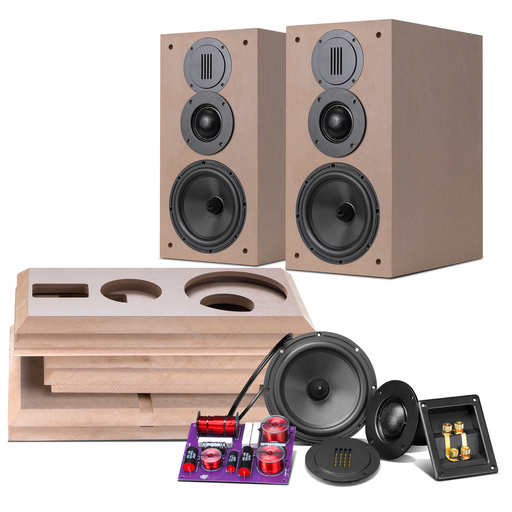 No image available
A passive bookshelf pair for stereo playback; you’ll need a suitable external amplifier and the required connection cables.
Variant: 6.5 inches, one pair.
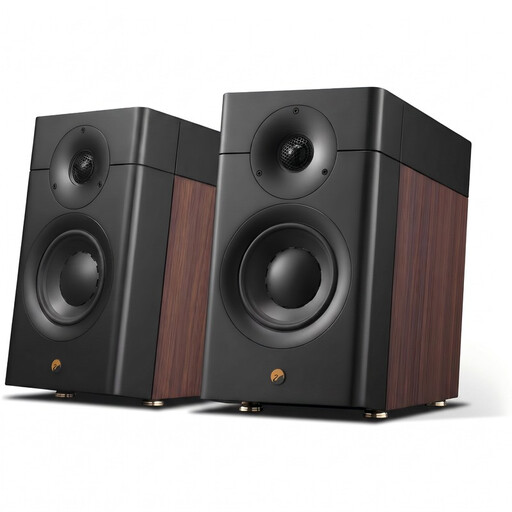 No image available
A passive bookshelf pair for stereo music; these speakers need to be connected to a separate, suitable amplifier.
Variant: 6.5 inches, one pair.
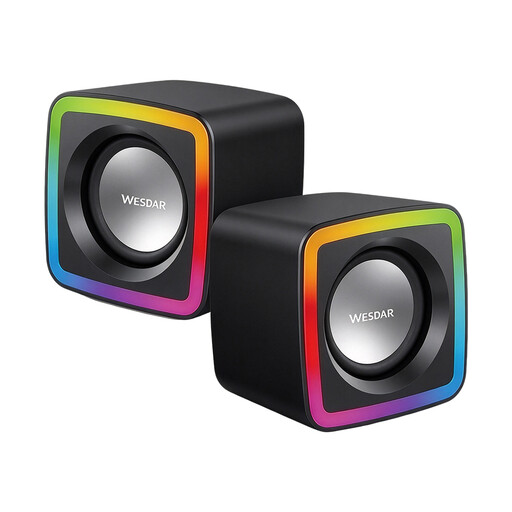 No image available
A compact stereo set for PC and desk use, ideal if you’re short on space and want a desktop system rather than a bookshelf pair.
For use in dry indoor spaces only.
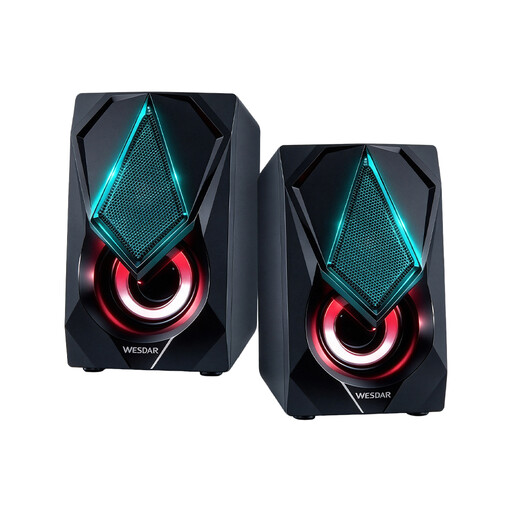 No image available
A compact desktop set for anyone looking to save desk space; the product name mentions coloured LED lighting.
For indoor use only; keep away from moisture.
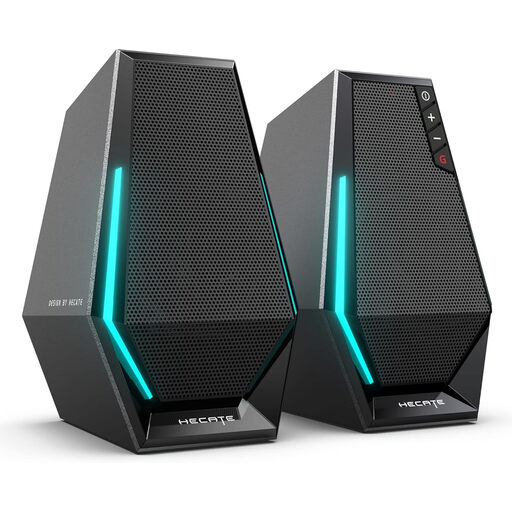 No image available
Computer speakers for a desktop setup. The product name lists Bluetooth 5.3, a USB input and a 3.5 mm AUX input.
Check that these connections are suitable for your computer and the way you want to play music.
An active set has built-in amplification, but you’ll still need to choose a suitable audio connection. Passive Polk Audio Monitor XT15 speakers need a suitable external amplifier and the required connections, so check what you already have first.
Start with a setup that’s as symmetrical as possible, with both speakers angled towards your usual listening spot. Genelec describes an equilateral triangle as ideal for studio monitors; this is positioning advice, not a guarantee of the same result in every home.
It depends on the model: the Edifier R1280DB speakers are connected to each other with a speaker cable, and KEF lists a C-Link interspeaker cable for the LSX II LT. Check how the exact version connects and plan where the cable will run.
For qualifying online consumer purchases in the Netherlands, you generally have 14 days to change your mind; whether this applies depends on the circumstances of the purchase. You’re also protected by statutory consumer guarantees, which have no fixed guarantee period in the Netherlands: if a product is faulty, contact the seller. Check separately for any additional manufacturer’s guarantee.
European product regulations apply when electrical and electronic equipment is placed on the market. Government guidance covers CE marking and an EU declaration of conformity; the Radio Equipment Directive is also relevant for devices with Bluetooth or Wi-Fi. According to the Netherlands Enterprise Agency, the CE logo is a conformity mark, not an independent safety certification.