What should you look for when choosing?
Start by measuring and checking: will two speakers fit on or beside your desk, and can you connect them to the sources you use? Then decide whether you want an active set, a system that streams independently or a passive setup with a separate amplifier.
| What to consider |
What should you check? |
Who is this important for? |
| Space and positioning |
Measure the space next to your screen and check whether both cabinets can be positioned facing your listening spot in a similar way. |
If I have limited desk space, I want to know whether both speakers will fit and can be positioned properly. Around 31% of consumers put positioning and desk space first. |
| Connecting to your source |
Make a note of the outputs on your computer or other source and compare them with the inputs on the exact model. |
I want to connect my computer or another music source without finding that I’m missing an input. Around 25% of consumers prioritise connecting to the music source they use every day. |
| A complete, working set-up |
Check whether the set is active or passive, and which amplifier and cables you still need. |
I want to know in advance whether I’ll need extra equipment as well as the speakers. Around 19% of consumers make the equipment needed for a complete set-up their first consideration. |
| Streaming independently |
Check whether the exact model supports the streaming features you want and whether a cable runs between the speakers. |
I want to play music without always using my computer as the source. Around 13% of consumers prioritise independent streaming. |
| Amplifier and passive speakers |
Compare the specifications of your amplifier with those of the exact speaker model, and measure the available space. |
I already have an amplifier, or I want to put together separate components, and I want to know whether they’ll work together. Around 12% of consumers start by checking amplifier compatibility. |
Brands to consider
The examples below relate to specific product ranges and models. They are not a judgement on every product from a brand or a guarantee of availability.
Audioengine
Audioengine describes the A2+ Gen 3 as an active desktop speaker set with USB-C audio, Bluetooth and an analogue connection.
- The manufacturer lists a subwoofer output and cabinet dimensions of 6 × 4 × 5.25 inches for this model.
- Check that you’re looking at the Gen 3; don’t assume that connections on this generation are also available on older A2+ models.
Kanto Audio
Kanto describes the active Ora as a compact desktop speaker set with USB-C audio and Bluetooth.
- Kanto lists automatic switching when a subwoofer is connected.
- This is a model specification and, by itself, doesn’t tell you how the set reproduces folk music.
Edifier
The Edifier R1280DBs is an active set for anyone who wants to connect several types of source to one stereo pair.
- Edifier lists Bluetooth, two RCA inputs, optical and coaxial connections, and a subwoofer output for the R1280DBs.
- The manufacturer lists cabinet dimensions of 146 × 234 × 196 mm per speaker; check they’ll fit on your desk, and don’t confuse the R1280DBs with the R1280DB or R1280T.
KEF
KEF describes the LSX II LT as a system with streaming features and USB-C audio from a computer.
- The UK product page lists streaming features and USB-C audio for this model.
- KEF specifies a C-Link cable between the speakers, so wireless doesn’t mean the cabinets can be positioned without a cable connecting them.
Q Acoustics
Q Acoustics presents the 3020c as a passive bookshelf speaker for a stereo system with a separate amplifier.
- This option could suit anyone who already has a suitable amplifier or wants to put together separate components.
- On their own, the speakers don’t make a complete active computer set-up; check the amplifier and cables you’ll need.
Joybuy products
These are passive bookshelf speakers for anyone looking to put together a stereo system with a suitable separate amplifier.
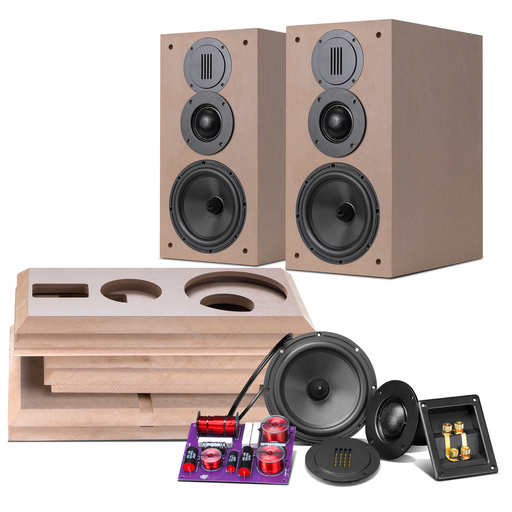 Image unavailable
HiVi-Swans DIY3.1 passive bookshelf speakers, 6.5 inch, pair
Suitable if you’re looking for a passive speaker pair for a stereo system; use with suitable amplification.
6.5 inch; one pair of passive bookshelf speakers.
View at Joybuy
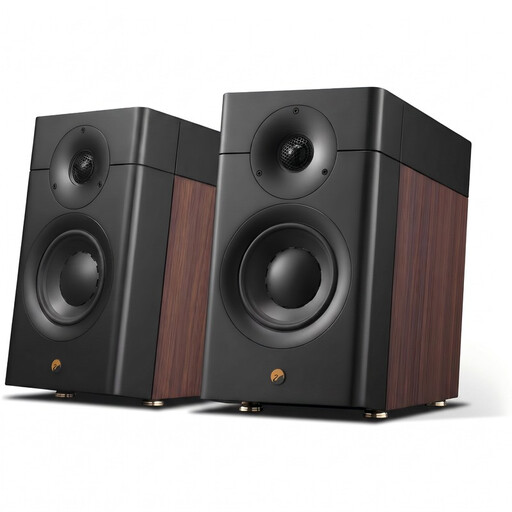 Image unavailable
HiVi-Swans D3.1MKII passive bookshelf speakers, 6.5 inch, pair
Suitable if you’re looking for a passive speaker pair for a stereo system; use with suitable amplification.
6.5 inch; one pair of passive bookshelf speakers.
View at Joybuy
Frequently asked questions
How should I position two speakers for my usual listening spot?
Try to position both speakers in a similar way and point them towards your listening spot. Genelec recommends symmetrical positioning for accurate stereo playback; reflections from the surroundings affect what you hear. This is positioning advice, not a legal distance requirement for a home-working desk.
Can I connect any active set directly to my laptop via USB-C?
No, it depends on the connections available on the exact set. Audioengine lists USB-C audio for the A2+ Gen 3, and Kanto does the same for the Ora; Edifier lists different inputs for the R1280DBs. Check both your laptop’s audio output and the input on the speaker model.
What are my rights if a product is faulty or I buy online?
According to the Dutch government, when you buy as a consumer you’re entitled to a product that works properly, and the seller is your point of contact if there’s a problem; there is no fixed statutory two-year guarantee period. For many online purchases from a business, you have a 14-day cooling-off period. Check the terms and exceptions that apply to your purchase.
What should I look for regarding CE marking on Bluetooth speakers?
Equipment sold in the Netherlands must comply with the applicable European product rules. The Dutch Authority for Digital Infrastructure says that equipment requiring it must carry the correct CE marking. Check the marking and product information for the exact device; this general rule doesn’t establish how an individual passive speaker pair has been assessed.


