
Electronic music listener at a desk
You mostly listen at your desk and want to assess the bass without choosing speakers that won’t fit.


Start by considering the space on your desk, your music source and whether you’ll just be listening or also working on music. A compact active pair is easy to connect; studio monitors suit anyone who also uses an audio interface, while passive speakers make most sense if you already have a suitable amplifier or deliberately want to add one. If you might want more bass later, check whether the exact model has a subwoofer output. A stated bass range alone won’t tell you how the speakers will sound in your workspace.
You mostly listen at your desk and want to assess the bass without choosing speakers that won’t fit.
You also make or edit music, so suitable inputs and control over playback matter, not just wireless streaming.
You already have an amplifier, or want to build a system from separate components, and are happy to deal with the extra connections involved.
Best for: listening from a computer or phone without a separate amplifier.
Bear in mind: a compact size doesn’t guarantee the deepest bass; check the inputs on each model.
Best for: listening to and working on electronic music with equipment such as an audio interface.
Bear in mind: check whether you’re buying a pair or individual speakers, which cables you’ll need and how you’ll control the volume.
Best for: an existing suitable amplifier, or a system you’re deliberately putting together from separate components.
Bear in mind: the amplifier, cables and connection to your music source are all part of the system.
| What to consider | What to check before buying | Who is this important for? |
|---|---|---|
| Bass and expandability | Compare frequency ranges only when the measurement basis is clear, and check whether the exact model has a subwoofer output. | If I listen to electronic music and might want to add a subwoofer later, I’ll check the output and the space I’ll need. Around 36% of consumers prioritise bass and expandability. |
| Desk space | Measure the available width and depth, allowing for connections and your preferred positioning. | If there’s little free space on my desk, I want to know whether both speakers will fit with the cables connected. Around 29% of consumers prioritise desk size and close-range listening. |
| Connection to your source | Compare the output on your computer or audio interface with the inputs on the exact model, and check the volume controls. | If I want to connect my computer or interface, I’ll look for a connection that matches the available outputs. Around 21% of consumers choose primarily based on this connection. |
| Complete system | For passive speakers, check the amplifier requirements and which equipment and cables you already have. | If I’m considering separate components, I want to weigh up the complete amplifier-and-speaker set-up. Around 14% of consumers prioritise putting together a complete system. |
A frequency range alone doesn’t tell you how the bass will sound in your room or at close range. Measurements also aren’t directly comparable if they’re based on different methods.
Compare the measurement basis and check whether the model has a subwoofer output and what it does.
Passive speakers need a suitable amplifier. Connecting that amplifier to your computer or another source is also part of the set-up.
Check the model’s amplifier requirements and compare complete systems, including any equipment and cables you still need.
A model name can vary between generations or versions. The De Betere Wereld ranking, updated on 11 August 2026, lists ‘Edifier Studio 1280T’; Edifier uses the name R1280T for the model. That doesn’t prove the names are identical.
Check the full model designation and the connections on the version you’re considering.
A mention in an updated list doesn’t mean a model is still being made or is currently available. Wharfedale marks the Diamond 220 as discontinued.
Use older models as a point of comparison and check each specific offer separately.
Edifier has active models for a range of desk set-ups, from the R1280T to the R1700BTs and MR4.
The T5V is a single active nearfield studio monitor for a compact production workspace.
The A2+ Gen 3 is a compact active desktop system with several connection options.
The active ORA4 combines connections suited to a desk set-up with a subwoofer output.
The passive Q150 is suited to anyone who wants to build a system with an amplifier and speakers as separate components.
The passive Diamond 220 shows how an amplifier-and-speaker set-up differs from an active desktop system.
These Joybuy picks are passive bookshelf speakers for a set-up with a separate amplifier.
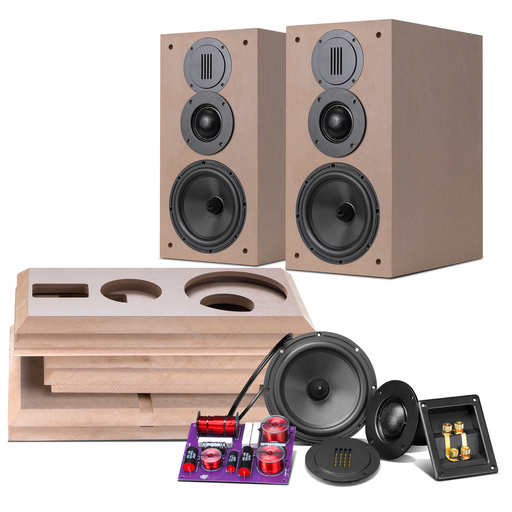 No image available
A passive pair for anyone who wants to play electronic music through a separate amplifier; check that your amplifier is suitable for the speakers.
The product name specifies a 6.5-inch version.
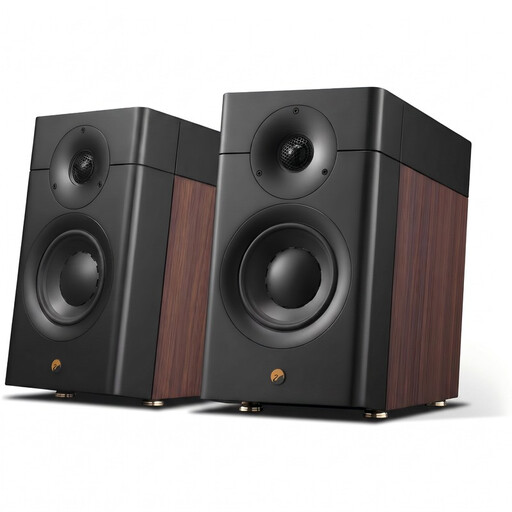 No image available
A passive pair for music in a home studio or office; remember that you’ll need a separate amplifier and the right connection to your source.
The product name specifies a 6.5-inch version.
An active system such as the Edifier R1280T has amplification built in; a passive KEF Q150 needs an external amplifier. KEF specifies an amplifier of 10–100 W for the Q150. Also check how you’ll connect your chosen amplifier to your music source.
First, check which outputs your audio interface has. The Edifier MR4 has balanced 6.35mm TRS inputs; these will only work if your equipment and cables are compatible.
No, it varies by model. The Audioengine A2+ Gen 3 lists USB-C audio and Bluetooth; the Edifier R1700BTs lists Bluetooth and dual RCA inputs. Check the connections on the exact version you’re considering.
Compare the full model name on the product page with the version you’re looking for. Audioengine distinguishes the A2+ Gen 3 from other A2+ versions; also check the connections and variant details before you choose.
According to the Dutch government, if a product is faulty, you’re entitled to a solution from the seller; the Netherlands has no fixed statutory warranty period. For distance purchases, a 14-day cooling-off period applies in many cases, with some exceptions.