If you mainly listen at your desk, start with a compact active stereo pair that suits the space you have and connects to your computer or another source. A passive pair is an alternative if you already have a suitable amplifier or want to choose the components separately; remember that you’ll need amplification. Speaker placement and room reflections affect the sound, so specifications alone can’t tell you how folk will sound in your study.
Who are these speakers for?
Computer listener
You usually listen to vocals and acoustic instruments at your desk and want a stereo pair that fits your desk and has the right connections. Genelec highlights the importance of positioning both speakers similarly in relation to reflective surfaces.
Listener with several audio sources
You might switch between a computer, mobile phone and other audio sources. Compare each model’s connections with the outputs you actually use; Edifier and Kanto list different combinations for different models.
Owner of a hi-fi amplifier
You want to connect passive speakers to a suitable amplifier and may want to choose the components separately. KEF and Wharfedale offer models to compare for this type of setup.
What should you look for when choosing?
Compact active stereo pair
Choose this if: you sit close to the speakers and want to listen from your computer or phone without a separate amplifier. Kanto lists USB-C, Bluetooth and an analogue connection for the ORA.
Bear in mind: the connections need to suit your devices, and you’ll need space to position the speakers either side of your listening position.
Active bookshelf speaker set with multiple inputs
Choose this if: you want to connect sources other than your computer, such as those with an optical, coaxial or analogue output. Edifier lists these inputs for the R1280DBs.
Bear in mind: according to Edifier, each R1280DBs speaker measures 146 × 234 × 196 mm, so measure your available space.
Passive speakers with a separate amplifier
Choose this if: you already have a suitable amplifier or want to choose the speakers and amplification separately. KEF and Wharfedale offer passive bookshelf models.
Bear in mind: passive speakers need external amplification. KEF specifies an amplifier requirement of 10–150 W for the Q1 Meta.
For acoustic folk at your desk, finding the right connection is only one part of the decision. Genelec points out that stereo imaging is influenced by speaker placement and reflections, so also consider where you can position both speakers in relation to your listening spot.
| Consideration |
What should you check? |
Who is this important to? |
| Space and stereo positioning |
Measure the space available and the dimensions of each speaker. Genelec recommends positioning both speakers so that reflections are similar. |
I want two speakers to fit beside my screen and be easy to position from my chair; around 31% of consumers prioritise placement above all else. |
| Connections |
Compare the outputs on your devices with the inputs on the exact model. Edifier and Kanto list different connection options. |
I want to connect my computer and other audio sources; around 25% of consumers prioritise source compatibility above all else. |
| Reproduction of vocals and instruments |
Consider your listening position and room reflections. A frequency range alone doesn’t determine how a speaker will sound to you. |
For folk, I want to judge for myself how vocals and acoustic instruments sound at my workspace; around 25% of consumers put this assessment first. |
| Active or passive |
Check whether you already have a suitable amplifier and what amplifier requirements are specified for the particular passive model. |
I want to use my existing amplifier or choose the components separately; around 19% of consumers prioritise how the system is put together above all else. |
How to avoid common buying mistakes
-
Buying a passive pair expecting it to work directly with your computer
Passive speakers don’t amplify the source signal themselves, so they won’t work as a complete system without an external amplifier.
Before buying, check whether you already have a suitable amplifier and whether it meets the requirements of the model you’ve chosen.
With a passive setup, also allow for the amplifier you’ll need and the space and connections required for it.
-
Focusing only on size
A speaker might be small enough to fit, but you’ll also need room to position both speakers in a stereo pair to suit your seating position.
Measure the space available and decide in advance where the left and right speakers can go.
-
Assuming similar model names or Bluetooth mean the connection is right
Inputs vary between models and generations. A wireless feature doesn’t tell you whether the wired connection you need is available.
Check the full model name and compare its listed inputs with the outputs on your devices.
Brands to compare
Edifier
The R1280DBs is an active bookshelf speaker set worth considering if you want several types of input without a separate amplifier.
- According to Edifier, the R1280DBs has Bluetooth, two analogue inputs, optical and coaxial inputs, and a subwoofer output. Each speaker measures 146 × 234 × 196 mm.
- The listed inputs don’t include USB-C audio. Edifier’s statements about the sound are manufacturer claims, not independent listening comparisons.
Kanto Audio
The ORA is a compact active desktop set to compare if you want to use audio from a computer and another source.
- Kanto lists USB-C, Bluetooth, an analogue connection and subwoofer integration for the ORA.
- Check that the connections suit your devices. Kanto’s description of the sound is a manufacturer claim, not an independent comparison.
Audioengine
The A2+ Gen 3 is an active desktop range to compare if you want USB-C, Bluetooth and an analogue connection.
- Audioengine lists USB-C audio, aptX Adaptive Bluetooth, an analogue connection and a subwoofer output for the A2+ Gen 3.
- Check the generation: details for an older A2+ or A2+ Next Gen don’t automatically apply to the Gen 3.
KEF
The passive Q1 Meta is a compact bookshelf model designed to be used with a separate amplifier.
- KEF specifies an amplifier requirement of 10–150 W and says a pair of Q1 Meta speakers is included in the box.
- Check that your amplifier is suitable. KEF’s statements about the sound are manufacturer claims.
Wharfedale
The passive Diamond 12.1i is a bookshelf model to compare for a hi-fi setup with a separate amplifier.
- Wharfedale describes the Diamond 12.1i as a bookshelf speaker and notes changes compared with the 12.1.
- Any claimed improvement in sound is a manufacturer claim, not an independent listening comparison. Take care not to confuse the model names.
Joybuy picks for your workspace
These product picks are aimed at listening at your workspace, including passive bookshelf pairs that need a suitable amplifier.
 Image unavailable
HiVi-Swans DIY3.1 passive bookshelf speakers, pair of 6.5-inch speakers
A passive bookshelf pair to consider if you have a suitable amplifier or want to choose one separately.
The product name specifies a pair of 6.5-inch passive speakers. Passive speakers need external amplification; check that your amplifier is compatible.
Joybuy
 Image unavailable
HiVi-Swans D3.1MKII passive bookshelf speakers, pair of 6.5-inch speakers
A passive bookshelf pair to compare if you already have a suitable amplifier or want to choose your amplification separately.
The product name specifies a pair of 6.5-inch passive speakers. Passive speakers need external amplification; check that your amplifier is compatible.
Joybuy
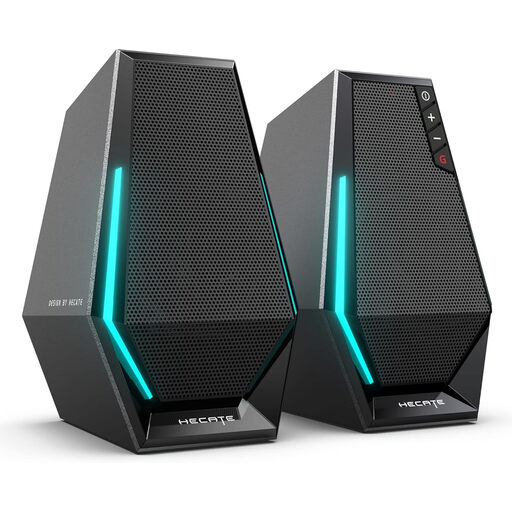 Image unavailable
Edifier G1500 Hecate gaming speakers, black
The product name positions these speakers for computer use, making them an option to consider for a workspace.
The product name lists RGB, Bluetooth 5.3, USB and a 3.5mm AUX input. Check that the listed connections suit your devices.
Joybuy
Frequently asked questions
Do I need an amplifier for passive bookshelf speakers?
Yes, passive speakers need an external amplifier or AV receiver. Check the requirements of the model you choose and whether it’s compatible with your amplifier; KEF specifies an amplifier requirement of 10–150 W for the Q1 Meta.
How should I position a stereo pair in my study?
Position the left and right speakers as similarly as possible in relation to your listening position, and angle them towards it. Genelec describes a listening setup with a 60° triangle at the listener; the room and reflections will still have an effect.
How do I safely maintain an active speaker set?
Follow the manual for the exact model. Edifier’s manual for the R1280DBs warns, among other things, not to block the ventilation openings and to switch off and unplug the device before cleaning it. These instructions don’t automatically apply to other speakers.
What are my rights when buying online in the Netherlands?
For a standard online product purchase, you generally have a statutory 14-day cooling-off period from the date of delivery; ACM ConsuWijzer lists some exceptions. You’re also entitled to a legal guarantee if a product doesn’t meet what you could reasonably expect under normal use. A manufacturer’s warranty doesn’t replace this right.
Where can I take an old electric speaker?
According to the Dutch government, when you buy a new, similar appliance, you can hand in your old electrical appliance to the retailer free of charge; this also applies to online purchases. Other options include collection points and your local council’s recycling centre.


