For fragile bound books, a contactless overhead scanner is an obvious choice; a book-focused flatbed scanner may work if the binding can rest safely on the glass. Test-scan representative books and assess the text near the spine, image quality, page order and OCR before your group chooses a workflow. A fast capture time alone won’t tell you how long the full checking and file-management process will take.
Who is this for?
People responsible for fragile books
If your books have fragile bindings, you’ll want to assess their physical condition first and handle them as gently as possible. ScanSnap Nederland and the National Archives provide information relevant to book preservation and careful digitisation.
Volunteers processing lots of pages
Your group will benefit from a repeatable approach to capturing images, managing page order and checking quality—not just a quick scan. IRIS and the National Archives describe workflows and checks that are relevant to this process.
People responsible for a searchable archive
You’ll want members to be able to find names, places and dates later on. That makes legible images, OCR and descriptive information important considerations; IRIS and the National Archives cover relevant aspects.
What should you look for?
Contactless overhead scanner
Choose this when: books are fragile or bound, and you’d rather not press the pages against glass.
Trade-off: check that the text near the spine remains legible. Curvature correction and page detection are features, not a guarantee of a good archival image.
Book-focused flatbed scanner
Choose this when: a sturdy book can rest safely on the glass without being forced, particularly if the text runs close to the spine.
Trade-off: assess each book’s condition and the angle it needs to be opened to before using this scanning method.
Standard A4 flatbed scanner
Choose this when: your group also processes loose photos and documents, or has books that can lie flat without being strained.
Trade-off: a standard A4 flatbed scanner isn’t necessarily suitable for fragile bound books; a high stated dpi value won’t solve visibility problems near the spine.
| Consideration |
What to look for when buying |
Who does this matter to? |
| Preserving the book and its binding |
Assess the binding’s condition and test-scan text close to the spine. Ricoh lists curvature correction and page detection for the SV600; check the results on your own books. |
If our bindings are fragile, I want to handle them as little as possible while still being able to check whether the text near the spine is legible. Around 33% of consumers put preserving the book and its binding at the top of their buying concerns. |
| Workflow speed and error checking |
Test a full chapter and check page order, cropped edges and missing pages. The National Archives describes checking image quality and completeness as part of digitisation. |
When there are lots of pages, I want a process volunteers can repeat and that helps us spot errors. Around 27% of consumers give workflow speed and error checking top priority. |
| Legibility and findability |
Test small print, captions and text near the spine; check OCR and whether names and places can be found. IRIS lists searchable PDF as an output option for the Desk 6 Pro; assess recognition on your own printed material. |
I want members to be able to find names, places and dates later, so image quality and text recognition need to be tested on our books. Around 20% of consumers put legibility and findability first. |
| Volunteer time and file management |
Check the software requirements and make sure they’re compatible with your group’s computer. Also allow time for preparation, checking and file management. |
With limited volunteer time, I want to know in advance how much work the full scanning and checking process will involve. Around 20% of consumers put the overall time required from volunteers and file management first. |
Common pitfalls
-
Assuming scan time is the same as the time needed to finish a book
The time taken to capture an individual image doesn’t automatically include handling, checking or rescanning pages.
Test a representative chapter and track the full process, including checks for page order and missing pages.
Allow volunteer time for handling, checking and any retakes.
-
Treating a high dpi or megapixel rating as proof of good book scans
A specification alone won’t tell you whether small print, illustrations and text near the spine will be legible in scans of your books.
Compare test images with the original and look for distortion after image correction, too.
Illegible or distorted pages may need extra checking and restoration work.
-
Putting every bound book on a standard flatbed scanner
The condition of a binding and the angle at which the book needs to be opened both help determine whether it can rest safely on the glass.
Assess books individually. For fragile bindings, choose a method that doesn’t require you to press them against a glass plate.
Unnecessary pressure could put a fragile binding at risk.
-
Making searchable files public straight away
Being able to digitise something technically and having the legal right to share it are two different things. The Dutch Government and Auteursrecht.nl outline restrictions and exceptions that come with conditions.
Check the rights for each work and decide who should have access before your group shares any scans.
Brands to consider
ScanSnap (Ricoh)
ScanSnap Nederland describes the SV600 as a contactless overhead scanner for books, bound documents and materials up to A3, among other things.
- Ricoh lists curvature correction and page detection as features.
- The stated optical resolution depends on the scanning direction. Use test scans to check whether the level of detail is sufficient for your own books.
CZUR
The ET range includes overhead book scanners with curvature correction; the ET24 Pro is a separate model.
- CZUR lists page-flattening features and software for multiple operating systems.
- Sensor and resolution specifications vary by model. Check the exact variant and test the results on your own books.
IRIS
IRIS positions the Desk 6 Pro as a document camera for capturing material up to A3, with searchable PDF among its output options.
- IRIS lists a 13-megapixel camera and multiple output formats for this model.
- The stated scanning speed is a manufacturer claim for each A3 page; it doesn’t represent the time needed to process a whole book.
Plustek
The OpticBook 4800 is a book-focused flatbed scanner for material that can rest safely on a glass plate.
- For this model, Plustek specifies a 2 mm book-edge design, 600 dpi optical resolution and Windows software.
- That book-edge design doesn’t remove the need to assess the binding’s condition and the angle at which it needs to be opened.
Epson
The Perfection V39II is an A4 flatbed scanner for photos and documents. It may be worth considering if your group also processes flat materials.
- Epson lists 4800 dpi and image-enhancement software for this model.
- The product information doesn’t support any particular suitability for fragile bound books.
Joybuy products
The products below are aimed at A4 flatbed scanning and loose, flat sheets up to A3. For bound books, first check whether the binding can rest safely on the glass; a product’s name alone doesn’t mean it’s suitable for fragile bindings.
 No image available
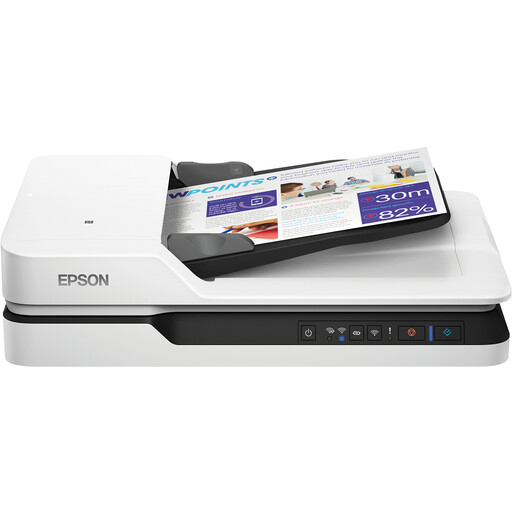
Epson WorkForce DS-1660W Flatbed Scanner, A4, 1200 x 1200 DPI
May suit your group if the books can rest safely and flat on the glass.
A4 flatbed scanner with a stated resolution of 1200 x 1200 DPI.
View on Joybuy
 No image available
CZUR Shine 800 A3 Pro Document Camera
May suit capturing loose, flat sheets up to A3; test separately to see whether the book pages you want to scan appear clearly in the image.
Document camera with A3 in the model name.
The product description advises against scanning glossy materials, such as glossy photos and magazines.
View on Joybuy
Frequently asked questions
Should our group choose a contactless scanner for every book?
No. Let the book’s condition and opening angle guide you: a contactless set-up avoids pressing the book against glass, while a book-focused flatbed scanner may work if the binding can be opened safely. Assess each book individually and compare test scans around the spine.
How can volunteers get started with a consistent scanning process?
First assess the physical condition, test representative pages, then check image quality and whether any pages are missing. The National Archives describes preparation, keywords and quality control as separate steps; your group can adapt its process to suit its collection.
Is a searchable PDF enough for an archive?
Not on its own: check the images as well and organise your file management. Some models offer searchable PDF as an output option; the National Archives stresses that long-term accessibility involves more than just storage space.
What practical arrangements does the group need to make besides choosing a scanner?
Check that the software requirements are compatible with your group’s computer, and allow time for preparation, checking for missing pages and file management. Ask the seller about the applicable warranty and service terms for the exact model.
Can we put scans of local history books online?
Not automatically. According to the Dutch Government, a private copy for personal use can’t simply be distributed or made publicly available. Auteursrecht.nl describes arrangements for certain heritage institutions and works, subject to conditions; check the rights for each book and decide who should have access before your group shares any scans.


