
Student with thick lecture notes
Wants to capture bound pages clearly without removing the notes from their binding. The shape of the spine and the supported book thickness are important factors when choosing a scanner.


An overhead scanner is a good choice if you want to capture bound pages without placing them on a flatbed. Choose a model that suits the thickness and curvature of your notes. A book flatbed is an alternative if you can position the pages carefully on the glass and keep the spine close to its edge. Also check the output, software and amount of space the open book will take up while scanning.
Wants to capture bound pages clearly without removing the notes from their binding. The shape of the spine and the supported book thickness are important factors when choosing a scanner.
Wants to search for text in scans later. Check the difference between an image-only PDF and OCR output, and test recognition with your own material.
Works at a small or shared classroom table and wants to be able to move or store the scanner after use.
Choose this if: you want to put the device away after use and capture bound pages without a flatbed. PCMag UK describes the CZUR Shine Ultra Pro as foldable in an independent review.
The trade-off: the manufacturer gives a reference thickness of 10 mm for A4 on the Shine Ultra Pro; check that it suits your notes.
Choose this if: your notes are difficult to keep open and flat, and correction of curved pages is important. CZUR positions its ET series for book scanning; Ricoh says the ScanSnap SV600 supports books up to 30 mm thick.
The trade-off: these thickness and feature claims apply to the models mentioned. Also check that there is enough desk space for the device and the open book.
Choose this if: you can position the pages carefully on the glass. Plustek gives a book edge of 2 mm for the OpticBook 4800.
The trade-off: you need to reposition the book for each scan. A quoted scan time for one page doesn’t include turning and positioning all the pages in a set of notes.
| What to consider | What to look for | Who is this important for? |
|---|---|---|
| Readability near the spine | Check the thickness and shape of the spine, and look at sample scans of text close to the fold. CZUR describes curvature correction for the ET series; Plustek gives a book edge of 2 mm for the OpticBook 4800. | If I need to read text right up to the spine, I want to capture those pages without taking the notes apart. Around 31% of consumers give the spine their top priority. |
| Searchable files | Check whether the exact model can create searchable PDFs, and test a page in your own layout. IRIS lists searchable PDF output for the Desk 6 Pro; Plustek lists OCR for the OpticBook 4800. | If I want to find passages in printed notes later, I check whether the text can be recognised. Around 25% of consumers put searchability first. |
| Desk space and storage | Measure the space needed for the device, open book, scanning mat or glass and cables. PCMag UK describes the CZUR Shine Ultra Pro as foldable; CZUR gives a reference thickness of 10 mm for A4 for this model. | If I work at a small classroom table, I want to be able to clear some space after scanning. Around 25% of consumers say limited desk and storage space is their main concern. |
| Scanning lots of pages | Check how pages are turned and positioned. Ricoh lists page-turn detection for the SV600; Plustek’s quoted 3.6 seconds is for one A4 scan at 300 dpi, not a complete scanning session. | If I’m capturing lots of pages in a row, I want to know how much manual page-turning and checking is involved. Around 19% of consumers give workflow their top priority. |
For the Desk 6 Pro, IRIS distinguishes between a 13MP sensor and a software-interpolated figure of 21MP. These figures do not describe the same thing.
Compare the original sensor and output specifications for the exact model, and look at a sample page.
CZUR gives a reference thickness of 10 mm for A4 for the Shine Ultra Pro and positions its ET series separately for thicker books.
Check your notes’ thickness and shape against the specifications for the specific model before letting compactness make the decision for you.
The quoted 3.6 seconds for a Plustek OpticBook 4800 is for one A4 scan at 300 dpi. Turning pages, positioning them and checking the scans are not included.
Compare the full workflow and, if possible, try scanning a sequence of consecutive pages.
Allow extra time for turning pages, positioning them and checking the scans, especially for a long set of notes.
The Dutch government distinguishes between making a copy for personal use and distributing it. Separate conditions apply to using parts of copyright-protected works in non-commercial education.
Before sharing, establish who owns the rights and which permission, educational exception or institutional arrangement applies. For institutional digital copying and sharing, permission and a fee under the relevant reprographic rights scheme may be required, according to the Dutch government.
Sharing within an institution may involve extra work to obtain permissions and follow the relevant arrangements.
The IRIScan Desk range includes overhead scanners for documents and books. The Desk 6 Pro combines A3 capture with a choice of output formats.
The Shine Ultra Pro is designed for portable use; CZUR positions its ET series for book scanning and correction of curved pages.
The OpticBook 4800 is a book flatbed scanner for pages you want to position on the glass individually.
The SV600 is a contactless overhead scanner for books and other originals.
This selection includes flatbed models whose descriptions mention books or bound documents, as well as scanners for booklets, loose documents or flat originals. For bound lecture notes, check whether the feed method, thickness and space around the spine suit your needs.
 Image unavailable
The product description mentions books and delicate materials for the flatbed. Check that the glass and available space will accommodate your open notes.
600 × 600 dpi; A4; 50-sheet ADF; duplex scanning. The ADF specifications don’t indicate book scanning speed.
The description also mentions output to editable PDFs.
 Image unavailable
The description mentions booklets up to 5 mm thick. Check this limit carefully if your lecture notes are bound.
600 × 600 dpi; A4; PDF, JPG and TIFF output. The U-shaped paper path is described as space-saving.
Its stated support for booklets up to 5 mm doesn’t make it an obvious choice for thicker sets of notes.
 Image unavailable
The product description lists books and bound documents as suitable originals. Compare the glass and working area with the dimensions of your open notes.
1200 × 1200 dpi; A4; duplex scanning; 25 ppm for the ADF. This ADF speed isn’t a measure of book scanning speed.
Stated dimensions: 451 × 315 × 120 mm.
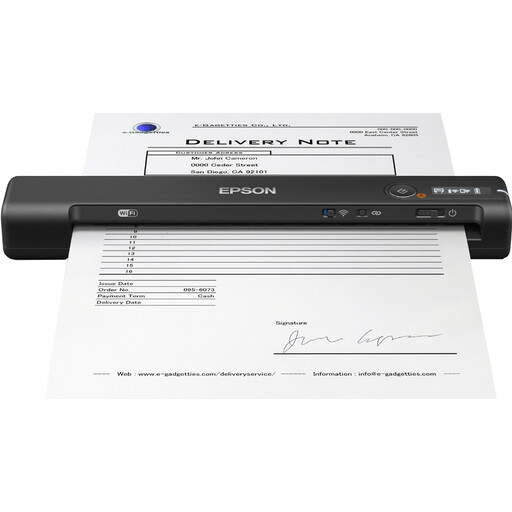 Image unavailable
This is a portable A4 document scanner. Consider it only if the pages can be handled individually; the product information doesn’t describe it as a solution for scanning bound notes.
600 × 600 dpi; Wi-Fi and battery. The description mentions OCR and searchable PDF output.
The stated capacity of up to 300 pages per battery charge is a product specification, not a measure of how long a full scanning job will take.
 Image unavailable
The description mentions flat documents up to A3 size. Before choosing it, check that the bound spine and pages of your notes are suitable for this use.
8MP sensor; USB connection; foot pedal. The description mentions OCR and a design that folds through 90°.
Stated weight: 2.3 kg.
Choose a searchable PDF if the exact model supports this output. Test recognition with your own pages: a listed OCR feature doesn’t guarantee that handwriting will be recognised accurately.
Set aside a stable work surface for the open notes and the accompanying scanning mat or glass. Also check the software requirements: Plustek’s Dutch support page lists separate Windows and Mac installations for the OpticBook 4800.
No. The Dutch government says that a copy for personal use must not be distributed or made public. Auteursrechten.nl sets out separate conditions for using parts of copyright-protected works as part of non-commercial education. Ask your institution to assess other forms of sharing against the relevant permissions or scheme.
That’s different from scanning pages alone. The Dutch Data Protection Authority explains that permission is required when a school records and publishes images of pupils who can be recognised. Point the camera at the paper, and assess any recording or publication of people separately.
Check which software is included and which operating system is supported for the exact version. If an institution digitally copies and shares copyright-protected publications, the Dutch government says permission and a fee under the relevant reprographic rights scheme may apply. This isn’t a general surcharge on every personal scan.