Who is this relevant to?

Collector of catalogues with fragile bindings

You want to digitise bound catalogues without pressing every page flat against glass. Look for contactless scanning and check that the scanner can accommodate the open catalogue. CZUR and Ricoh describe overhead scanners for books and documents.

Image researcher

You want to view illustrations and colour pages clearly, so you check for reflections, framing and how scans look on your own catalogue paper. IRIS’s scanning guide warns that edge correction can affect images.

Home archivist who searches by text

You want to find names and captions in catalogues, so you look for OCR, searchable PDFs and software that works with your computer. Plustek and IRIS describe OCR or searchable output options for specific models.

What should you look for?

Overhead book scanner

Choose this if: you regularly scan bound catalogues and don’t want to press the spine against glass.

Bear in mind: check the size of the open spread and the model’s maximum book thickness. Correction features and lighting don’t guarantee a reflection-free or colour-accurate scan.

Book-oriented flatbed scanner

Choose this if: smaller pages and text close to the spine are your main priorities, and you can place the book on glass.

Bear in mind: the book edge can make text near the spine easier to access, but you’ll still need to position the book and turn the pages.

Standard A4 flatbed scanner

Choose this if: you mainly scan loose images or smaller pages occasionally, and an A4 scan area is enough.

Bear in mind: A4 limits the size of the image you can capture, and a bound book needs to go on the glass plate.

What to consider What should you check? Who is this important to?
Images and gloss Make a test scan of a glossy page; check for reflections, shadows and cropping, especially on images that run to the edge of the page. If I want to capture illustrations without distracting reflections or cropping, I need to be able to assess them on my own pages. Around 33% of consumers give image pages the highest priority.
Protecting the book binding Compare the dimensions of the open catalogue with the scan area, and check whether the book needs to be placed on glass. If my catalogue is fragile, I don’t want to press the binding against glass for every page, and the open spread needs to fit. Around 27% of consumers give protecting the book binding the highest priority.
Searchable text Check whether the exact model and software version can create a searchable PDF and work with your computer. If I want to find artists’ names and captions later, I look for OCR and a suitable software workflow. Around 20% of consumers give searchable text the highest priority.
Size and storage Check both the space needed while scanning and the scan area. A compact device with an A4 scan area can’t capture a larger spread in one go. If I only scan occasionally, I want to be able to store the scanner easily in my home workspace. Around 20% of consumers give compact, occasional use the highest priority.

Common buying mistakes

  • Assuming a sheet-fed scanner is the same as a book scanner

    Feeding in loose documents is a different process from scanning on a flatbed or using an overhead camera. So a model in a general scanner category isn’t automatically suitable for a bound catalogue.

    Check the full model number and see whether the product information mentions bound books and specifies a scan area.

    An unsuitable process may mean extra manual work or the need for a second scanning set-up.

  • Choosing based only on resolution or stated dpi

    A stated resolution doesn’t tell you whether glossy illustrations will be captured without reflections or unwanted cropping. IRIS’s scanning guide warns that edge correction can affect images.

    Make a test scan of one of your own glossy pages, ideally with an image that runs to the edge, and check the result.

    If reflections, curvature or cropping affect the image, rescanning can take extra time.

  • Confusing a manufacturer’s warranty with your full statutory protection

    According to the Dutch government, there is no fixed statutory warranty period for products in the Netherlands. If a product is faulty, the retailer remains your point of contact for your statutory rights.

    Check exactly what any additional warranty covers, and keep the information provided by the retailer.

Relevant brands for book and document scanners

CZUR

The ET series is an overhead range designed for bound books. CZUR distinguishes it from Shine, which is intended for thinner books.

  • CZUR lists book curve correction and side lighting for the ET series.
  • Features vary by series; don’t assume a Shine model is equivalent to an ET for thicker catalogues.

IRIS

According to Canon Netherlands, the IRIScan Desk 7 Pro is an overhead camera for books and documents up to A3, with OCR.

  • IRIS lists anti-glare lighting and book correction for this model.
  • The IRIS scanning guide warns that edge correction can affect images and that fingers may not always be reliably removed if there’s no margin.

Plustek

The OpticBook 4800 is a book-oriented flatbed scanner for bound material and searchable files.

  • Plustek Europe lists a 2 mm book edge for this model, and Plustek describes a scanning workflow for searchable PDFs.
  • The book needs to be placed on the scanner; check the software and platform details for the version on offer.

Epson

According to Epson Netherlands, the Perfection V39II is an A4 flatbed scanner for photos and documents, suitable when you mainly need to scan smaller pages.

  • Epson describes an integrated stand that lets you store the scanner upright.
  • The A4 scan area and flatbed design limit its usefulness for large, stiffly bound catalogues.

Ricoh ScanSnap

According to Ricoh, the ScanSnap SV600 is a contactless overhead scanner for books and A3 documents.

  • Ricoh lists automatic book correction and a maximum book thickness of 30 mm for the SV600.
  • Check that this model’s thickness limit and computer workflow suit your catalogues.

Joybuy products for this scanning need

This selection includes an A4 flatbed scanner and an A3 document camera for flat sheets. Check their limitations with bound and glossy catalogues before choosing.
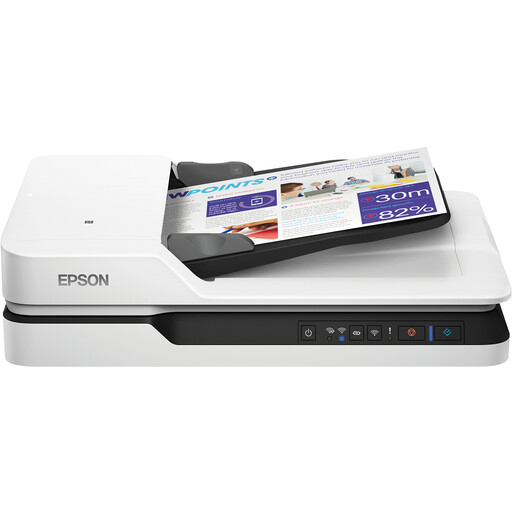
Epson WorkForce DS-1660W Flatbed Scanner, A4, 1200 x 1200 dpi, Black, White

Epson WorkForce DS-1660W Flatbed Scanner, A4, 1200 x 1200 dpi, Black, White

The product description mentions books and bound documents; the A4 scan area means a larger open spread won’t fit in a single scan.

Flatbed scanner with a stated scan area of A4 and a resolution of 1200 x 1200 dpi. The description mentions automatic cropping and skew correction.

Joybuy

CZUR Shine 800 A3 Pro Document Camera for flat sheets

CZUR Shine 800 A3 Pro Document Camera

The product information lists flat sheets up to A3 and OCR; it doesn’t confirm suitability for bound catalogues.

The listing advises against scanning high-gloss materials such as magazines. The product name states that it is compatible with Windows and macOS.

Joybuy

Frequently asked questions about book scanners

How can I check whether a catalogue will fit in one scan?

Measure whether you want to scan a single page or the whole open spread, then compare the dimensions with the scan area of the exact model. Canon Netherlands describes the IRIScan Desk 7 Pro as suitable for sizes up to A3; Epson Netherlands lists the Perfection V39II as an A4 flatbed scanner.

How do I set up a scanner for glossy pages?

Start with a test scan of a glossy image page, especially if the illustration runs to the edge. Check for reflections, shadows, white balance and cropping. IRIS’s scanning guide warns that edge correction can affect images, and that direct sunlight can cast shadows in a scan.

What if the scanning software doesn’t work with my computer?

Before buying, check the download, supported operating system version and system requirements for the exact model. For example, CZUR publishes separate software downloads and requirements for the ET24 Pro for Windows, Mac and Linux; this doesn’t tell you anything about other models.

What are my rights if a scanner I bought online doesn’t work properly?

For a consumer purchase in the Netherlands, you’re entitled to a product that works properly, and the retailer is your point of contact if the product is faulty, according to the Dutch government. There is no fixed statutory warranty period. For eligible online distance sales, you generally have 14 days to change your mind; check the terms of your specific purchase.

Can I share scans of an exhibition catalogue?

The Dutch government explains that making a copy for personal use at home is permitted, but it must not be distributed or made public. So don’t assume that scanning at home gives you permission to publish catalogue pages online; you may need permission for other uses.
