
Home reviewer
You record long sections of your own commentary and want your voice to remain clear. Start with a quiet room and a stable microphone position. Shure explains how distance and room acoustics affect voice recordings.


For a long spoken book review, good microphone placement, enough power and sufficient storage for the entire recording matter more than the recording format alone. A compact voice recorder can be handy if you want to find passages quickly; a portable audio recorder offers different recording formats and connections, but 32-bit float won’t eliminate room echo or compensate for a poorly placed microphone.
You record long sections of your own commentary and want your voice to remain clear. Start with a quiet room and a stable microphone position. Shure explains how distance and room acoustics affect voice recordings.
You want to avoid interruptions caused by a flat battery or full storage. Compare the power supply and available storage for the format you intend to use. Tascam and OM SYSTEM publish usage time and storage details for specific models.
You listen back to recordings to check wording or edit them. Look for markers, playback navigation and file transfer options; Sony and Zoom describe features that help you find passages.
Best if: you want to record spoken commentary and prioritise easy playback or finding specific passages. For the ICD-UX570 series, Sony highlights features including Easy Search and Time Jump.
Keep in mind: the ICD-UX570 series has a built-in rechargeable battery, so check the charge and available recording time before a long take.
Best if: you want to record without other equipment and compare recording formats or a connection for an external microphone. Zoom and Tascam list 32-bit float recording for the H1essential and DR-05XP respectively.
Keep in mind: the H1essential uses a microSD card, and the recording formats mentioned won’t solve problems caused by a reverberant room; microphone placement still matters.
| Consideration | What should you check? | Who is this important for? |
|---|---|---|
| Clarity | Check the distance to the microphone and listen back to a test recording in the room where you plan to record. | If I’m recording at home, I want my voice to sound clear without echo masking my words. Around 31% of consumers rank clarity as their top priority. |
| Finishing a take | Check the remaining power and storage available in your chosen recording format; test a memory card beforehand. | When I record a long review, I don’t want to stop halfway because the battery is flat or there isn’t enough storage. Around 31% of consumers prioritise uninterrupted recording. |
| Listening back | Check markers, playback navigation and whether file transfer fits your workflow. | If I want to check or edit passages, I want to find them quickly. Around 23% of consumers rank listening back and transferring files as their top priority. |
| Carrying and setting up | Compare the size, built-in microphones and controls for the place where you plan to record. | If I want to use the recorder in different places, I want it to be easy to carry and set up. Around 15% of consumers rank portability as their top priority. |
Recording format and room acoustics solve different problems. Shure explains that a microphone cannot separate unwanted room echo from direct speech.
Make a test recording in the room where you plan to speak. Check the microphone distance and reflections before treating higher recording resolution as the deciding factor.
Recording another take or changing the recording location can take extra time.
Published usage time applies to a specific model under particular conditions; your recording settings may produce different results.
Check the power supply for the exact model and test your intended settings well before recording the full review.
If a recording is interrupted, you may need to record the take again.
Storage varies by model: the H1essential uses microSD, while Sony lists 4 GB of internal memory for the ICD-UX570 series and OM SYSTEM lists 16 GB for the LS-P5.
Check the storage and any card requirements for the exact version. Test a memory card before a long recording; Zoom recommends doing this with new cards and cards previously used in another device.
The H1essential requires a microSD card; check whether one is included with the version you’re buying.
Having a private copy doesn’t automatically mean you can share an extract publicly. Quoting from a book in a review is subject to conditions.
Before publishing, consider whether the extract is relevant and no longer than necessary, and credit the source and author where required. The Dutch government and Auteursrecht.nl explain the distinction and the conditions.
The H1essential is a standalone recorder with built-in X/Y microphones, USB-C connectivity for use as a microphone, and a connection for a compatible external microphone.
The DR-05XP combines built-in omnidirectional stereo microphones with recording formats and an input for a compatible external microphone.
The ICD-UX570 series is a voice recorder with built-in memory, LPCM and MP3 recording, and features for finding and transferring voice recordings.
According to OM SYSTEM, the LS-P5 has built-in memory, microSD expansion and remote control via a smartphone.
This Joybuy selection features voice recorders for recording and listening back to spoken reviews or working with the recordings. Before a long take, check the storage, power supply and features you need for the exact version.
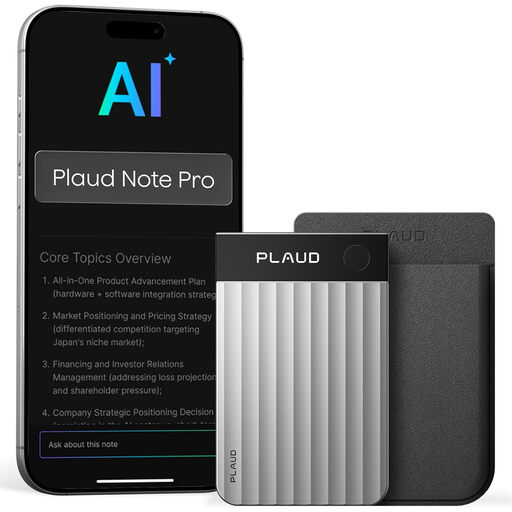 Image unavailable
Suits consumers who want to record spoken content and work with it afterwards.
Product information lists transcription and summaries.
 Image unavailable
Suits consumers who want to record spoken content and work with it later.
The product name specifies 64 GB of storage; product information lists transcription and summaries.
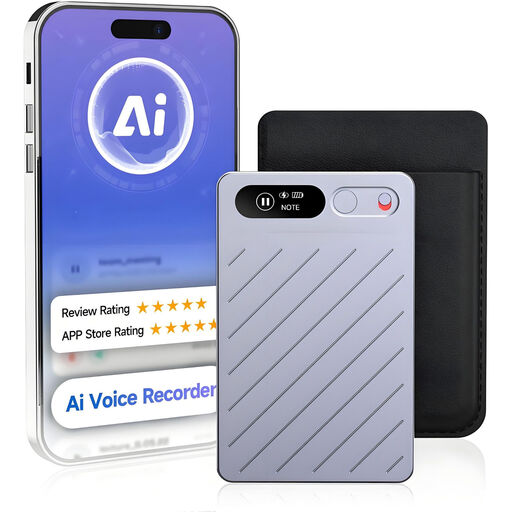 Image unavailable
Suits consumers who want to record spoken content and work with it afterwards.
The product name specifies 64 GB of storage, with transcription and summaries in 118 languages.
 Image unavailable
Suits consumers looking for a voice recorder with 128 GB of storage for spoken recordings.
The product name specifies model L357 and 128 GB of storage.
 Image unavailable
Suits consumers looking for a recorder with storage for spoken content and straightforward recording controls.
The product name specifies model L810, 64 GB of storage and one-touch recording.
Check the power and available storage for your chosen recording format, and make a test recording before the full take. If your recorder uses a memory card, use a supported card that you’ve tested in advance; Zoom also recommends this for new microSD cards and cards previously used in another device.
Start with microphone placement and test the recorder in the room where you plan to record your review. Shure explains that a microphone cannot separate unwanted room echo from direct speech or improve the room’s acoustics.
According to ACM ConsuWijzer, the seller is responsible if a product doesn’t meet what you could reasonably expect from it. The appropriate remedy at no cost depends on the circumstances; there isn’t one fixed statutory warranty period that automatically applies to every recorder.
A review doesn’t automatically give you permission to make large parts of a protected book available to the public. According to Auteursrecht.nl, a short quotation from a published work may be used without prior permission under certain conditions. These include being relevant to the content, not reproducing more than necessary, and acknowledging the source and author. The Dutch government distinguishes between a private copy and making a work available to the public.
According to the Dutch Data Protection Authority, in most cases you need permission to publish other people’s personal data online. This isn’t a blanket permission or a general ban on recording every conversation; before publishing, consider whose voices can be heard and the circumstances involved.