
Vandaag of morgen in huis

Kwaliteit gegarandeerd

Welkomstaanbiedingen ontgrendelen: GRATIS bezorging | Tot 80% korting | Gratis 30 dagen JoyPlus-proefperiode
Download de app
A Bluetooth speaker may seem easy to choose: connect your phone, press play and you’re ready to go. Yet many people buy a model that turns out not to suit their needs after just a few weeks. A small speaker may be convenient for taking on the go, for example, but fail to deliver enough volume for a garden party. A model with long battery life, on the other hand, may be large and heavy.
As a Joybuy Product Recommendation Officer, I therefore focus mainly on verifiable specifications and the intended use of each speaker. Below, you’ll find what to look for in a wireless speaker, which marketing claims to assess critically and which models suit different user profiles.
Higher wattage does not automatically mean that a speaker will sound better. The final result also depends on the size of the drivers, the enclosure, positioning and frequency range. So check whether the figure refers to RMS power or peak power. RMS gives a more useful indication of power during normal use, while peak power is a temporary maximum.
A compact model may be sufficient for a bedroom, kitchen or desk. For an outdoor speaker or party speaker, volume, sound distribution and battery capacity are also important.
An IP rating describes protection against dust and water under specific conditions. An IP67 speaker is completely dustproof and, according to the product specification, can be temporarily submerged in fresh water. That does not automatically mean it is safe for prolonged exposure to seawater, chlorinated water or a high-pressure jet.
A model without an official IP rating, such as many PC speakers and active speakers, should remain indoors. Check this before taking a speaker to the beach, swimming pool or a campsite in rainy weather.
A manufacturer’s claim such as “up to 16 hours” depends on volume, audio content, the Bluetooth connection and any lighting. RGB lighting and high volume often reduce playing time. If long battery life is important to you, don’t just compare the stated number of hours. Also check the charging port, charging time and intended usage scenario.
Bluetooth 5.3 and Bluetooth 5.4 support modern, stable connections, but the version alone does not determine sound quality. Also look at the supported codecs, connection range and features such as pairing with a second speaker.
A Bluetooth 5.3 speaker is suitable for phones, tablets and laptops with Bluetooth. The Edifier G1500 supports Bluetooth 5.3 as well as USB and 3.5mm AUX. For a PC, this may be more practical than using a wireless connection only. The Edifier ES20 uses Bluetooth 5.4 and also supports stereo pairing.
A 1.0 speaker uses a single audio channel and is usually compact. A 2.0 stereo speaker has left and right channels, which can create a greater sense of space for music and gaming. A 2.1 system adds a subwoofer for lower frequencies.
Check the connections before ordering:
For cycling, walking or travelling, weight is just as important as sound. According to the product specification, the Sony SRS-XB100 weighs 274 grams and has a carrying strap. The compact Transformers TF-Y07 weighs approximately 80 grams, but has a stated power output of 3 W and battery life of up to 6 hours. This represents a different usage profile from a large party speaker.
For outdoor use, look for:

Why it suits this profile: A compact portable Bluetooth speaker for everyday use, travelling and short trips. The stated battery life is 16 hours and it weighs 274 grams.
The IP67 rating provides more specific protection information than a general claim such as “water-resistant”. The battery life and dimensions are clearly specified.
Bluetooth 5.3, IP67 protection, USB-C and a carrying strap. The speaker also supports pairing with a second unit.
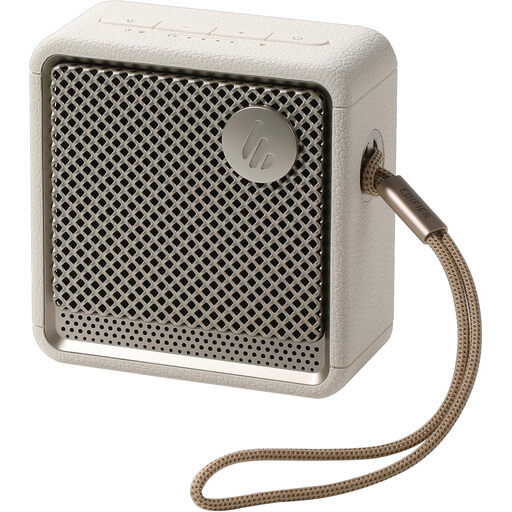
Why it suits this profile: Designed for users who want to combine a compact speaker with stereo pairing, lighting and protection for indoor and outdoor use.
The product specification lists Bluetooth 5.4, 15 hours of battery life and IP67. This means you can check the key purchase criteria in advance.
6 W RMS, 360° sound according to the product information, RGB ambient lighting, dual-device connection and stereo pairing.
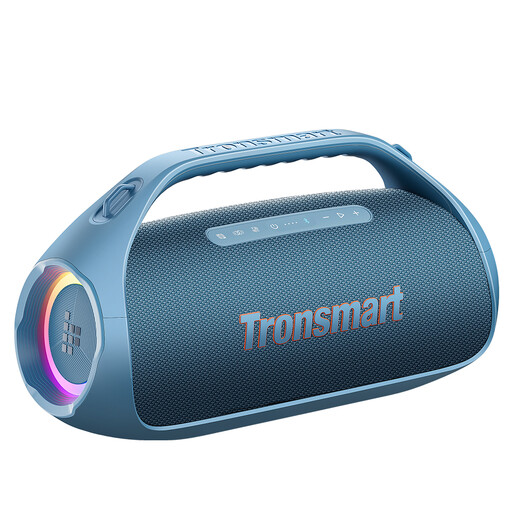
Why it suits this profile: For garden parties, larger groups and users who need higher output and many hours of playing time.
Alongside the stated peak power of 90 W, the specification lists an IPX6 rating and battery life of up to 26 hours under certain settings. Bear in mind that lighting and volume affect playing time.
Bluetooth 5.3, stated output of 90 W, IPX6, USB-C and support for True Wireless Stereo.
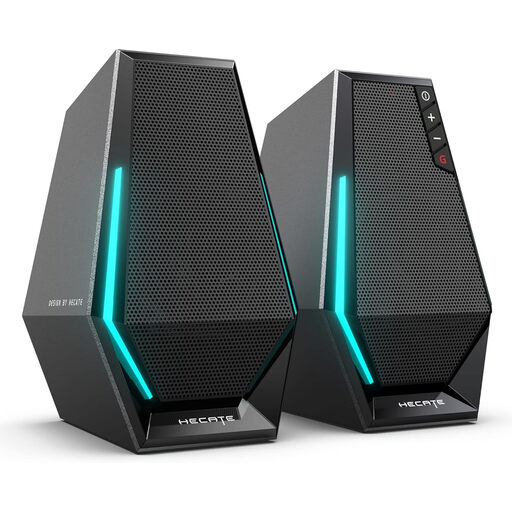
Why it suits this profile: A fixed set-up for a desk, gaming PC or laptop, with multiple connection options and adjustable RGB lighting.
You’re not dependent on a single connection: Bluetooth 5.3, USB and 3.5mm AUX are available. The three modes for gaming, music and films suit different uses.
2.5-inch full-range drivers, 10 W peak power, USB power and five RGB lighting effects according to the product information.
Choose a portable speaker if you want to use it in multiple rooms, outdoors or while travelling. A fixed stereo speaker or set of active speakers is better suited to a desk or living room. For watching television, a TV soundbar makes more sense, particularly when HDMI ARC, eARC or optical audio is available.
For films and gaming, systems with a subwoofer and surround channels can be appealing. Check whether your space is large enough for additional speakers and cables. A 7.1 system requires more room and installation than a compact Bluetooth speaker.
We’ve put together a complete, up-to-date list of products that fully meet these strict selection criteria and the applicable European safety regulations.
Switch on the speaker and activate pairing mode. Then open the Bluetooth settings on your phone, select the speaker’s name and confirm the connection. On some Android devices, models such as the Sony SRS-XB100 support fast pairing.
Play time per charge varies by model, volume and features. Check the stated battery life in the technical specifications. The overall lifespan of the device also depends on charging cycles, storage, moisture and temperature. Use only the recommended charging cable and avoid prolonged exposure to heat.
A portable speaker mainly uses power while charging. Consumption increases at high volumes, with RGB lighting and when additional features are active. A fixed speaker or soundbar relies on mains power. Switch the device off when you’re not using it and, if you want to limit energy consumption, look for automatic standby when buying.
