
Vandaag of morgen in huis

Kwaliteit gegarandeerd

Welkomstaanbiedingen ontgrendelen: GRATIS bezorging | Tot 80% korting | Gratis 30 dagen JoyPlus-proefperiode
Download de app
A Bluetooth speaker may seem simple: connect it, turn on your music and you’re ready to go. In practice, models vary considerably in size, sound output, battery life and water protection. As a result, a cheap purchase may prove less suitable for the beach, a garden party or everyday use at home.
The most common disappointing purchases are caused by three pitfalls:
Long battery life without clear usage conditions
Manufacturers often state a maximum playback time. This usually applies at a particular volume, with the lighting switched off and specific audio being played. At higher volume or with active RGB lighting, actual playback time may be lower.
Misinterpreting an IP rating
IP67 and IPX6 do not mean the same thing. The first digit refers to protection against dust, while the second refers to water. A waterproof Bluetooth speaker is therefore not automatically suitable for prolonged immersion, salt water or a powerful water jet.
Confusing wattage with sound quality
A powerful Bluetooth speaker can offer greater range and more volume, but wattage does not tell you everything about clarity, bass response or distortion. The speaker arrangement, enclosure and positioning also make a difference.
For everyday use, a Bluetooth speaker with long battery life can be convenient, but always compare the stated playback time with the way you plan to use it. Check:
A compact model such as the Sony SRS-XB100 states up to 16 hours of playback time. A larger party speaker may play for longer according to the product information, but sometimes only with the lighting switched off or at medium volume.
For a Bluetooth speaker for outdoor use, the IP code is a useful selection criterion:
Always follow the instructions for use. Avoid salt water, chlorinated water and liquids if the manufacturer advises against them.
Bluetooth 5.3 or 5.4 can provide a modern, stable connection, but compatibility also depends on your phone, tablet and codec. Also check whether you need:
Stereo pairing only works when two compatible speakers can be linked together according to the instructions. It is therefore not enough for both models to support Bluetooth individually.
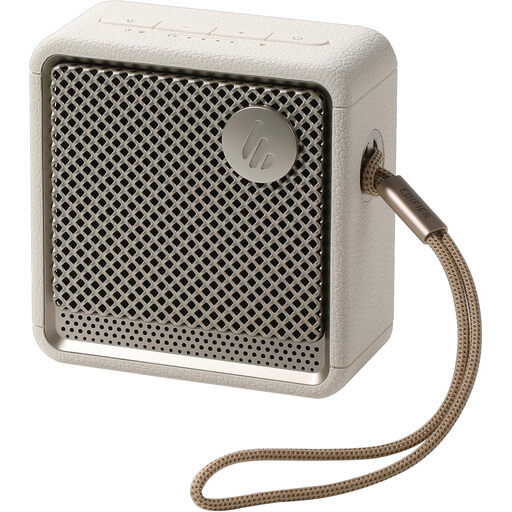
Why it suits this profile: This compact model is suitable for anyone who wants to play music wirelessly at home, on the go or while out for a walk, without setting up a large system.
The product information states an IP67 rating, up to 15 hours of playback time and Bluetooth 5.4. However, check the playback time at your chosen volume and with the lighting in use.
6 W RMS, two passive bass radiators, stereo pairing, a microphone and control via the EDIFIER ConneX app.

Why it suits this profile: A suitable choice for listeners who want more sound output at home and outdoors, and who value the option to expand to stereo.
The stated 34 W RMS gives you more useful information than a marketing term such as “powerful” alone. The IP66 code indicates protection against dust and water jets, not immersion.
Bluetooth 5.4, connection to two devices simultaneously, stereo pairing, three lighting effects and up to 9 hours of playback time according to the product description.
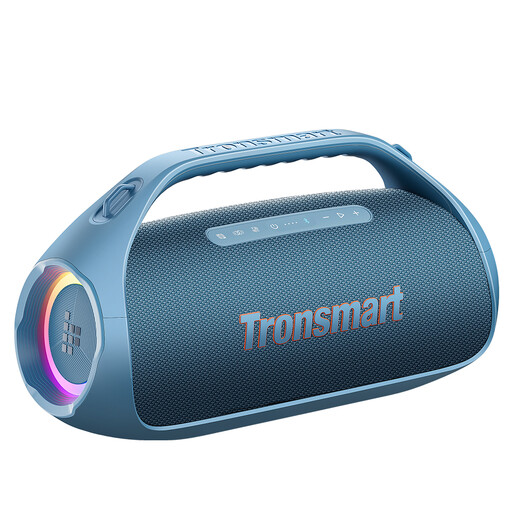
Why it suits this profile: This larger portable speaker is aimed at families, partygoers and outdoor use where higher volume and long playback time are important.
The product information explicitly states that playback time varies depending on volume, lighting and audio. The IPX6 rating is suitable for water jets, but does not include a dust classification.
90 W output power, up to 26 hours of playback at 50% volume with the lighting switched off, a handle, carrying strap and TWS pairing.
We’ve put together a complete, up-to-date list of products that fully meet these strict selection criteria and the applicable European safety regulations.
Switch on Bluetooth on your phone, turn on the speaker and activate pairing mode. Select the speaker’s name from the Bluetooth list. On some models, such as devices with Fast Pair, a connection notification appears automatically. Consult the manual if the speaker does not appear.
Battery capacity and usage determine the practical battery life between charges. Manufacturers usually state a maximum, such as 12, 16 or 20 hours. Higher volumes, bass boost and lighting reduce this time. The built-in battery’s lifespan also decreases over time. Store and charge the speaker according to the instructions, and do not leave it in extreme heat for extended periods.
While playing, a portable speaker mainly uses power from its built-in battery. Energy consumption per charge depends on volume, the Bluetooth connection, lighting and battery capacity. A larger, more powerful model may use more energy during operation than a compact speaker. So don’t just consider the stated battery life; also look at charging time and charging behaviour.
