
Vandaag of morgen in huis

Kwaliteit gegarandeerd

Welkomstaanbiedingen ontgrendelen: GRATIS bezorging | Tot 80% korting | Gratis 30 dagen JoyPlus-proefperiode
Download de app
A Bluetooth speaker may seem easy to choose: select a size, compare the wattage and check the price. Yet many buyers later run into the same problems. The speaker only sounds good at low volume, the battery does not last as long as promised, or the device turns out not to be suitable for rain and dust.
As a Joybuy Product Recommendation Officer, I therefore focus primarily on verifiable specifications and the intended usage scenario. Below, you can find out what to look for in a wireless speaker and which models suit different types of users.
A high wattage tells you something about output power, but it does not automatically indicate clarity, bass response or distortion. Also look at the type of drivers, the number of channels and any available information about the frequency range. A compact speaker with a single driver can be practical, but it will not produce the same stereo sound as a model with two channels or stereo pairing.
Also check whether the stated power is RMS or peak power. RMS is generally more useful for comparison, while peak power indicates a temporary maximum.
A product description may use terms such as water-resistant or waterproof, but without an IP rating it remains unclear how much protection is meant. IP67, for example, means complete protection against dust and protection against temporary immersion under the specified conditions. IPX6 refers to protection against powerful water jets, but says nothing about resistance to dust.
So do not automatically use a waterproof Bluetooth speaker in a swimming pool, under a shower or in seawater. Always check the manual and avoid liquids against which the manufacturer does not specify protection.
A Bluetooth speaker with long battery life will usually achieve its stated playtime under specific conditions. Volume, equaliser, lighting and the type of audio all affect power consumption. The Tronsmart Bang 2, for example, is stated to offer up to 26 hours of playtime at 50% volume and without LED lighting; with the lighting switched on, a considerably shorter playtime is specified.
Therefore, look at the conditions attached to the battery claim and also check the charging time, charging port and whether the speaker can charge a smartphone.
A Bluetooth 5.3 speaker or Bluetooth 5.4 model can offer a stable connection and efficient energy use, but the actual experience also depends on your smartphone, tablet or computer. Newer Bluetooth versions do not automatically make an older device faster or compatible with every feature.
Look at the supported profiles, range and any additional connections. A 3.5mm AUX input is useful when you want to listen without a wireless connection. On some speakers, USB may be used for power or audio playback, so check the product information before assuming that every USB port works in the same way.
For cycling, travelling or spending a day in the park, weight, a handle, carrying loop and charging options are often more important than high output power. A small speaker weighing a few hundred grams is easier to carry than a powerful party model weighing several kilos.
Look out for:
For an outdoor Bluetooth speaker, the IP rating and construction are relevant purchasing criteria. A model with IP66 is protected against dust and powerful water jets, while IP67 additionally specifies protection against temporary immersion. These ratings are no substitute for careful use: close the ports properly and allow a wet speaker to dry before charging it.
If you want a wide soundstage, look for a Bluetooth speaker with stereo pairing. With TWS, or True Wireless Stereo, two compatible speakers can form a stereo pair. This is particularly interesting for a living room, garden or party. Do check that both units are the same model and that the function is supported in the manual.
For a television, a soundbar is often a more logical choice than a portable speaker. Models with HDMI ARC, an optical input or a subwoofer are designed for permanent setups and offer different connection options.
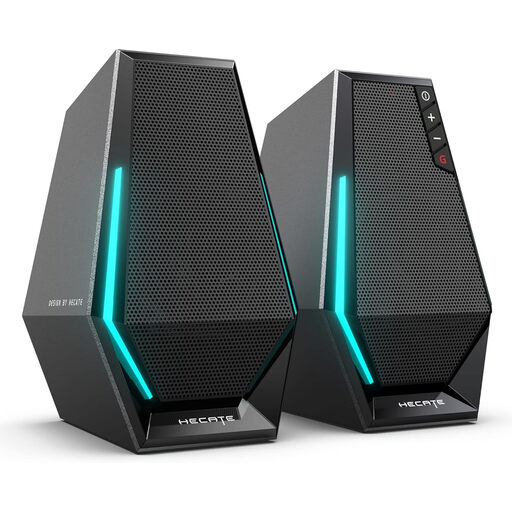
Why it suits this profile: This compact 2.0 system is designed for a desk, computer or gaming setup and works via Bluetooth, USB or 3.5mm AUX.
The specifications list two 2.5-inch full-range drivers and 10 watts of peak power, so you do not have to rely on an isolated wattage claim.
Bluetooth 5.3, USB power, AUX input and switchable modes for gaming, music and films.

Why it suits this profile: A lightweight choice for everyday use, commuting, the balcony, the park or holidays.
The IP67 rating provides more specific information about dust and water protection than simply using the word “waterproof”.
Stated battery life of up to 16 hours, Bluetooth 5.3, a carrying loop and a weight of 274 grams.
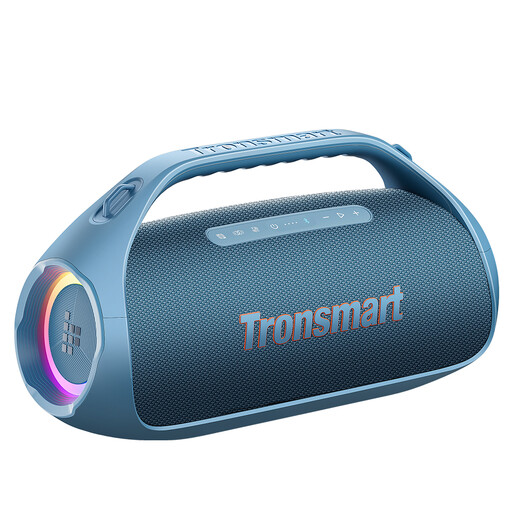
Why it suits this profile: Designed for garden parties, larger groups and users who need a handle or carrying strap.
The IPX6 rating and separately stated battery scenarios make it clear under which conditions the claims apply.
Stated output power of 90 watts, up to 26 hours without LED lighting at 50% volume, Bluetooth 5.3 and TWS pairing.

Why it suits this profile: Suitable for anyone looking for a portable speaker with dust and water protection and the option to pair two units.
The product information explicitly mentions IP66 and lists the TWS function separately, rather than presenting these features merely as general marketing terms.
We have put together a complete, up-to-date list of products that fully meet these strict selection criteria and the applicable European safety regulations.
Switch on the speaker and activate pairing mode. Then open the Bluetooth settings on your smartphone, tablet or computer and select the speaker’s name. If it has been paired before, the device will often reconnect automatically. If this does not work, remove the old pairing and check that the speaker is not already connected to another device.
This varies by model and usage. Volume, lighting, equaliser and audio type all affect playtime. A stated battery life is therefore a guideline. For everyday use, a model with USB-C and a battery indicator is practical, as you can easily check the charge level.
When playing audio, a portable speaker mainly uses its built-in battery. The costs consist primarily of charging it and are generally limited. A fixed speaker or soundbar uses mains electricity for as long as it is switched on. Switch the device off when you are not using it and, where relevant, choose a model with an automatic sleep mode.
