What should you look for?
This guide is for consumers who want to practise blues progressions at a low volume at home.
| What to consider |
What should you check? |
Who is this important for? |
| Headphones and key noise |
Check the plug type and socket; if possible, try out the mechanical key noise. |
If I practise in a shared home, I want to listen privately without assuming the keys are silent. Around 31% of consumers prioritise quiet practice at home. |
| Key action and chords |
Play bass notes and chords on the models you’re considering; check the touch-response setting and pedal. |
If I want to master bass notes and chords, I want to be able to judge the key action for myself. Around 25% of consumers prioritise piano technique above all else. |
| Timing and accompaniment |
Decide whether you’re looking for a metronome, drum rhythm or automatic chord accompaniment. |
If I want to practise chord changes with a groove, I need to know what kind of support the instrument offers. Around 25% of consumers prioritise rhythm or accompaniment. |
| Space and essentials |
Measure your playing area and check which stand and pedal are included with each version. |
If I want to set up the piano in a limited space, I need to know in advance how much room and which accessories I’ll need. Around 19% of consumers prioritise space and clarity about what’s required. |
Joybuy product picks
Digital pianos for consumers who want to practise privately and are looking for rhythm features; check which features and accessories are included with each model and version.
 No image available
MLS-931 digital piano, 61 keys, black
Suitable if you’re looking for a 61-key model to practise with rhythms; check that the listed features suit the way you practise.
61 keys; weighted keys; 300 sounds; 300 rhythms.
View at Joybuy
 No image available
Electronic keyboard, 61 keys, black
Suitable if you’re looking for a 61-key keyboard for private practice; check that the connections are compatible with your headphones.
61 keys; black; metronome; built-in speakers.
View at Joybuy
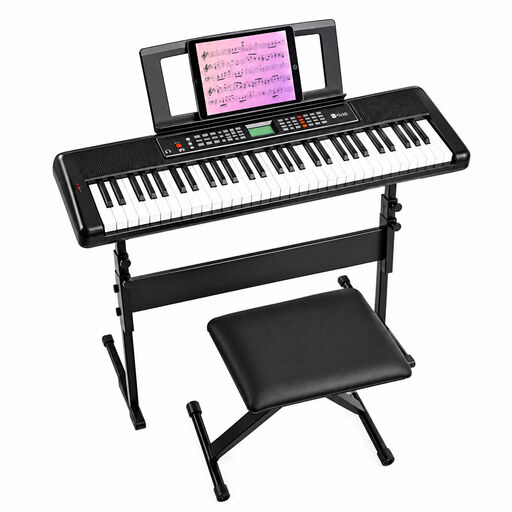 No image available
Digital keyboard piano kit, 61 keys, with stand and bench
Suitable if you’re looking for a 61-key model with a stand and bench; check that the set fits the space you have available.
300 sounds; 300 rhythms; 3-level learning mode; USB-MIDI.
View at Joybuy
Frequently asked questions
Do I need automatic accompaniment to learn blues progressions?
No, not if you mainly want to practise chord changes and timing yourself; a metronome may be enough. Roland lists a metronome for the FP-10. If you want an accompaniment part to play along with your chords, you could look at the PX-S3100, for which Casio lists automatic accompaniment; Kawai describes drum rhythms for the ES120.
Can I practise with headphones without other people hearing the piano?
Headphones mute the sound from the speakers, but they don’t guarantee that other people won’t hear the mechanical sound of the keys. Check the connection and try out the key noise in the room where you plan to practise.
Which pedal should I check before ordering?
Check what’s included with the exact version and which pedal you need. Casio lists an SP-3 sustain pedal with the CDP-S110; Roland lists the DP-10 pedal for half-pedalling as optional for the FP-10.
How can I avoid listening at too high a volume through headphones?
Choose a comfortable volume that’s right for you, and avoid listening at a high or uncomfortable level for extended periods. Yamaha warns against this in the P-145BT/P-143BT manual.
What are my rights when buying online in the Netherlands?
According to ACM ConsuWijzer, for a standard online purchase you generally have up to 14 days after delivery to change your mind; check which exceptions and returns terms apply. You’re also entitled to a legal guarantee if the product doesn’t meet reasonable expectations under normal use. A commercial guarantee doesn’t replace your statutory rights, and there’s no fixed statutory guarantee period for every product in the Netherlands.


