If you want to repeat chords and improvise over them without a computer, choose a keyboard with built-in accompaniment. If you’ll be playing the parts yourself, a simpler 61-key model may be enough. An 88-key instrument gives you a wider range, but takes up more width and doesn’t automatically include accompaniment styles. Measure both the width and depth of your setup before choosing.
Who is this buying guide for?
Blues beginner with limited storage space
You want to practise chords and melodies with both hands, then put the instrument away afterwards. Compare its full dimensions and key range: Casio Europe, for example, lists the CT-S300 as 930 × 256 × 73 mm.
Player who wants to practise with accompaniment
You want to repeat a chord progression and play a melody or solo over it without having to launch software first. Yamaha describes the PSR-E383 as having automatic accompaniment styles, while Roland lists the ability to create your own chord progressions among the GO:KEYS 3’s features.
Player looking for a wider key range
You also want to play music that needs more keys, and have room for a wider setup. Korg specifies 88 keys for the Liano. The number of keys and the type of key action are separate things to consider.
What should you look for when choosing?
61 keys with accompaniment
A good fit if: you want to repeat a blues chord progression and improvise over it without a computer.
Trade-off: check that the controls and available accompaniment suit the chords you want to play. The range is smaller than on an 88-key instrument.
Self-contained 61-key model
A good fit if: you play the parts yourself and need an instrument you can put away after practising.
Trade-off: a narrow instrument doesn’t necessarily need little depth. If you want accompaniment, check what’s available.
Slim 88-key digital piano
A good fit if: a wider key range matters more than automatic blues accompaniment, and you have room for the extra width.
Trade-off: Korg describes the Liano as having an LS keyboard, but not weighted hammer action. The number of keys alone doesn’t tell you what the key feel will be like.
| What to consider |
What should you check? |
Who should give this more weight? |
| Fitting it in and putting it away |
Measure the instrument’s width and depth, along with the surface or stand and your storage space. Allow room for your hands, sheet music and cables too. |
If you want to put the instrument away after every practice session, make sure the whole setup will fit. Around 36% of consumers prioritise having a suitable setup and storage space. |
| Repeating chords with accompaniment |
Check how to set chords and tempo, and whether the features you want work without a computer. |
If you want to repeat a chord progression and play a melody over it, focus on how the accompaniment is controlled. Around 29% of consumers rank this as their main purchasing concern. |
| Touch response and key range |
Try playing left-hand chords and a right-hand melody on the keyboard. Assess the feel of the keys and the number of keys separately. |
If you want to play more expressively or need a wider range of notes for both hands, compare both the touch response and the number of keys. Around 21% of consumers put these features at the top of their list. |
| Practising with headphones |
Check the type of connection and whether the required power supply or adapter is included with the version you choose. |
If you don’t want to use the built-in speakers while practising, check the model’s headphone socket. Around 14% of consumers make this their main priority when choosing. |
Things to watch out for when buying
-
Comparing only the number of keys
An 88-key keyboard doesn’t automatically have weighted hammer action. Equally, a 61-key designation alone doesn’t tell you whether the keys are touch-sensitive.
First decide whether you mainly want to play a keyboard with accompaniment or practise piano technique. Then check both the key range and the stated type of keyboard action.
If the key action doesn’t suit your learning goals, you may later need a different stand or instrument.
-
Assuming width tells you how much space it needs
According to Casio Europe, the Casio CT-S300 is 256 mm deep. The Medeli MK61 is deeper at 305 mm, despite having a smaller stated width.
Measure both sides of the casing and leave room for your hands, cables and sheet music.
-
Assuming every accompaniment will play your blues progression
Preset styles and patterns, and chord progressions you can programme yourself, are different features. Having a style available doesn’t guarantee that it will match your blues progression exactly.
Before buying, check the manual or watch a demonstration to see how to set and repeat the chords you want.
Brands and models to consider
Yamaha
The PSR-E383 is a 61-key model with touch response, lesson features and automatic accompaniment, designed for practising chords and melodies on your own.
- Yamaha lists 260 accompaniment styles for the PSR-E383. Its stated dimensions are 941 × 317 × 105 mm.
- Check that you have enough depth and that the controls provide the blues accompaniment you want. These specifications don’t automatically apply to other PSR models.
Casio
The CT-S300 is a 61-key option for a shallow setup. The CT-S1 is a different model, designed for straightforward operation and instrument sounds.
- Casio Europe lists the CT-S300 as 930 × 256 × 73 mm and specifies touch response.
- Casio lists piano, electric piano and organ sounds for the CT-S1. This description of its sounds doesn’t confirm any specific automatic accompaniment feature.
Roland
The GO:KEYS 3 is an option for experimenting with chord progressions and playing over them.
- Roland describes this model as having 61 keys and the ability to create your own chord progressions.
- Check that the available controls and styles suit the blues progressions you want to practise.
Medeli
The MK61 is a 61-key alternative with built-in speakers and styles.
- Medeli lists touch-sensitive keys, 150 styles, a headphone socket and a power supply included in the box.
- Its stated depth is 305 mm, so a smaller width doesn’t automatically mean the model will fit on a shallow surface.
Korg
The Liano is a slim digital piano for anyone who wants 88 keys and has around 1.28 m of width available.
- Korg specifies a touch-sensitive LS keyboard, eight sounds, a metronome and an adapter included in the box.
- The specifications don’t mention automatic accompaniment styles. The LS keyboard isn’t described as having weighted hammer action.
Joybuy products
This selection focuses on 61-key keyboards and sets for practising blues chords and melodies in a compact setup.
 No image available
MLS-931 61-key keyboard
The listed rhythms may be useful for practising with a built-in rhythm track. Check that the controls suit your chord progression.
61 keys; 300 sounds and 300 rhythms; LCD screen; USB-MIDI; speakers and headphone socket.
View at Joybuy
 No image available
Electronic keyboard with 61 keys
An option to consider if you’re looking for a 61-key model with built-in speakers. Check which features are available on the version you choose.
61 keys; MIDI controller; recording function; speakers; metronome and music stand.
View at Joybuy
 No image available
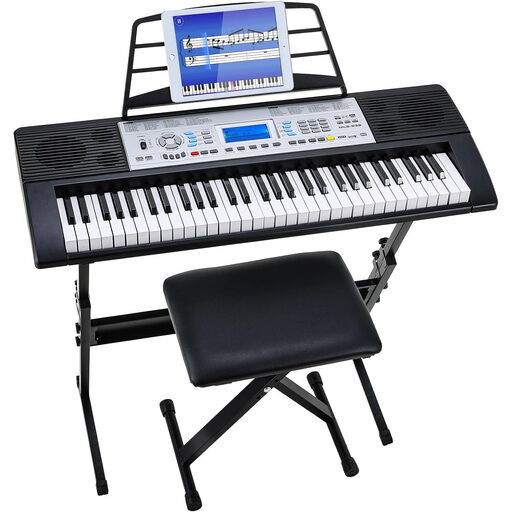
61-key keyboard set with stand and stool
This set may suit you if you’re also looking for a stand and stool for your practice setup. Check that everything will fit in your available space.
61 keys; 500 sounds; three-level learning mode; dual speakers and LCD screen.
View at Joybuy
Frequently asked questions
Do I need 88 keys to play blues progressions?
Not for every chord progression. Bax Music recommends 61 touch-sensitive keys as a guide for keyboard lessons, and 88 keys with hammer action for piano lessons. Try playing the range of the music you have in mind to see whether a smaller setup will be enough.
Can I use a keyboard with batteries, and do I need to buy a power supply separately?
It depends on the model and version. Medeli lists six AA batteries and a power supply included with the MK61. Korg lists six AA batteries, sold separately, and an adapter included with the Liano. Check what’s in the box for the model you choose.
Who should I contact about a faulty keyboard bought in the Netherlands?
Report the fault to the seller. According to the Dutch government, there is no fixed two-year statutory guarantee period in the Netherlands. What you can expect from a product that is fit for purpose depends on the product and the circumstances. A manufacturer’s guarantee doesn’t replace your statutory rights.
Is CE marking relevant for an electronic keyboard?
Check which EU conformity requirements apply to the specific version. The European Commission explains that CE marking is only required when the relevant harmonised EU rules say it is. A CE mark is not an independent product test.


