
Vandaag of morgen in huis

Kwaliteit gegarandeerd

Welkomstaanbiedingen ontgrendelen: GRATIS bezorging | Tot 80% korting | Gratis 30 dagen JoyPlus-proefperiode
Download de app
A blood glucose meter can make daily blood glucose testing easier to manage. However, test kits vary widely in ease of use, ongoing costs and included accessories. If you only look at the price of the device, you may discover later that the test strips are expensive, have a short shelf life or are difficult to find.
This buying guide helps people with diabetes, those at increased risk and carers choose a suitable blood glucose meter for home use. It focuses on verifiable product specifications, practical operation and safe use.
A cheap meter is not necessarily good value. In particular, check how many diabetes test strips and lancets are included, and what you’ll need to buy afterwards. If you test regularly, a kit with a larger starter supply may be more practical than a cheaper device that requires you to buy extra consumables straight away.
Check the expiry date, too. For example, the Sinocare Safe AQ Smart instructions state that test strips should be used within six months of opening the vial. So, if you only test occasionally, avoid opening more strips than you need.
Terms such as “medical accuracy” or “painless lancing” may sound convincing, but you should check the product information. According to Sinocare’s product description, the Safe AQ Smart uses an FAD-GDH enzyme system and requires a 0.6 µl blood sample. These are product specifications, but they are no substitute for medical advice or a laboratory test.
Discuss an unusual reading, recurring concerns or a result that doesn’t seem right with a healthcare professional. Use the meter according to the instructions and don’t change your medication on your own based on a single reading.
Not every diabetes test kit includes a lancing device, lancets and enough test strips. So, check:
For users in the Netherlands, a glucose meter displaying mmol/L is usually the practical choice. Always check this before buying to make sure the readings are shown in the unit you’re used to.
A short test time makes regular self-testing easier. The Sinocare Safe AQ Smart has a stated test time of 5 seconds and, according to the product information, requires a blood sample of 0.6 µl. A small sample requirement can be useful if you test several times a day, but using the right lancing technique and applying the drop correctly still matter.
Wash and dry your hands before testing. Traces of food, hand cream or water can affect the process. Also follow the instructions for applying blood to the test strip.
An adjustable depth setting gives you more control when lancing. According to the product description, the Safe AQ Smart comes with a lancing device that has a dial-adjustable setting. Start with a suitable depth that isn’t unnecessarily deep, and follow the instructions.
Lancets are for single use only. Never share a lancing device, lancet or meter with anyone else. Dispose of used lancets and test strips safely in accordance with local guidelines, preferably in a suitable sharps container.
Test strips are sensitive to moisture, heat and improper storage. Close the vial immediately after use and don’t use strips past their expiry date. Also check that the strips are specifically made for your blood glucose meter model; strips from another system won’t necessarily work.
A no-coding system can make setup simpler. According to the product information, the Sinocare Safe AQ Smart doesn’t require coding. This means fewer steps before testing, but you should still check the strip direction and follow the instructions.
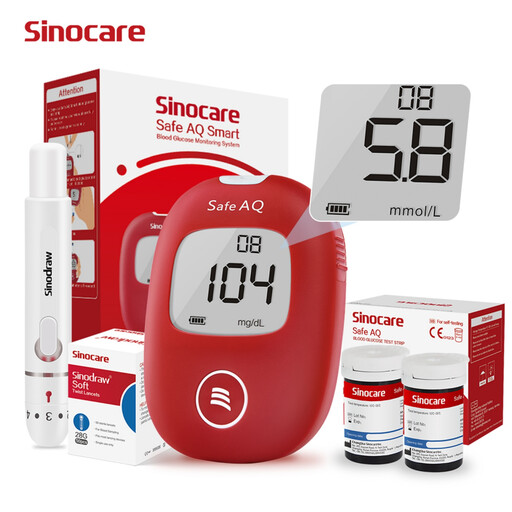
Why it suits this profile: The kit includes a meter, lancing device, 50 test strips and 50 lancets. It gives beginners the essentials to get started with blood glucose testing at home.
The contents of the pack are clearly listed. That means you won’t need to buy a lancing device or your first supply of strips separately straight away.
50 strips and 50 lancets; no coding required according to the product description; large screen and compact design.
Why it suits this profile: If you value straightforward operation, this meter offers a large display, a compact design and a stated test time of 5 seconds.
According to the product information, there’s no coding step. This means fewer extra settings to deal with before testing.
Requires 0.6 µl of blood according to the product description; large screen; FAD-GDH system stated by the manufacturer.
Why it suits this profile: For people who test frequently, a full supply of 50 strips and 50 lancets is practical, as long as you follow the storage and expiry instructions.
The kit lists the number of both strips and lancets. This helps you estimate usage in advance and avoid starting with an incomplete kit.
50 test strips and 50 lancets; adjustable lancing depth; portable storage case according to the product information supplied.
We’ve put together a complete, up-to-date list of products that meet these strict selection criteria and the applicable European safety regulations.
First, wash and dry your hands. Then insert a suitable test strip into the meter, set the lancing device according to the instructions and apply a drop of blood to the indicated area of the strip. Wait for the reading and note down the result if needed for your treatment plan. Use a new lancet for every test.
Shelf life varies by brand and pack. For the Sinocare Safe AQ Smart, the product information states that strips should be used within six months of opening the vial. Store them in a dry place and close the vial straight away. Lancets are for single use and must be disposed of safely.
The cost includes the meter, test strips and lancets. So, don’t just compare the price of the starter kit: work out the cost per test based on the price and number of strips, too. Also check that the strips are specifically designed for the meter you’ve chosen.
