
Blend straight in the pan
You make mushroom soup in a pan and want to blend the cooked ingredients without transferring them elsewhere. The Consumers' Association describes blending in the pan as a useful feature of a stick blender.


If you want to blend cooked mushroom soup without transferring it to another container, a stick blender is the best fit. For larger quantities, a blender with a jug that is confirmed to be heat-resistant may be more convenient. A soup maker is another option if you want to cook the ingredients in the appliance too, but check its capacity, programmes and cleaning instructions. For a specific electrical appliance, check whether the relevant CE rules apply and whether the model has the required marking.
You make mushroom soup in a pan and want to blend the cooked ingredients without transferring them elsewhere. The Consumers' Association describes blending in the pan as a useful feature of a stick blender.
You make several portions and value a smooth texture enough to clean a blender jug afterwards. The Consumers' Association recommends checking that the jug is heat-resistant when using a blender for soup.
You want to cook and blend in one appliance, and are happy to work within a soup maker’s capacity and programmes. The Philips model mentioned has its own programmes and a limited jug capacity.
Best for: blending cooked mushrooms directly in the soup pan, whether you’re making a small or varying quantity.
Bear in mind: splashing and a texture that may be less smooth than with a blender; the Consumers' Association cites blending in the pan as an advantage of this approach.
Best for: blending larger quantities of liquid soup when a consistently smooth texture matters to you, using a jug that the product specifications confirm is suitable for hot ingredients.
Bear in mind: transferring the soup, cooling time, extra washing-up and storage space; the Consumers' Association advises letting hot ingredients cool slightly first.
Best for: cooking and blending the ingredients in the appliance, rather than preparing the soup in a pan first.
Bear in mind: the programmes, capacity and cleaning instructions for the exact model; a soup maker won’t necessarily replace a larger pan.
The table compares appliances for mushroom soup according to consumers’ main purchasing priorities. The percentages in each row show the proportion of consumers who put that priority first.
| Factor | What to look for when buying | Who is this important to? |
|---|---|---|
| Blending in the pan | Check the blending foot, speed settings, cord length and suitability for your pan. | If I want to blend cooked soup straight in the pan, avoiding an extra transfer is my main priority; around 38% of consumers prioritise this approach. |
| Portions and texture | Check the usable capacity, suitability for hot ingredients, and the filling and lid instructions. | If I’m making several portions and want a consistently smooth texture, I’ll weigh up using a jug against the extra transfer and washing-up; around 23% of consumers prioritise larger portions and texture. |
| Cleaning and storage | Check which parts can be removed, which are dishwasher-safe according to the manual, and how many accessories you’ll use. | After cooking, I want to wash and store as few loose parts as possible; around 23% of consumers consider easy cleaning their top priority. |
| Cooking and blending | Compare the programmes, usable capacity, recipe restrictions and cleaning instructions. | If I want to cook and blend the ingredients in the appliance, its capacity needs to suit my portion; around 16% of consumers prioritise automatic cooking. |
A blender can mix ingredients without heating them. So a soup programme doesn’t automatically mean the appliance will cook the ingredients.
Check whether the appliance cooks the ingredients itself or only blends soup that has already been prepared.
If the blender doesn’t heat the ingredients, you’ll still need a pan, as well as extra steps for transferring the soup and cleaning up.
A jug’s capacity alone doesn’t tell you how much hot soup it can safely hold.
Before you buy, check the manual for instructions on hot ingredients, the maximum fill level and the lid.
If the permitted quantity is smaller than the amount you’ve made, blending in several batches can mean more time and washing-up.
A chopper and whisk have different functions from the blending foot used to purée soup.
Compare sets based on the dishes you actually make.
Extra accessories need more storage space and will also need cleaning after use.
The ErgoMixx MSM66120 is a stick blender option for blending directly in the pan.
The MultiQuick 7 MQ7025X is a stick blender option supplied with a chopper and whisk.
The Intention HB46E8 is a stick blender option without an extensive accessory set.
The Blender Power 4 is a jug blender option for liquid soup.
The refurbished SoupMaker HR2204/80R1 represents the option where the appliance prepares the soup.
These product picks are mainly for blending soup with a stick blender; if you’re considering a jug blender, check its specific functions and suitability for hot ingredients. For the exact model, also check the applicable CE marking and the instructions for use.
 No image available
A hand blender option for puréeing soup; when blending hot ingredients, use a heat-resistant container and small batches, following the product instructions.
The set includes a detachable blending wand, measuring beaker, chopper and whisk.
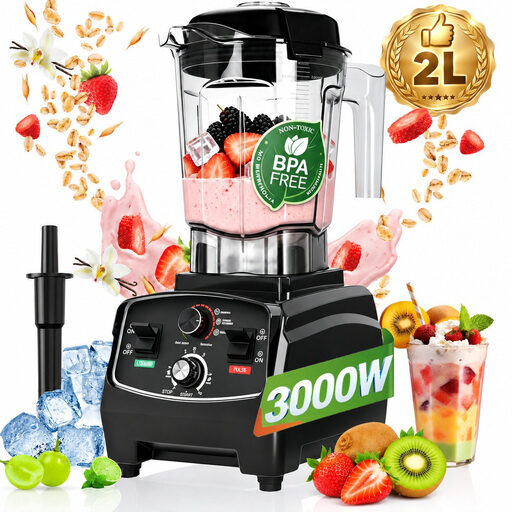 No image available
If you’re considering a jug blender for soup, check that this model is actually suitable for soup and hot ingredients.
The product name specifies a 2 L jug; follow the filling and lid instructions for the specific model.
 No image available
A stick blender option for soups and sauces; don’t process boiling liquids, in accordance with the instructions for use.
 No image available
This stick blender is described as suitable for soups and sauces; stick to the stated usage time: no more than 1 minute of continuous use, followed by a 1-minute rest.
The product name specifies a 700 ml measuring beaker and a 500 ml chopper.
 No image available
A hand blender option for puréeing soup; check the manual for instructions on using it with hot ingredients.
You can’t assume so just because it’s called a ‘blender’. Check whether the specific jug is suitable for hot ingredients and follow the filling and lid instructions; the Consumers' Association advises letting hot ingredients cool slightly first.
A standard stick blender blends soup but doesn’t cook it. If your soup is already cooked, you can blend the ingredients in the pan; if you want to combine cooking and blending, check the programmes and capacity of a soup maker.
Follow the instructions for your model. For the HR2204/80R1 mentioned here, Philips warns against immersing the motor unit in water; don’t assume this instruction applies to other models without checking.
The Netherlands Nutrition Centre advises cooling leftovers quickly and storing them in a sealed container in the fridge or freezer. Check its Storage Guide for advice suited to the ingredients in your soup.
When you buy from a business online, you generally have a 14-day cooling-off period, according to the Dutch Government. If a product is faulty, contact the seller; there is no fixed term for statutory guarantee in the Netherlands, and it is separate from any manufacturer’s warranty.
CE marking is required for electrical products covered by the relevant rules. The Netherlands Food and Consumer Product Safety Authority describes the scope of the low-voltage rules as 50–1000 V nominal AC voltage; check whether those rules apply to the specific model and whether it has the required marking.