For a single milkshake made with soft strawberries and milk, a compact blender with a blending or drinking cup is a natural choice; for several glasses, a jug is more practical. Consider the usable capacity, the space needed for the appliance and its separate parts, and the cleaning instructions. If you often use frozen fruit or ice, assess how it handles those ingredients separately: wattage alone won’t tell you how well a blender will cope. The Consumentenbond also assesses different blending tasks separately.
Who is this advice for?
One-person milkshake maker with limited space
You mostly make small portions and want to store the appliance, cup and separate parts without giving up much worktop space. The Consumentenbond describes a small blending cup as a typical feature of a smoothie blender or personal blender.
Milkshake maker for several glasses
You want to make enough in one go to pour into several glasses, so a suitably sized jug is more useful than a travel cup. The Consumentenbond discusses larger jugs for people who prepare bigger quantities.
Fan of frozen fruit or ice
You regularly use harder or frozen ingredients, so it’s worth checking how the blender performs for that specific task. The Consumentenbond points out that many cheaper blenders struggle with frozen fruit and ice.
What should you look for when buying?
First, decide how many glasses you usually make at once. Then choose a blending cup or jug that suits your portion size and the space available for storing the appliance and its separate parts.
| What to consider |
What to look for |
Who should prioritise this? |
| Worktop and cupboard space |
Measure the appliance with the cup or jug in place, and allow for its storage height and separate parts. |
I want to be able to put the blender away after use without cluttering my small worktop. Around 28% of consumers prioritise suitable storage and set-up space. |
| Capacity per batch |
Compare the stated working capacity and the cups included with the exact version; the Consumentenbond recommends 1,5 litres or more as a guide for larger quantities. |
If I want to pour several glasses at once, I don’t want to have to blend again and again. Around 22% of consumers prioritise the amount made per batch. |
| Results with strawberries and milk |
Look for reviews of blending the ingredients you use; don’t judge the results by wattage alone. |
For my usual milkshake with soft strawberries and milk, a good blend matters more than a function for tougher tasks. Around 22% of consumers prioritise results with soft ingredients. |
| Cleaning after use |
Check which parts are dishwasher-safe for each model and how to clean the blades and lid. |
I want to be able to clean the cup, lid and blades after making a milkshake without unnecessary hassle. Around 17% of consumers put ease of cleaning first. |
| Frozen fruit or ice |
Check whether the manufacturer allows these ingredients and look for information on how the exact model performs for this task. |
If I often use frozen fruit or ice, I want to know how the blender handles them specifically. Around 11% of consumers give this task top priority. |
Common pitfalls
-
Choosing based on wattage alone
A higher stated power rating doesn’t, by itself, tell you how a blender will handle frozen fruit or ice. The Consumentenbond assesses blending tasks separately and reports that many cheaper models struggle with these ingredients.
First decide whether you’ll mostly use fresh, soft strawberries or also want to blend frozen ingredients. Then compare information about that specific task for the exact model.
-
Looking only at the cup’s capacity
A personal blender, a jug blender and a combination model may come with different parts. The jug, lid or extra cup may also take up space when you store everything away.
Measure the space for the appliance and its parts together, and check the working capacity and the capacity of the version on offer.
-
Assuming a similar product name means it’s the same version
The nutribullet page for the NB603DG lists one Tall Cup of 700 ml. The Joybuy listing for a nutribullet Original includes two drinking cups, so don’t assume they’re the same bundle without checking.
Before buying, compare the full model number, cup capacity and included parts.
Brands to consider
Philips
Philips describes the Blend & Go HR2670/01 as a compact blender with a drinking cup and two speeds.
- Philips lists the motor power as 350 W and says the removable parts are dishwasher-safe.
- Check the cup capacity of the version you’re considering; the model specifications don’t tell you what texture your milkshake will have.
nutribullet
nutribullet describes the Original 600 NB603DG as a personal blender with a 600 W motor base.
- The manufacturer lists a 700 ml cup and dimensions of 343 × 140 × 140 mm for the NB603DG.
- Check the full model number and bundle: a product listing with extra cups may not be the same version.
Braun
Braun describes the PowerBlend 1 JB1051BK as a compact jug blender with a to-go bottle.
- Braun lists the glass jug’s working capacity as 1,25 l and mentions a removable blade and dishwasher-safe parts.
- If you have limited storage space, bear in mind the jug, bottle and stated weight of 3,1 kg.
Tefal
According to Tefal, the Blend Up BL19H4F0 combines a compact design with 400 and 700 ml bottles and eight automatic programmes.
- Tefal lists a cleaning programme, removable blades and dishwasher-safe bottles.
- Tefal’s description of the quiet setting compares it with this model’s maximum setting; it isn’t an independent comparison with other blenders.
Products at Joybuy
These product picks are suited to making milkshakes in a blending cup, travel cup or jug. Before choosing, check that the version and any usage restrictions suit your portion sizes.
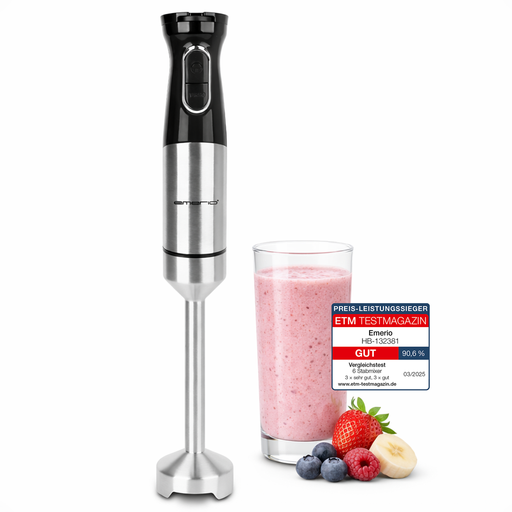 Image unavailable
Emerio HB-132381 hand blender, 1000W, variable speed
Could suit you if you want to make a shake with a hand blender in a separate cup.
The product name mentions variable speed and a black and stainless steel finish.
View at Joybuy
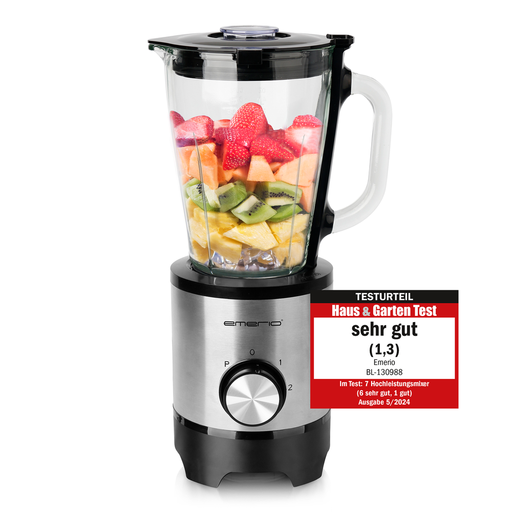 Image unavailable
Emerio BL-130988 blender with glass jug, 1.5L
Could suit you if you’d rather make a shake in a jug and pour it from there.
The product name lists a capacity of 1.5L. Do not blend liquids hotter than 60 °C in the jug.
View at Joybuy
 Image unavailable
Ninja BlendBoss portable blender with removable travel cup
Could suit you if you want to make a shake directly in a travel cup.
The product name mentions a 710 ml travel cup, three automatic programmes and dishwasher-safe parts; ice crushing is also listed.
View at Joybuy
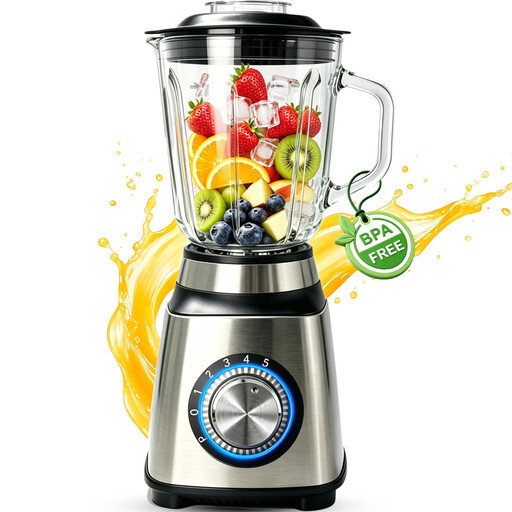 Image unavailable
VitaBoost blender, 1.5 L, 6 blades
Could suit you if you’d rather make your shake in a jug blender.
The product name lists a capacity of 1.5 L and six blades; an ice-crushing function is also mentioned.
View at Joybuy
 Image unavailable
ochama multifunction blender, 600W, 1.5L
Could suit you if you want to make a shake in a jug and are looking for a blender with multiple speeds.
The product name lists three speeds and an ice-crushing function.
View at Joybuy
Frequently asked questions
Do you need a high-powered blender for strawberries and milk?
Not for those ingredients alone. Choose a cup or jug that suits your portion size, and assess tougher tasks such as crushing ice separately; the Consumentenbond warns that wattage alone doesn’t predict the result.
How do I clean a blender after making a milkshake?
Follow the instructions for the exact model, including guidance on the cup, lid, blades and dishwasher use. The Voedingscentrum recommends using clean kitchen utensils when preparing dairy products.
What if a blender I bought online doesn’t fit or breaks quickly?
Online purchases generally come with a 14-day statutory cooling-off period from delivery, although exceptions apply. Your statutory guarantee is separate from any manufacturer’s warranty: if a product used normally doesn’t meet what you could reasonably expect, the seller must resolve the issue under the applicable terms. ACM ConsuWijzer explains these rights.
Does a blender need a CE mark in the Netherlands?
Electrical equipment covered by the Dutch Commodities Act Decree on Electrical Equipment must carry a CE mark. The Netherlands Food and Consumer Product Safety Authority describes a range of 50–1000 V AC for the low-voltage rules; which rules apply depends on the model and the relevant product framework.


