
If you make small portions
You make one or a few bowls at a time and want a blending container that suits your portion size. This is one of the factors highlighted by the Consumers’ Association and manufacturers Philips and nutribullet.


For small portions of cold tomato soup, start by considering how much you make at a time and which blending container you want to use. A mini blender jug gives you a sealed container, while with a hand blender you can choose a suitable container yourself. In either case, check that the minimum working quantity suits your recipe. A personal blender may be suitable for cold ingredients, but don’t use a sealed cup for hot soup if the manufacturer advises against it.
You make one or a few bowls at a time and want a blending container that suits your portion size. This is one of the factors highlighted by the Consumers’ Association and manufacturers Philips and nutribullet.
You want to decide how finely the tomato is puréed, so you’re comparing a blender jug with a hand blender. The Consumers’ Association describes both appliances as suitable for puréeing foods such as soup and sauce.
You make soup regularly and consider how many parts you’ll need to clean after each use. Check which parts are removable on the specific model and how the manufacturer says they should be cleaned.
Start with the smallest portion you want to purée and compare it with the minimum filling quantity in the manual; the maximum capacity won’t tell you this. Then decide whether you’d prefer to use a blender jug or work in a container of your own, and only consider extra features if you’ll need them for other recipes too.
| What to consider | What to look for | Who it matters most to |
|---|---|---|
| A suitable blending container | Compare your portion size with the usable capacity and minimum filling quantity in the manual. | If I make one or a few bowls, I want a blending container that suits my portion size. Around 36% of consumers prioritise a suitable size for small portions. |
| Texture and control | Consider the controls and the most suitable blending container; don’t judge the result by power alone. | If I want to control how finely the tomato is blended, I’ll compare a blender jug with a hand blender. Around 29% of consumers prioritise texture and control. |
| Cleaning | Check which parts are removable and which the manual says are dishwasher-safe. | After making a small amount, I don’t want to clean more parts than necessary. Around 21% of consumers prioritise easy cleaning over other buying concerns. |
| Extra features | Decide whether you’ll also make larger quantities or hot dishes before weighing up extra features. | If I’m buying the appliance mainly for small portions of cold soup, I want to know whether I’ll actually use its extra features. Around 14% of consumers place the most importance on cost and versatility. |
The stated maximum capacity doesn’t tell you whether the blades will blend a very small portion effectively.
Before choosing, compare your usual portion size with the minimum filling instructions for the exact model.
A cup that’s awkwardly large for your recipe could mean extra decanting or having to use a different appliance.
nutribullet’s safety instructions warn that hot ingredients can cause pressure to build up in a sealed blending cup.
Use the cup within the temperature limits set by the manufacturer, and check the manual for other models.
Heating and blending are separate functions; you don’t need to heat cold tomato soup in the appliance.
Only consider this feature if you also want to use the appliance for hot dishes.
Philips describes the HR2510/90 as a compact mini blender.
The MultiQuick 1 MQ10.001MWH is a hand blender for anyone who wants to choose their own blending container.
According to the manufacturer, the Original 600 NB603DG is a personal blender with a 700 ml cup.
Tefal lists the Lightmix BL1C02 as having a capacity of 300 ml.
This selection includes hand blenders and jug blenders, from a mini blender jug to larger blending jugs. Check the filling instructions for each model and make sure the blending container suits the portions you usually make.
 Image unavailable
The product description lists a glass blending jug for soup and sauce. The different blending containers may be useful if you make other recipes too.
The set includes a 1,500 ml blending jug, a 600 ml travel bottle and a 300 ml chopper cup.
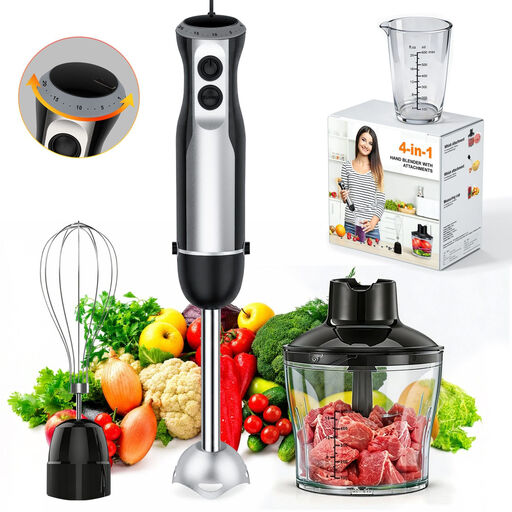 Image unavailable
A hand blender is a good option if you’d rather purée ingredients in a suitable container of your choice.
The product name lists 20 speeds and a turbo function. The product details also mention a 600 ml measuring beaker.
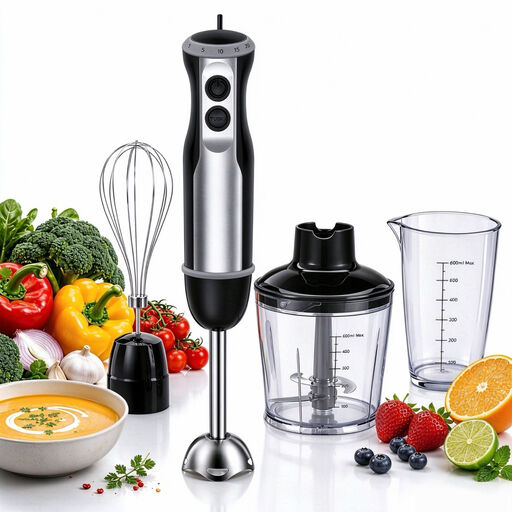 Image unavailable
This hand blender is an option if you want to use it in a suitable blending container and adjust the controls yourself.
The product details list six speeds and a turbo function.
 Image unavailable
The jug capacity makes this one worth comparing if you want to prepare larger quantities as well as small portions.
The product name lists a 1.5-litre jug and three speeds. For heavy blending, the product information recommends running it for no more than one minute at a time, followed by a two-minute rest.
 Image unavailable
A mini blender jug is an option if you’d rather purée ingredients in a blender jug. Compare the filling instructions with the portion you make.
The product details list a capacity of 0.6 litres, a power rating of 350 W and two speeds. Philips says the removable parts are dishwasher-safe.
No, not for blending it cold. Only consider heating in the appliance if you also want to use it that way, and check the instructions for the exact model.
Not in the sealed cup covered by nutribullet’s safety instructions: the manufacturer warns that hot ingredients can cause pressure to build up. Check the manual for other models.
No, it varies by model. Philips lists dishwasher-safe parts for the HR2510/90; check the manual to see which parts of your model can go in the dishwasher.
The Netherlands Nutrition Centre recommends keeping leftovers in the fridge for no more than two days after preparation. Check any additional storage advice that may apply to specific ingredients.
According to ACM ConsuWijzer, the seller is responsible for the statutory guarantee and must provide an appropriate free solution if your claim is valid. A manufacturer’s guarantee does not replace your statutory rights.