
Office worker who doesn’t want to disturb colleagues
You want to make a shake during the working day without unnecessarily interrupting your colleagues. Consumentenbond assesses noise as a separate part of its blender testing.


For one shake, a compact blender with a drinking cup is practical; choose a rechargeable model if there’s no socket nearby. If you’re using frozen raspberries, check that the exact model is suitable for them. And for a quiet workspace, don’t rely on the manufacturer’s claims alone: compare independent noise tests if you can. A jug blender is better suited to making several portions, but it takes up more space.
You want to make a shake during the working day without unnecessarily interrupting your colleagues. Consumentenbond assesses noise as a separate part of its blender testing.
You want to use frozen fruit, so you’re checking which ingredients are permitted and what the smoothie will be like, rather than looking at wattage alone.
You make one portion, like to take it with you and want the cup to be easy to clean afterwards. Whether a corded or battery-powered model is right for you depends on your workspace.
First, choose between a personal cup, a rechargeable blender and a jug for several portions. Then compare noise levels, suitability for your ingredients and the cleaning instructions for the exact model.
Choose this if: you usually make one shake, have a socket nearby and want to take your drink with you straight away.
Bear in mind: the cup determines how much you can make at a time; the product specifications don’t necessarily tell you anything about noise or raspberry seeds in your shake.
Choose this if: there’s no socket at your workspace or you want to take a small personal cup with you.
Bear in mind: charging and the stated cup capacity; also check the instructions for frozen ingredients.
Choose this if: several colleagues want a portion at the same time and you have room for the jug.
Bear in mind: a jug takes up more space than a personal drinking cup.
| What to consider | What should you look for? | Who is this important for? |
|---|---|---|
| Noise in a shared space | Look for an independent noise test of the exact model; don’t infer noise levels from wattage or battery power. | I want to blend during working hours without unnecessarily disturbing colleagues. Around 31% of consumers consider noise their top priority. |
| Results with raspberries | Check the manual to see whether the model can handle frozen fruit and which quantities and liquids are permitted. | I mainly want to know whether my shake will have the texture I want, including when made with frozen raspberries. Around 31% of consumers put blending results first. |
| Cleaning after use | Check the dishwasher instructions for each part and whether the blade unit is removable; the motor base isn’t automatically dishwasher-safe. | After my shake, I want to clean the cup, lid and blades thoroughly before the next person uses them. Around 25% of consumers make ease of cleaning their top priority. |
| Blending without a socket | Check the cup capacity, charging method and stated number of blending cycles; follow the filling instructions for your portion. | I don’t always have a socket at my workspace, so I want a battery-powered blender. Around 13% of consumers prioritise being able to blend without a socket. |
A manufacturer’s description doesn’t prove that a blender is quieter than another model. Consumentenbond assesses noise separately in its blender testing.
If noise is a deciding factor, look for an independent test of the exact model and check whether blending is permitted in your workspace.
Cleaning instructions can differ for the cup, lid, seal and blade unit. A dishwasher-safe cup doesn’t mean that the motor base can go in the dishwasher too.
Check the manual for each part individually. Consumentenbond advises drying loose parts thoroughly after washing.
A personal cup and a jug are designed for different quantities and uses. A larger jug also needs more space.
Decide in advance how many portions you’ll make at a time, and whether you want to drink from the same cup or take your shake with you.
The Blend & Go HR2670/01 is a compact option with a drinking cup for making one shake when you have a socket nearby.
According to Bosch, the VitaPower Serie 2 MMB2111S has a 0.6 l To Go bottle and is suitable for recipes including those made with frozen fruit.
The rechargeable Lightmix BL1C0430 is designed for a small portion without needing a socket.
The Portable NBP003NBL is a rechargeable personal blender with a 475 ml cup.
The PowerBlend 3 JB3150BK is a jug blender for anyone who wants to make several portions.
These models are jug blenders for smoothies and larger portions. Check the manual for the exact model for guidance on your ingredients and cleaning.
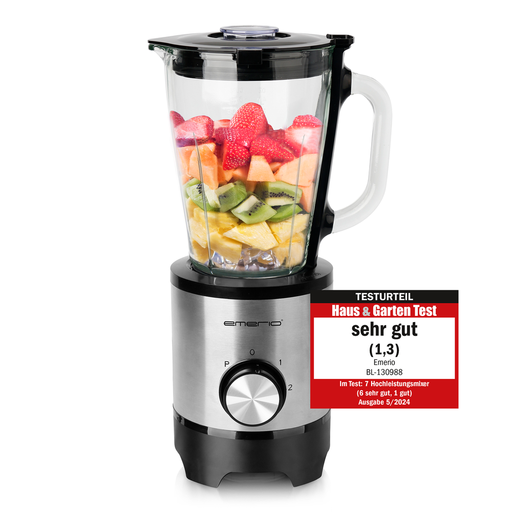 No image available
A jug blender for making smoothies when you need more than one personal cup.
The product description lists an ice-crushing function and dishwasher-safe parts. The glass jug is described as heavy and fragile, so handle it with care.
 No image available
The travel bottle gives you the option of taking a smoothie with you; the set also includes a mixing jug and chopper cup.
The product name lists 800 W, a smoothie programme and an ice-crushing function. Follow the model-specific instructions for ingredients and use.
 No image available
A jug blender for making smoothies when you want to prepare a larger quantity.
The product name lists three speeds and an ice-crushing function. The product description mentions a design that can be taken apart for cleaning.
 No image available
A compact blender for smoothies, if the stated 0.6-litre capacity suits your portion size.
The product name lists an ice-crushing function. The product description mentions removable, dishwasher-safe parts.
 No image available
A jug blender for making smoothies when you want to prepare several portions.
The product name lists a 1.9-litre jug and an ice-crushing function; the product description states a working capacity of 1 litre and mentions removable, dishwasher-safe parts.
No, don’t assume that from its portable design. Bosch lists recipes with frozen fruit for the MMB2111S, while nutribullet lists frozen fruit for the NBP003NBL. For the exact model, follow the manual, permitted quantities and any instructions about adding liquid.
Remove the cup from the base and check the manual to see which parts are dishwasher-safe. Consumentenbond advises drying loose parts thoroughly after washing; don’t immerse an electric motor base in water.
Chill perishable ingredients and the prepared drink promptly. Voedingscentrum recommends keeping your fridge at 4 °C and not leaving highly perishable food or drink out of the fridge for more than two hours. The 1–2-day storage advice applies specifically to the ‘smoothie, fruit’ category and doesn’t automatically apply to a shake containing dairy.
According to the Dutch government (Rijksoverheid), you’re entitled to a product that works properly and should contact the seller if there’s a fault. The Netherlands has no fixed statutory warranty period for all products; a manufacturer’s warranty is in addition to your statutory rights.
Applicable European safety requirements apply to electrical appliances placed on the market in the Netherlands. According to Ondernemersplein, if an appliance meets the requirements, the manufacturer must apply the CE mark and draw up an EU declaration of conformity; this doesn’t confirm that a specific model complies. The NVWA warning about certain batches of the KOENIC KSBL-TR456224 M concerns products bought before February 2026 and doesn’t apply to all smoothie makers.