
Making lunch for a group
If you want to pour pineapple smoothies at the table, compare the usable capacity of jug blenders. Philips and Tefal list a usable capacity separately from the larger maximum jug capacity for their models.


Choose a jug blender if you want to make several glasses at once; for a single serving, a personal blender with a blending cup may be more practical. Compare the usable capacity, not just the jug’s maximum capacity, and check the instructions for the specific model when blending ice or frozen fruit. These considerations do not confirm that any individual product meets all applicable safety requirements.
If you want to pour pineapple smoothies at the table, compare the usable capacity of jug blenders. Philips and Tefal list a usable capacity separately from the larger maximum jug capacity for their models.
If you add ice or frozen fruit, check whether the manufacturer specifies that use for the particular model, and which setting is intended for it. The motor power alone won’t tell you how it will handle your recipe.
A personal blender with a blending cup may suit you if you’re making one smoothie and don’t need a large jug. Its smaller capacity may mean blending in batches when you have several lunch guests.
First, decide how many glasses you want to make at a time and whether you’ll be adding ice. Also check how the parts are cleaned and which product information applies to the specific model.
| What to consider | What to look for | Who should prioritise it? |
|---|---|---|
| Servings per batch | Compare the usable capacity with the amount you want to make at once. Philips lists 1 l effective capacity and 1.9 l maximum capacity for the HR2041/00; Tefal lists 1.5 l usable capacity and a 2 l jug capacity for the BL871D31. | If I’m serving several lunch guests, I want to know how much smoothie I can make in one go. Around 33% of consumers put making enough servings per batch at the top of their list. |
| Ice or frozen fruit | Look up the instructions for the exact model and check whether ice crushing is explicitly mentioned. A feature label alone can’t predict how smooth your smoothie will be. | If I add ice, I want to know which settings and ingredients the model can handle. Around 27% of consumers give ice crushing and texture their highest priority. |
| One compact serving | Check the capacity of the cup included and how many servings you’ll actually make one after another. For the Original 600 NB603DG, nutribullet lists a 700 ml cup. | If I usually make one glass, I’d rather have a suitable blending cup than extra jug capacity. Around 20% of consumers prioritise making one compact serving. |
| Cleaning after use | Check which parts can be removed and which cleaning method the manufacturer recommends. A cleaning programme doesn’t automatically replace all manual cleaning. | After lunch, I want to know how much effort it takes to clean the cup, jug and blade. Around 20% of consumers name easy cleaning as their top buying priority. |
For the Philips HR2041/00 and Tefal BL871D31, the stated usable capacity is lower than the maximum jug capacity. When working out how many glasses of smoothie you can make for lunch, the usable capacity is the figure that matters.
Compare the effective or usable capacity with the amount you need to make per batch. A lower usable capacity may mean blending extra batches for your guests.
Consumentenbond describes differences between blenders when crushing ice; a higher wattage alone doesn’t show how a blender will perform with your pineapple and ice mixture.
Check the instructions for the exact model. Use comparative test results only for models and conditions that were actually included in the test.
A programme doesn’t necessarily clean every part for you. Instructions for the jug, cup, blade and seals can vary by model.
Before buying, check which parts can be removed, need to be cleaned by hand or are dishwasher-safe according to the manufacturer.
Some parts may still need to be cleaned by hand after the programme.
Additional commercial cover is separate from your statutory rights. ACM ConsuWijzer states that your statutory warranty applies even without an additional warranty product.
Compare any additional cover with what your statutory warranty already provides.
The HR2041/00 is a jug blender to consider if you want to compare effective capacity and controls.
The PerfectMix+ BL871D31 is a jug blender to consider if you’re making several servings and want an ice programme.
The PowerBlend 3 JB301AI-JB3150BK is a jug blender to consider if you want to compare glass jugs and adjustable controls.
The Original 600 NB603DG is a personal blender to consider if you usually make one serving and want to blend in a compact container.
This selection includes jug blenders for several servings and personal blenders for smaller amounts. For the specific model, check that it meets the applicable safety requirements and rules for food contact materials: the NVWA outlines the relevant CE requirements for electrical products, while the European Commission refers to Regulation (EC) No 1935/2004 for materials that come into contact with food.
 No image available
A jug blender to consider if you’re making smoothies for several people and want to crush ice. The product name lists 1.5 l, two speeds, a pulse function and Ice Crush.
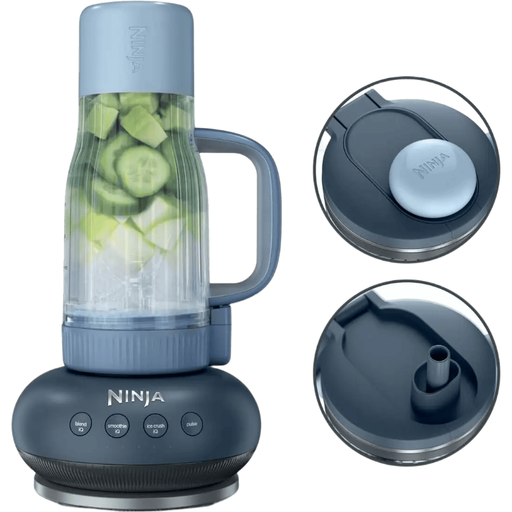 No image available
A personal blender to consider if you want to make smaller servings. The product name lists a 710 ml cup and ice crushing; check the instructions for the specific model for guidance on ingredients and cleaning.
 No image available
A jug blender to consider for lunch servings when you want to crush ice. Philips lists 1 l effective capacity, a maximum jug capacity of 1.9 l and ice crushing using the pulse setting; 1.9 l is therefore not the effective capacity.
 No image available
A jug blender to consider if you want to make several servings of smoothie. The product name lists 1.5 l and 1200 W; check the usable capacity and the instructions for blending ice for this specific model.
 No image available
A jug blender to consider if you’re making smoothies for lunch. Before buying, compare the usable capacity with the number of servings you want and check the instructions for ice or frozen ingredients for this exact model.
Not necessarily. Philips lists a maximum capacity of 1.9 l and an effective capacity of 1 l for the HR2041/00; Tefal lists a 2 l jug and 1.5 l usable capacity for the BL871D31. Compare the usable capacity with the number of glasses you want to make.
Follow the instructions for the exact model and part. For the NB603DG blade, nutribullet recommends using water and washing-up liquid, and says the cups can go on the top rack of the dishwasher; for the BL871D31, Tefal lists Auto-Clean, removable blades and a dishwasher-safe glass jug.
No, you don’t need an extended warranty to have statutory rights. ACM ConsuWijzer states that your statutory warranty applies alongside any commercial warranty; compare the terms of additional cover separately.
The NVWA explains that CE marking is compulsory for electrical products; the Low Voltage Directive applies to mains-powered products with a rated AC voltage of 50 V to 1000 V, subject to the stated exceptions. The European Commission says that materials that come into contact with food must comply with Regulation (EC) No 1935/2004. Check the information for the specific product; a product listing alone does not confirm that all applicable requirements have been met.
According to the ACM, online consumer purchases generally come with a statutory 14-day cooling-off period from delivery, subject to applicable exceptions. This is separate from your statutory rights if the product is faulty.