
For icy-cold shakes
If you’re using frozen pineapple or ice, check that the exact model can handle those ingredients. The Consumers’ Association warns that not every blender can process frozen fruit or ice cubes.


If you’re mainly making one shake and space is limited, choose a compact blender with a blending and drinking cup; a jug blender is a better fit for making several glasses. If you’re using frozen pineapple or ice, check that the exact model is suitable for them. A rechargeable blender can be useful if there’s no socket near your preparation area, but you’ll need to charge it in advance and its cup capacity is limited.
If you’re using frozen pineapple or ice, check that the exact model can handle those ingredients. The Consumers’ Association warns that not every blender can process frozen fruit or ice cubes.
If you’re making one serving in a small holiday kitchen, a blending and drinking cup can be handy: you make the shake in the cup and have fewer separate parts to take with you.
When making several glasses, the jug’s usable capacity matters more than its total capacity as stated on the packaging. Compare the usable capacity with the amount you want to make each time.
Start with the ingredients: if you’re using frozen fruit or ice, check that the exact model is suitable. Then choose a cup capacity to suit the number of servings, and consider the power supply and cleaning requirements.
| What to consider | What to look for | Who it matters most to |
|---|---|---|
| Frozen pineapple and ice | Check whether the exact model can handle frozen fruit or ice, and whether there’s a limit on the quantity. Wattage alone doesn’t tell you whether the appliance is suitable. | If I want to make my shake with frozen pineapple or ice, I want to know in advance whether that’s within the appliance’s intended use. Around 33% of consumers prioritise processing frozen fruit or ice. |
| One serving in a small kitchen | Check the cup capacity, whether a lid is included and whether the appliance needs to be plugged into a socket. | If I’m making one shake and have little worktop space, I don’t want a large jug or lots of unnecessary loose parts. Around 25% of consumers prioritise one compact serving. |
| Several glasses | Compare the usable capacity with the amount of shake you need to make each time. | If I’m making shakes for several people, I want to know how much will actually fit in the jug at once. Around 25% of consumers prioritise making several glasses per batch. |
| Cleaning | Check whether each part is removable and dishwasher-safe; follow the model’s instructions. | If I want to spend less time washing up during my stay, I look for parts that are easy to clean. Around 17% of consumers put easy cleaning top of their list. |
Wattage alone doesn’t tell you whether a blender can process ice or frozen fruit. The Consumers’ Association points out that this varies from one blender to another.
Check which ingredients the exact model can handle and whether there are any quantity limits.
According to Philips, the Philips HR2041/00 has an effective capacity of 1 l and a maximum capacity of 1,9 l. Tefal lists a usable capacity of 1,25 l for the BL5958F0, with a total capacity of 1,9 l.
Plan the amount for each batch based on the stated usable capacity.
According to the manufacturer, the nutribullet Portable NBP003NBL has a 475 ml cup and needs to be charged. Crushing ice is only specified for a small quantity.
Choose a serving size that fits the cup and check that you’ll be able to charge the blender before you leave.
The models reviewed range from a compact blending and drinking cup to a jug blender for larger batches.
The VitaPower Serie 2 MMB2111S model reviewed is a compact blender with a 0,6 l blending cup.
The Portable NBP003NBL model reviewed is a rechargeable blender for use away from a socket.
The Blendforce 3 BL5958F0 model reviewed is a jug blender for making several servings.
These Joybuy products include jug blenders and models with a travel cup, to suit different serving sizes. Before buying, check that the information for the specific item on offer covers the applicable CE marking and requirements for materials that come into contact with food.
 No image available
The 1,5 l jug capacity is suited to making several glasses; the product information also states that it can crush ice.
1300 W, 1,5 l jug, two speeds and pulse function.
 No image available
The 1,5 l jug is suited to making several servings; the product information mentions smoothies and shakes, as well as a pulse function for crushing ice.
1,5 l jug and two speeds. The product information states that it must be connected to an earthed socket.
 No image available
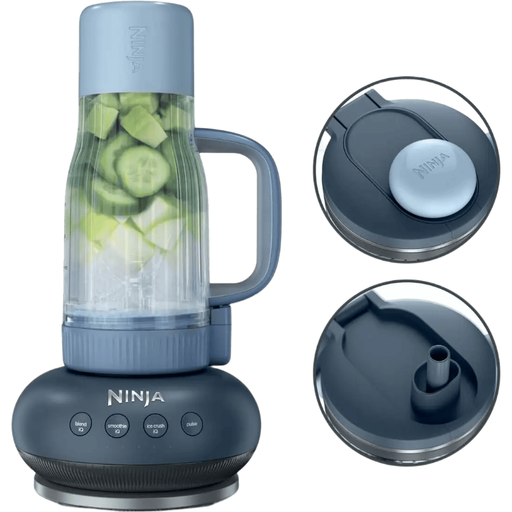
The product information describes a travel cup for blending and drinking from, and states that it can crush ice and blend frozen ingredients.
710 ml travel cup, three automatic programmes and removable dishwasher-safe parts, according to the product information.
 No image available
The product title lists both a travel bottle for one serving and a larger blending jug, and mentions ice crushing.
600 ml travel bottle, 1500 ml blending jug and 300 ml chopper cup. The product information recommends adding at least 300 ml of liquid.
 No image available
The 1,5 l jug capacity is suited to making several servings; the product title states that it can crush ice for shakes.
1,5 l jug and three speeds. The product information specifies a minimum of 300 ml of liquid and recommends resting the blender for two minutes after blending for a maximum of one minute.
No, not every blender can process frozen fruit or ice cubes. The Consumers’ Association therefore recommends checking the specifications and instructions for the exact model. For example, the manufacturer only specifies a small quantity of ice for the nutribullet Portable NBP003NBL.
Check the instructions for each part to see whether it’s removable and dishwasher-safe. Philips lists dishwasher-safe parts for the HR2670/01; Tefal lists removable blades and a dishwasher-safe jug for the BL5958F0.
Electrical appliances sold on the EU market must carry the applicable CE marking, as explained by the Dutch government. The Netherlands Food and Consumer Product Safety Authority states that materials that come into contact with food must meet the applicable requirements. Check the information for the specific item on offer.
No. ACM ConsuWijzer explains that your statutory guarantee depends on what you could reasonably expect from the product under normal use, and exists alongside any seller’s or manufacturer’s warranty. If a product is faulty, the seller is responsible for providing an appropriate solution.
For a standard online consumer purchase, you generally have a statutory 14-day cooling-off period from the date of delivery. Check the applicable exceptions and the conditions for trying out and returning the product.