
Soup maker with full cupboards
You make soup in a saucepan and want to use as little storage space as possible for your appliance. Compare a standalone stick blender with sets that also come with extra accessories you’ll need to store.


If you make roasted pepper soup in a saucepan and want to save cupboard space, start with a simple stick blender: you can blend the soup in the pan without needing a separate blender jug. A compact blender is best if your portion fits in the cup and the manual says it can process soup at the temperature you need. A larger jug blender or soup maker takes up more storage space, so choose one only if its extra capacity or cooking function is worth the extra decanting and cleaning for you.
You make soup in a saucepan and want to use as little storage space as possible for your appliance. Compare a standalone stick blender with sets that also come with extra accessories you’ll need to store.
You’d like to use a separate, compact cup. Check that the portion size and permitted processing temperature suit the exact model.
You use a blender for more than just soup and want to decide whether a larger jug or soup-making programme is worth the extra cupboard space.
First, decide what matters most for the way you make soup: storage space, temperature, portion size or cleaning. The main difference between appliance types is how you process the soup and which parts you’ll need to store afterwards.
Best for: blending soup in the pan and storing as few separate parts as possible.
Trade-off: you hold the appliance while blending; an accessory set takes up extra cupboard space.
Best for: small portions in a separate cup, such as the 400 and 700 ml bottles Tefal lists for the BL19H4.
Trade-off: you’ll need to transfer the soup and store the cups as well as the appliance; check the instructions for hot ingredients.
Best for: anyone who also makes other blended recipes and has room for a jug.
Trade-off: you’ll need to transfer the soup and check the permitted temperature for the exact model and jug.
Best for: anyone who wants to prepare soup in the same appliance and has room for it.
Trade-off: the extra heating function is most useful if you’ll use it; also check whether the model is new or refurbished.
| What to consider | What should you look for? | Who should pay extra attention? |
|---|---|---|
| Storage space | Measure the appliance and any included parts. Bosch lists dimensions of 393 × 55 × 62 mm for the MSM66110. | If I blend in a saucepan I already own, I want the appliance and its parts to fit in my cupboard. Around 36% of consumers prioritise storage space and blending in the pan. |
| Blending hot soup | Check the temperature instructions for the exact appliance and the jug or blending attachment you’ll use; guidance for other models doesn’t automatically apply. | I want to blend hot pepper soup without exceeding my appliance’s instructions. Around 29% of consumers give blending hot soup top priority. |
| Portion size and texture | Compare your usual quantity with the effective capacity. Philips lists an effective capacity of 1 l and a maximum capacity of 1,9 l for the HR2041/00. | If I want to blend all my soup at once, the usable capacity needs to suit my portion. Around 21% of consumers focus mainly on portion size and desired texture. |
| Cleaning and parts | Read which parts can be removed and how each part can be cleaned; Bosch lists a removable blending foot for the MSM66110. | I want to clean or store as few extra parts as possible after cooking. Around 14% of consumers prioritise cleaning and the parts included. |
The Philips HR2041/00 has a listed maximum capacity of 1,9 l, while its effective capacity is 1 l. This difference could mean you can’t blend as much soup at once as you expect.
Compare your usual portion with the effective capacity and filling instructions for the exact model.
A smaller usable capacity may mean blending the soup in several batches.
Tefal lists cold soup as suitable for the Blend Up BL19H4. Instructions for other models don’t confirm that this version can process hot soup.
Check the temperature instructions for the exact appliance and cup before transferring hot soup.
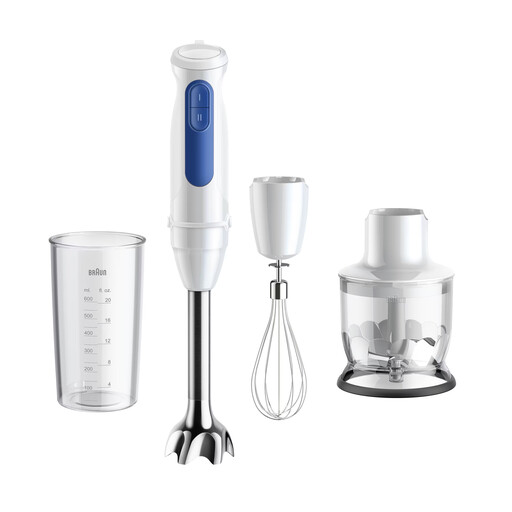
A chopper or whisk adds more functions, but you don’t necessarily need one to blend soup in the pan. Extra parts also take up storage space and need cleaning.
Compare everything included in the box and choose only the accessories you’ll actually use.
According to ACM ConsuWijzer, your statutory guarantee is separate from any manufacturer’s or retailer’s guarantee.
Consider what extra cover offers, and contact the retailer if a product is faulty.
The MSM66110 is an example of a stick blender with a removable foot for blending in a saucepan.
Philips offers both a jug blender and a soup maker among the models mentioned; they suit different preparation and storage needs.
The Blend Up BL19H4 is a compact blender with separate bottles for smaller blends.
The MultiQuick range includes stick blenders with different accessories; check which parts are included with each model.
The Joybuy products below are stick blenders for blending in a saucepan you already own. For hot soup, check the instructions and usage restrictions for the exact version.
 No image available
The product information recommends this hand blender for thick soups.
The description lists two stainless steel blades, a splash guard, removable parts, 20 speeds and a turbo setting.
 No image available
The removable blending foot is designed for liquids and soups.
Power: 900 W; two speeds. Follow the usage restriction of no more than one minute of continuous use, and allow the appliance to cool between uses.
 No image available
This hand blender is designed for mixing and blending, including thicker mixtures.
The product information lists 25 speeds, a turbo function and PowerBell VPlus. Do not process boiling liquids.
 No image available
The stainless steel blending foot is designed for blending soup.
The set includes a 500 ml chopper and a 700 ml measuring cup. For hot ingredients, the product information specifies a heat-resistant cup and small portions; check the manual for your soup.
 No image available
This stick blender is designed for soups and sauces; the set also includes separate accessories to store.
The product information lists stepless speed control, a 700 ml measuring cup and a 500 ml chopper. The instructions limit continuous use to one minute, followed by a one-minute rest.
Follow the instructions for the exact model and jug you’re using. For models HR2512/90, HR2511/90 and HR2510/90, Philips advises letting liquids cool to below 60 °C first; this limit doesn’t automatically apply to the HR2041/00 or a Tefal cup. Check the relevant manual before transferring the soup.
Tefal lists the bottles and removable blades for the Blend Up BL19H4 as dishwasher-safe. Check the manual before putting any other parts in the dishwasher.
The Netherlands Nutrition Centre advises cooling leftovers quickly, storing them in a sealed container in the fridge or freezer, and not leaving them out of the fridge for more than two hours. For thick soup containing meat and vegetables, the centre recommends keeping it in the fridge for two days; check the relevant storage advice for your recipe.
No, you don’t need an extended guarantee to have statutory rights. ACM ConsuWijzer explains that your statutory guarantee is separate from any manufacturer’s or retailer’s guarantee. Compare any extra cover with the rights you already have.
The Netherlands Food and Consumer Product Safety Authority states that CE marking is compulsory for electrical consumer products covered by the relevant rules. This general requirement doesn’t prove that an individual product for sale meets the rules; check the markings on the appliance itself.