
Single-serving lassi maker
You mostly make one glass with peach and yoghurt, and want the cup and appliance to take up very little space. The Consumentenbond describes personal smoothie blenders as appliances with a small blending cup.


If you usually make one serving with soft peach, yoghurt and milk, a compact smoothie blender is a good fit if you want to blend directly in a cup. A hand blender is an alternative if saving storage space matters more to you than having a sealed blending cup. A jug blender is worth considering if you often make several servings at once and have room for the jug and extra washing-up. If you use ice or frozen fruit, check the instructions for the exact model: general blender advice doesn’t prove how well a specific model will make peach lassi.
You mostly make one glass with peach and yoghurt, and want the cup and appliance to take up very little space. The Consumentenbond describes personal smoothie blenders as appliances with a small blending cup.
You want to tidy up quickly after blending, so you compare the removable parts and their cleaning instructions. The Consumentenbond notes that a blender often creates more washing-up than a hand blender.
You use ice or frozen fruit, so you check what the chosen appliance can handle according to its manual. The Consumentenbond assesses ice-crushing separately from smoothie-making.
| What to consider | What should you check? | Who is this important for? |
|---|---|---|
| One serving and limited space | Measure the space available and compare the cup capacity with your portion size. Check the fill line too: a small cup could mean blending twice. | If I usually make one glass and want to store the appliance in a small cupboard or on a limited worktop, I look at its size and usable capacity. Around 40% of consumers prioritise compact storage and a suitable single-serving size. |
| Cleaning | Check the cleaning instructions for each part. A dishwasher-safe cup doesn’t automatically mean the blade is dishwasher-safe too. | If I want to tidy up quickly after making peach and yoghurt, I want to know in advance how to clean the cup and blade. Around 30% of consumers put ease of cleaning above their other buying concerns. |
| Ice or frozen peach | Check whether the specific model is suitable for these ingredients and follow the guidance on quantities and liquid. Wattage alone doesn’t tell you how well an appliance will perform. | If I make my lassi cold with ice or frozen fruit, I check the model’s instructions first. Around 20% of consumers make processing ice or frozen fruit their main consideration. |
| Several glasses | Compare the quantity you need with the maximum permitted fill level. A larger jug could mean fewer blending rounds, but it takes up space and may create more washing-up. | If I often make several glasses at once, I want enough capacity without taking up unnecessary space in the kitchen. Around 10% of consumers prioritise making several servings in one batch. |
The Consumentenbond assesses smoothie performance, ice-crushing and ease of use separately. The stated power rating therefore doesn’t, on its own, tell you what results you’ll get with peach lassi.
Start by considering your ingredients and portion size, then check the instructions and performance information for the exact model.
A stated capacity, such as 300 ml or 700 ml, doesn’t automatically tell you how much you can add when blending.
Before buying, check the fill line and the manual for the cup you’ve chosen.
If the cup is smaller than the total quantity you need, you may have to blend in several batches.
Cleaning also depends on the number of removable parts and the instructions for each one; the Consumentenbond notes that blenders often create more washing-up than hand blenders.
Compare the complete set and its cleaning instructions, not just the size of the motor base.
The Blend & Go HR2670/00 is a compact blender with a travel cup.
The Original 600 NB603DG is a personal blender with a manufacturer-stated cup capacity of 700 ml.
The VitaPower Serie 2 MMB2111S is a slim mini blender with a mixing cup that Bosch states has a capacity of 0,6 l.
The MultiQuick 5 range offers a hand blender as an alternative to a jug blender.
The Lightmix BL1C0430 is a portable blender with a manufacturer-stated cup capacity of 300 ml.
This selection includes hand blenders and compact blenders for small servings. Check that the cup and ingredients suit your recipe for each model.
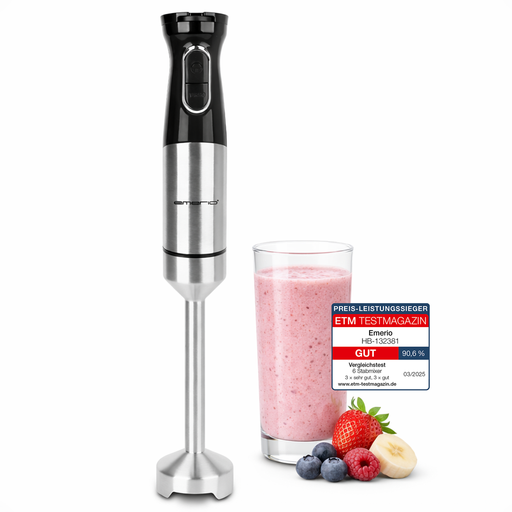 No image available
A hand blender to consider if you want to blend soft peach with dairy and have limited storage space.
1000 W and variable speed. Use a suitable mixing beaker.
 No image available
A compact blender to consider if you make a small serving and want to be able to clean the removable parts.
0,6 l, 350 W, two speeds and a pulse function. The product title mentions ice-crushing; check the model-specific instructions before using ice.
 No image available
A jug blender to consider if you want to make a small quantity and remove the parts for cleaning.
250 W and a 500 ml glass jug. The description states that the removable parts are dishwasher-safe.
 No image available
A portable blender to consider if you want to make one smoothie serving and take the cup with you.
475 ml, rechargeable battery and USB-C charging. The description warns against blending hot or carbonated liquids.
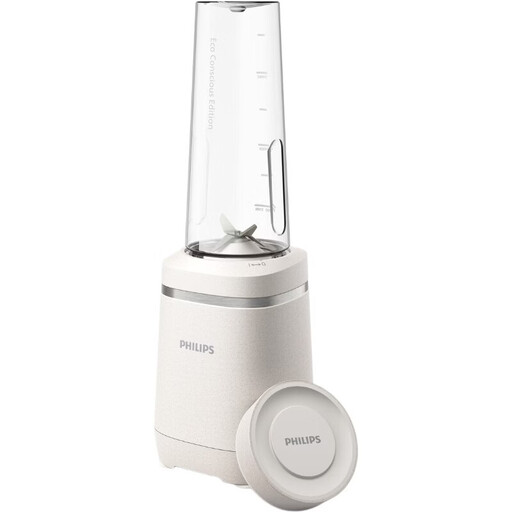 No image available
A compact blender to compare if you make a small serving and want to be able to process ice in line with the model-specific instructions.
0,6 l and 350 W. The description mentions an ice function and dishwasher-safe removable parts.
No, not if you’re using soft peach, yoghurt and milk without ice or frozen fruit. If you do add ice, check the instructions for the exact model; a recipe that includes ice doesn’t mean every blender is suitable for it.
It depends on the model and the individual parts. Nutribullet advises rinsing the blade for the NB603DG with water and washing-up liquid, and placing the cup on the top rack of the dishwasher. For other models, check their own manuals.
Put a drink made with chilled dairy ingredients back in the fridge promptly. The Voedingscentrum recommends a fridge temperature of 4 °C and lists milk as a product that must be kept chilled; this doesn’t specify how long homemade peach lassi will keep.
For distance purchases, the cooling-off period is usually 14 days according to the Rijksoverheid; check the applicable terms and exceptions. ACM ConsuWijzer states that if a product breaks sooner than you could reasonably expect under normal use, the seller must put it right free of charge.