
Families who want to make one batch for breakfast
Want to pour melon smoothies for several people at once, so usable jug capacity is a priority.


For fresh melon smoothies for the family, a standard blender will do: according to the Consumentenbond, standard blenders can make smoothies. Choose a usable jug capacity that suits the number of glasses you want to pour, and check how the jug and blades can be cleaned. An ice programme or extra capacity is only worth prioritising if you’re actually going to use those features.
Want to pour melon smoothies for several people at once, so usable jug capacity is a priority.
Make breakfast regularly and want to know how to clean the jug and blades after use.
Regularly use ice or frozen fruit and check whether the specific model is suitable, rather than relying on its wattage alone.
Start with the quantity you want to make in each blend; then consider whether easy cleaning, frozen ingredients or compact storage matters most to you.
| What to consider | What to check before buying | Who is this important for? |
|---|---|---|
| Capacity for one batch | Compare the amount you want to pour with the usable capacity, not just the stated jug capacity. Tefal lists a 2-litre jug capacity and a usable capacity of 1.5 litres for the BL871D. | I want to pour a drink for everyone at breakfast without having to blend another batch. Around 36% of consumers prioritise making one batch for the whole family. |
| Cleaning | Check which parts can be removed and put in the dishwasher for each model. Bosch lists dishwasher-safe parts for the MMB6141B, but also says that the blade cannot be removed; Tefal lists removable blades and a dishwasher-safe glass jug for the BL871D. | If I use the blender often, I want to know how many parts I’ll need to wash by hand after breakfast. Around 29% of consumers prioritise quick cleaning. |
| Ice or frozen fruit | Check whether the manufacturer says the specific model is suitable for your ingredients. Wattage alone doesn’t guarantee a smooth result; the Consumentenbond assesses smoothies separately from other blending tasks. | I regularly add ice or frozen fruit and want to know whether the appliance is designed for it. Around 21% of consumers prioritise frozen ingredients. |
| Compact storage | Compare the capacity of the cups, how many cups are included and whether there’s a family-sized jug. nutribullet’s Dutch product information lists 900 and 700 ml cups alongside a jug for the SmartSense 1500 Combo. | I have limited storage space and would rather make several small portions if needed than store a large jug. Around 14% of consumers prioritise compact storage. |
According to Tefal, the Tefal BL871D jug has a stated capacity of 2 litres but a usable capacity of 1.5 litres. If you only go by the larger figure, you may still need to blend an extra batch for a family breakfast.
Compare the usable capacity with the total amount you want to pour.
The Consumentenbond says that power isn’t everything and treats making smoothies as a separate blending task. A higher wattage on its own doesn’t tell you how well a model will handle your ingredients.
Start by considering whether you’ll blend fresh melon or ice and frozen fruit, then check for a relevant smoothie test or a suitable feature for the specific model.
A personal blender is designed for blending in a smaller cup. For several people, that could mean blending and cleaning in multiple rounds.
Choose based on the volume you need per blend, or compare a model that comes with both a jug and individual cups.
The VitaPower Serie 4 MMB6141B is an example of a blender with a family-sized jug.
The PerfectMix+ BL871D is worth comparing if you’re looking for a family-sized jug, smoothie programme and ice programme.
According to nutribullet, the SmartSense 1500 Combo combines a blending jug with separate travel cups.
This selection focuses on blenders with a jug for making smoothies for several people; some models also have an ice function. Compare the stated capacity of each model and check which features and cleaning instructions suit the way you’ll use it.
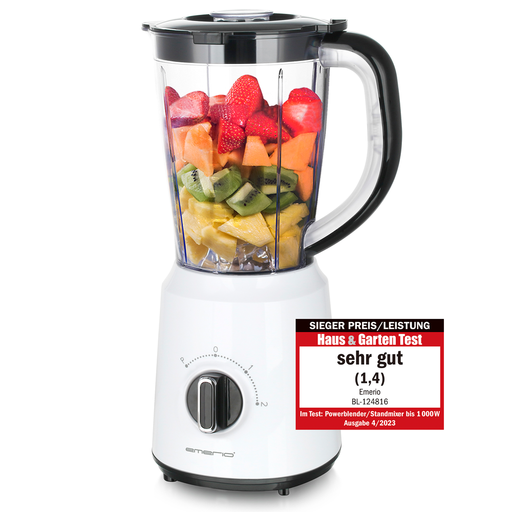 No image available
The stated 1.5-litre jug capacity and multiple portions make it a good fit if you want to make smoothies for the family in one go.
Two speeds and a pulse function. The removable parts are listed as dishwasher-safe.
 No image available
The stated 1.5-litre jug capacity is designed for smoothies and fruit and vegetable blends.
The product information lists three speeds and an ice-crushing function. Its 600 W power rating alone doesn’t determine the blending result; according to the description, the parts can be taken apart for cleaning.
 No image available
The usable capacity of 1.5 litres suits anyone looking to make a family-sized batch, as long as that amount matches how much you want to pour.
The stated jug capacity is 2 litres, with a usable capacity of 1.5 litres. The product description lists an ice programme, Auto-Clean, removable blades and a dishwasher-safe jug.
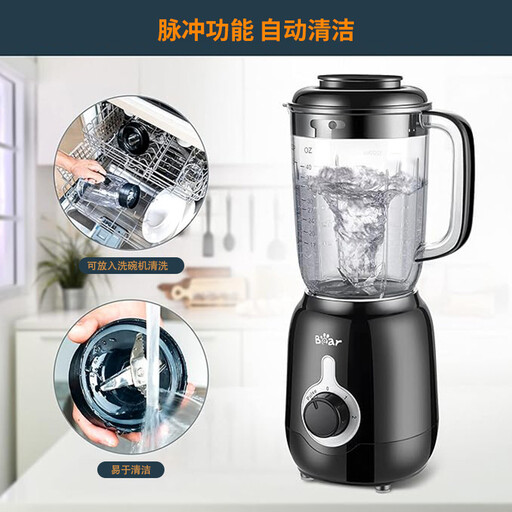 No image available
The stated 1.2-litre jug capacity is an option to compare if you’re looking for a blender that can make larger quantities of smoothie.
Two speeds, a pulse function and four stainless steel blades. The product description lists a self-cleaning function using warm water and washing-up liquid.
 No image available
The stated working capacity of 1.5 litres and family-sized batch are a good fit if you want to prepare several portions at once.
1000 W, three speeds and a pulse function. The product description lists removable blades and removable dishwasher-safe parts. According to the instructions, cut large ingredients into pieces of around 2 × 2 × 2 cm beforehand.
No, 1200 W isn’t a general requirement for a fresh melon smoothie: according to the Consumentenbond, a standard blender can make smoothies. A more powerful model may be useful for tougher jobs such as crushing ice, but wattage alone doesn’t determine the result.
The Voedingscentrum advises washing the melon under running water before cutting it. Store cut melon covered in the fridge; the Voedingscentrum recommends keeping it for up to two days.
The Voedingscentrum says a fruit smoothie can be kept in the fridge for 1–2 days. Check the advice for other ingredients separately: this storage time applies to fruit smoothies and doesn’t automatically apply to smoothies containing dairy.
No, your statutory guarantee applies alongside any manufacturer’s or seller’s guarantee. ACM ConsuWijzer explains that the seller is responsible for providing an appropriate solution if a product breaks during normal use sooner than you could reasonably expect. There is no fixed statutory lifespan of two years for every blender.
The Netherlands Food and Consumer Product Safety Authority says that CE marking is mandatory for electrical products covered by the Dutch Electrical Equipment Decree. The applicable directive depends, among other things, on the appliance’s rated voltage. CE is a declaration by the manufacturer, not an independent quality mark for performance.