
Iced coffee drinker who blends in ice
You want to blend ice cubes into your latte. The Consumentenbond points out that not every blender can crush ice, so check the feature for the exact model.


If you want to blend ice cubes into your iced latte, choose a model whose manufacturer confirms this feature for that exact version; wattage alone doesn’t tell you. A rechargeable blender is handy if there’s no socket where you plan to use it, but it has a smaller cup. A jug blender is more practical for making several drinks, but needs mains power and more space. Also check the instructions and make sure the electric blender you’re buying has the required CE marking.
You want to blend ice cubes into your latte. The Consumentenbond points out that not every blender can crush ice, so check the feature for the exact model.
You usually make one drink and want to blend without mains power where you’re using the blender. Check the power source, cup capacity and how the blender is charged.
You want to make more than one serving at a time. Compare the jug’s usable capacity, and consider how much worktop space you have and how easy it is to clean.
Choose this if: you want to make one drink without a socket where you’re blending.
Bear in mind: you’ll need to charge it, and it makes a smaller serving. For the nutribullet Portable NBP003NBL, the manufacturer says it can crush a small amount of ice.
Choose this if: there’s a socket available and you mainly make one serving.
Bear in mind: Bosch lists frozen fruit and hard ingredients for the MMB2111S, but the specification consulted doesn’t separately confirm that it can crush loose ice cubes.
Choose this if: you want to make several drinks or need a clearly stated ice-crushing function.
Bear in mind: it takes up more space and needs more cleaning. Philips gives the HR2041/00 a usable capacity of 1 l, compared with its nominal jug capacity of 1.9 l.
| Concern | What to check before buying | Who is this important to? |
|---|---|---|
| Crushing ice cubes | Check whether the manufacturer specifies an ice-crushing function for the exact model, and follow the instructions and any limits on the amount of ice. The Consumentenbond warns that not every blender can crush ice cubes. | If I want to blend ice cubes into my latte, I want the exact version I choose to be explicitly listed as suitable for ice. Around 42% of consumers put this feature first. |
| Blending without a socket | Check the power source, cup capacity and charging or operating instructions for the exact version. According to the manufacturer, the nutribullet Portable NBP003NBL charges via USB-C and has a 475 ml cup. | If there’s no convenient socket and I’m making one drink, being able to blend freely is important. Around 33% of consumers give cordless use top priority. |
| Several drinks and cleaning | Compare the usable capacity with the nominal jug capacity, and check which parts are dishwasher-safe. Philips gives the HR2041/00 a usable capacity of 1 l; Bosch says that parts of the MMB2111S are dishwasher-safe. | If I want to make several drinks for a group, I look at the usable capacity and how much there is to clean afterwards. Around 25% of consumers prioritise making several servings at once. |
A high wattage on its own doesn’t confirm that a blender can crush ice cubes. The Consumentenbond warns that this isn’t the case for every blender.
Check whether ice crushing is listed for the exact model, and follow the relevant instructions and limits on the amount of ice.
The Philips HR2041/00 has a nominal capacity of 1.9 l, while Philips lists its effective capacity as 1 l. This difference matters if you want to make several drinks.
Compare the usable capacity of the specific jug with the number of servings you want to make.
A rechargeable blender needs to be charged sufficiently in advance. So, being portable doesn’t mean you can blend without any preparation.
Take the right charging cable with you and check the charge before using the blender away from a socket.
The nutribullet Portable NBP003NBL is a rechargeable personal blender with a travel cup.
The 3000 Series HR2041/00 is a mains-powered jug blender for anyone who wants to make more drinks at a time.
The VitaPower MMB2111S is a compact blender with a single-serving cup, designed to be used with a socket.
According to its Dutch range information, Tefal offers everything from compact to-go models to larger jug and high-speed blenders.
This selection includes mains-powered jug blenders, compact single-serving blenders and a rechargeable personal blender, to suit different ways of making an iced latte.
 No image available
A mains-powered jug blender for making several drinks at a time.
The product name lists a 1.5 l jug, ice crushing, 2 speeds and 4 Black Titanium blades.
 No image available
A jug blender for anyone who wants to crush ice and make more than one serving.
The product name lists 3 speeds and ice crushing.
 No image available
A compact mains-powered blender for making one serving, with an explicitly stated ice-crushing function.
The product name lists a capacity of 0.6 l, 350 W and ice crushing.
 No image available
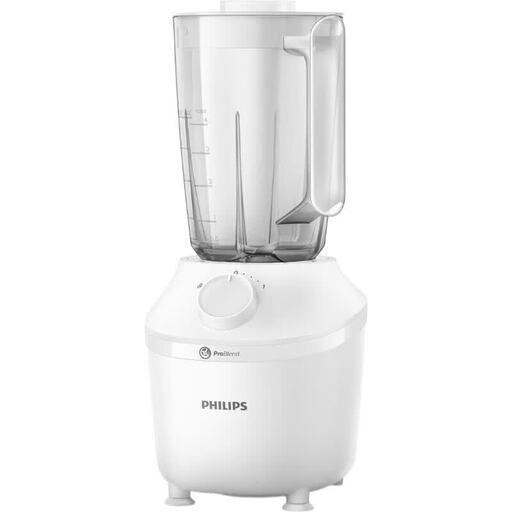
A jug blender for making several drinks, with an ice-crushing function listed by Philips.
Philips lists 450 W, a nominal capacity of 1.9 l, a usable capacity of 1 l and ice crushing using the pulse setting.
 No image available
A rechargeable personal blender for making a drink without mains power where you’re blending.
The product name lists a 475 ml cup and USB-C charging. Check the instructions for this version to see whether ice cubes are allowed.
No. The Consumentenbond warns that not every blender can crush ice cubes. Check the ice-crushing function and instructions for the exact model. For example, nutribullet says the Portable NBP003NBL can only crush a small amount of ice.
Check how many parts you’ll need to wash by hand and how easy they are to reach. Bosch lists dishwasher-safe parts for the MMB2111S, but that’s only useful if there’s actually a dishwasher available.
No. According to the Rijksoverheid, the seller must provide a solution if a product is faulty; a manufacturer’s guarantee is in addition to your statutory rights. In the Netherlands, there’s no fixed statutory guarantee period that applies to all products.
Yes. The Nederlandse Voedsel- en Warenautoriteit states that CE marking is required for electrical products, including electrical kitchen appliances. Also check that the specific version you’re considering carries the marking.
The Voedingscentrum recommends setting your fridge to 4 °C and putting food and drinks back in the fridge promptly after use. Also follow the storage instructions on the milk packaging; this isn’t a specific shelf-life recommendation for a prepared latte.