
Iced latte drinker who blends in the ice
You want a cold, blended drink, so you’re looking for a compact model with an ice function confirmed for the exact version. The Consumers’ Association warns that not every blender can crush ice cubes.


If you want to blend ice cubes into your drink, check that the ice function is confirmed for the exact model code. If you add the ice afterwards, the cup size, cleaning and storage are more important. With a drinking cup, you won’t need to pour your latte into another container; with a jug blender, you will. Also check the manual and the CE marking on the specific product listing: the NVWA states that CE marking is compulsory for electric blenders placed on the market in the Netherlands.
You want a cold, blended drink, so you’re looking for a compact model with an ice function confirmed for the exact version. The Consumers’ Association warns that not every blender can crush ice cubes.
You want to make a single serving and put the appliance away easily after use. That means considering its size and where you’ll store the appliance and its separate parts. The Consumers’ Association describes a small blending cup as a feature of smoothie blenders and portable blenders.
You want to blend straight into a drinking cup and check which cup and lid are included, as well as how easy it is to wash. The Consumers’ Association explains that you can make a smoothie in a small blending cup and drink from it or take it with you.
For a single iced latte in a small kitchen, the first question is whether you’ll actually blend in the ice. The Consumers’ Association notes that not every blender can crush ice cubes; wattage alone won’t tell you whether a model is suitable.
| What to consider | What should you check? | Who is this most important for? |
|---|---|---|
| Blending ice | Check the ice-related product information and usage instructions for the exact model code. | If I want to blend ice cubes with coffee and milk, I need to know whether the chosen model can handle it according to the instructions. Around 36% of consumers in this buying context prioritise ice processing. |
| Space required | Compare the external dimensions, the capacity of the jug or cup, and the space needed for separate parts. | In a small kitchen, I want to be able to find a permanent place for the appliance and its parts after use. Around 29% of consumers prioritise storage space. |
| Cleaning | Check whether each part can be removed and whether the manufacturer says it is dishwasher-safe. | If I often use the blender for a single drink, I want to know how many parts I’ll need to clean afterwards. Around 21% of consumers prioritise easy washing. |
| Taking it with you | Check which cup and compatible, sealable lid are included with the exact version. | If I want to take my latte with me, I don’t want to assume that a drinking ring or blending cup will seal securely. Around 14% of consumers start by considering whether they can take the drink with them. |
Not every blender can crush ice. The Consumers’ Association also notes that power alone doesn’t show how well a blender performs different tasks.
Look for information about ice processing and follow the instructions for the exact model code.
Nutribullet warns that hot ingredients can build up pressure in a sealed blending cup.
Let the coffee cool and follow the temperature and usage limits in the manual for your chosen model.
For the Nutribullet NB904CP, the accessories list includes a drinking ring but no sealable travel lid. So don’t assume that the cup is sealed securely just because it has a drinking ring.
If you want to take your latte with you, check what’s included with the exact version.
You may need to buy a separate compatible lid for taking it with you; check before relying on the cup.
The HR2510/90 is a compact mini jug blender for home use and easy storage.
According to Nutribullet, the personal blender NB904CP blends in a 700 ml cup.
The Blend Up BL19H4F0 is designed for blending in the included 400 ml and 700 ml bottles.
The PowerBlend 1 JB1000WH is a compact jug blender for anyone who pours their drink at home.
These compact models are suited to making a single serving of iced latte. For your chosen model, check whether it can be used to process ice, which cup and lid are included, and whether the specific product listing has the required CE marking. The NVWA states that CE marking is compulsory for electric blenders placed on the market in the Netherlands.
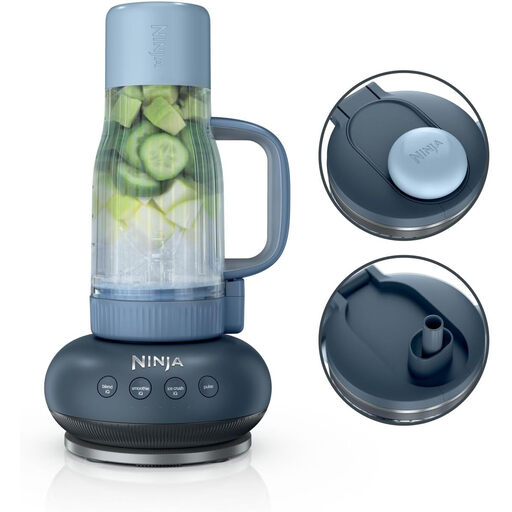 No image available
The product information mentions ice crushing and blending in the included cup.
The description lists a 710 ml cup with a leakproof lid, three automatic programmes and removable dishwasher-safe parts.
 No image available
The compact design and 0,6 l capacity make it a good fit for smaller preparations.
The product name mentions ice crushing and 350 W; check the manual for the exact version before blending in ice.
 No image available
The product title lists a 500 ml glass jug; the description says the blender can crush ice.
If you want to take your drink with you, check which cup and lid are included with the exact version.
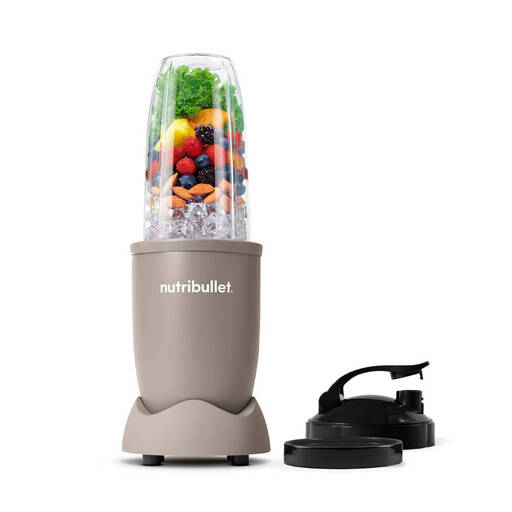 No image available
The product information mentions ice processing and a cup with a to-go lid for taking a serving with you.
Don’t blend hot liquids in the sealed cup: Nutribullet warns that pressure can build up.
 No image available
The description lists a 475 ml cup for individual drinks and a rechargeable battery.
The product name mentions USB-C charging and a 20-minute runtime. Check the manual before choosing this model for blending ice.
Not in a sealed Nutribullet blending cup: Nutribullet warns that hot ingredients can build up pressure. Let the coffee cool and consult the manual for any other model.
No. Check the function and usage instructions for the exact model code before blending in ice. The Consumers’ Association warns that not every blender can crush ice cubes.
It varies by model and part. Philips lists dishwasher-safe parts for the HR2510/90, and Tefal lists dishwasher-safe bottles for the BL19H4F0. Follow the separate instructions for the blades and motor base.
Yes. The NVWA states that CE marking is compulsory for electric blenders placed on the market in the Netherlands. Check the marking on the specific product; the general requirement doesn’t in itself mean that every item offered complies with it.