
Anyone making frappés with whole ice cubes
Check whether the exact model can process ice cubes, and follow the instructions on how much liquid to add. The Consumentenbond notes that not every blender can crush ice cubes.


Choose a blender to suit your recipe and serving size. If you’re using whole ice cubes, check that the exact model can handle them according to its instructions, then choose between a compact cup and a jug. The Consumentenbond points out that not every blender can crush ice cubes. Wattage alone won’t tell you how well it does so, and a larger jug or ice programme won’t automatically guarantee the frappé texture you want.
Check whether the exact model can process ice cubes, and follow the instructions on how much liquid to add. The Consumentenbond notes that not every blender can crush ice cubes.
A compact drinking cup could be a good fit if you usually make one frappé and want to drink straight from the same cup. The Consumentenbond describes small blending cups as an option for making a smoothie to drink straight away or take with you.
Compare the jug’s usable capacity with the quantity in your recipe, and bear in mind how much space the appliance takes up. The Consumentenbond recommends considering capacity and how you’ll use a blender.
Decide which feature matters most for your afternoon drink: processing ice, making a single serving, cleaning or preparing other recipes too.
| What to consider | What to look for | Who is this important for? |
|---|---|---|
| Ice cubes and frappé texture | Check which ice cubes and how much liquid are permitted for the exact model, and follow the instructions. | If I make my frappé with whole ice cubes, I want to know whether this model can handle them according to its instructions; around 36% of consumers are said to prioritise ice processing when buying. |
| One serving and space | Compare the usable capacity with your recipe, and check which cup is included with that version. | For a quick break, I want to make one drink without preparing a larger quantity; around 29% of consumers are said to prioritise making one compact serving. |
| Cleaning | Check which removable parts are dishwasher-safe and how to clean the blade unit according to the instructions. | After my break, I want to know how much cleaning by hand is needed; around 21% of consumers are said to prioritise easy cleaning when buying. |
| Cost and other uses | Decide which other recipes you actually want to make, and check whether the model is suitable for them. | If I want to use the blender for other recipes too, I weigh those features against how often I’ll use it for frappés; around 14% of consumers are said to prioritise cost and versatility. |
The maximum amount a jug can hold isn’t always the amount you can blend effectively. For example, Philips lists a maximum capacity of 1.9 litres and a usable capacity of 1 litre for the HR2041/00.
Compare the usable capacity with the amount of coffee, milk and ice in your recipe.
A wattage rating isn’t a test of how well a blender processes ice. The Consumentenbond assesses ice crushing as a separate aspect of blender performance.
Look up the instructions for using ice cubes with the exact model, and check which ingredients and quantities are permitted.
A programme tells you what the appliance is designed to do, but doesn’t prove what your particular combination of coffee, liquid and ice will turn out like.
Use programme information as one factor in your choice, and follow the recipe and filling instructions for the model you select.
The HR2041/00 is a jug blender worth comparing if you’re looking for a usable capacity of 1 litre and an ice function.
The VitaPower MMB6141B is a jug blender to consider if you want to make several servings.
The Perfectmix+ BL811D is worth considering if you want to compare blenders with a dedicated ice-crushing programme.
The Original 600 NB603DG is a compact personal blender worth comparing if you’re making one drink.
This selection includes compact blenders and jug blenders whose product names mention ice crushing. Check the instructions for the exact model to find out how to use ice cubes and how much you can prepare.
 Image unavailable
The product name describes a jug blender with Ice Crush for anyone looking for an ice function and wanting to make several servings.
The product name lists 1300 W, a 1.5-litre jug, two speeds and four Black Titanium blades.
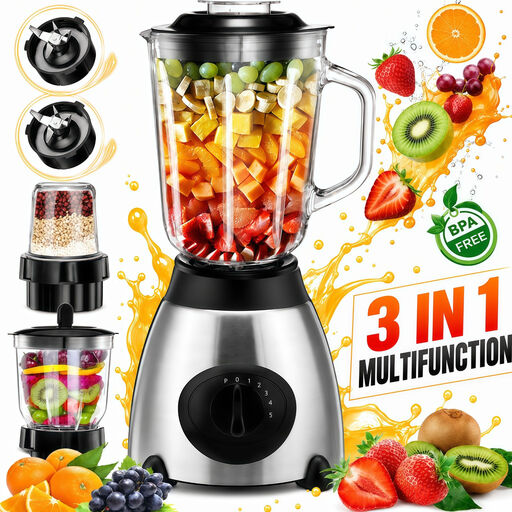 Image unavailable
The product name mentions an ice crusher; check the model instructions before using whole ice cubes.
The product name lists a 1.5-litre glass jug and six blades.
 Image unavailable
The product name mentions Ice Crushing; check the manual for the permitted ice cubes and filling quantity.
The product name lists 600 W, a capacity of 1.5 litres and three speeds.
 Image unavailable
The product name mentions ice crushing for this compact model; check the instructions for using ice cubes with the exact version.
The product name lists a capacity of 0.6 litres and 350 W.
 Image unavailable
The product name mentions ice crushing; check the instructions for using whole ice cubes with this model.
Philips lists 450 W, one speed and a pulse setting. The usable capacity is 1 litre; 1.9 litres is the maximum jug capacity.
No. According to the Consumentenbond, not every blender can crush ice cubes. Check the instructions for the exact model; its wattage or a ‘smoothie’ label alone doesn’t confirm that ice cubes are permitted.
Follow the cleaning instructions for the exact model before putting any removable parts in the dishwasher. The Consumentenbond recommends drying the jug and blades thoroughly after washing.
No. According to the Dutch Government, there is no fixed statutory guarantee period in the Netherlands: what you can reasonably expect from a product also matters. If a product is faulty, the retailer is your point of contact; a manufacturer’s guarantee is separate.
According to the Netherlands Food and Consumer Product Safety Authority, CE marking is compulsory for electrical products sold on the Dutch market. Parts that come into contact with ingredients must also meet the requirements for food contact materials; a CE mark on its own doesn’t confirm that a specific jug or cup meets those separate material requirements.