
Vandaag of morgen in huis

Kwaliteit gegarandeerd

Welkomstaanbiedingen ontgrendelen: GRATIS bezorging | Tot 80% korting | Gratis 30 dagen JoyPlus-proefperiode
Download de app
Choosing a blender for smoothies seems straightforward: enough power, a spacious jug and a few automatic programmes. Yet many purchases disappoint. A motor that only seems powerful when the appliance is empty, a jug with a larger stated capacity than its usable volume, or components that are difficult to clean can make everyday use unnecessarily frustrating.
This buying guide will help you assess the key differences. Whether you are looking for a smoothie maker for one person, a blender for the family or a versatile appliance for soups, sauces and dough, focus on verifiable specifications rather than vague marketing claims.
A higher wattage sounds appealing, but it does not tell you everything about the result. The blade design, drive system, speed control and maximum operating time also play a role. A 1200 W blender may be suitable for smoothies and ice, while a less powerful model can work perfectly well for soft fruit and yoghurt.
Always check:
A blender with a 1.5-litre jug does not always provide 1.5 litres of space for ingredients. Hot preparations, frothy smoothies and ingredients that expand all require some room to spare. Also check whether the capacity is given as the total or usable volume.
For a household, a 1.5-litre blender is often practical. A compact model of around 0.6 litres is better suited to a single portion or a smoothie you want to take with you straight away.
A glass blender is heat-resistant and generally absorbs odours or colours less readily than some plastics. On the other hand, glass can be heavier and needs to be handled with care. A blender with a glass jug is particularly useful if you want to prepare both cold and lukewarm recipes, provided the manufacturer specifies thermal resistance.
Also look for removable blades, a dishwasher-safe jug and a lid that seals securely. ‘Easy to clean’ is not a fixed technical standard, so check which parts can actually go in the dishwasher.
A few hundred watts is often enough for soft smoothies. If you want to process frozen fruit, nuts, hard vegetables or ice, you will need more power in reserve. A powerful blender with several speeds gives you more control than an appliance with just one fixed setting.
A high-speed blender may be able to reach high speeds according to the product description, but that does not automatically mean that every ingredient can be processed without preparation. Cut large pieces into smaller ones, add enough liquid and only use the tamper if it is designed for that model.
A smoothie or ice-crushing programme is useful, but also look for manual controls. A pulse function lets you use short bursts for dishes such as salsa, pesto or chunkier dips.
Choose the capacity based on your usual portions:
A large jug takes up space on the worktop and may be more difficult to get out of the cupboard. Measure the appliance’s height, width and depth, and check whether the jug will fit beneath your kitchen wall units.
A blender with an ice crusher is useful for cold drinks and cocktails, but only use this function when it is explicitly stated in the product information. If you want to do more than blend, a blender with food processor may be appealing. In that case, check the included bowls, slicing discs, grinding cups and maximum quantities.
A dishwasher-safe blender saves time, but this usually applies only to removable parts. The motor base must not be immersed in water. Blades remain sharp, so unplug the appliance before removing or cleaning any components.
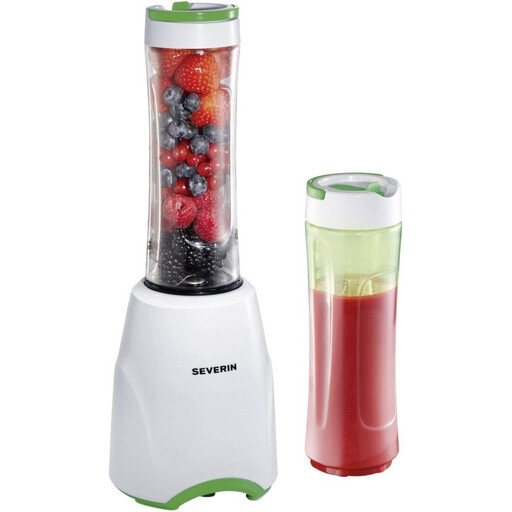
Why it suits this profile: This compact model is designed for smoothies, milkshakes and sports drinks. The two cups make it practical for commuting, the office or training.
The specifications clearly state 300 W, 0.60 litres, two speeds and a pulse function. Therefore, do not expect an all-round appliance for large quantities or heavy chopping.
Two removable Tritan cups, a capacity of 0.60 litres and dishwasher-safe parts according to the product information.

Why it suits this profile: The combination of a glass jug, automatic programmes and manual speed control is well suited to households that regularly make smoothies, soups and cold drinks.
The product listing distinguishes between a total jug capacity of 2 litres and a usable capacity of 1.5 litres. This prevents you from misjudging the portion size.
1200 W, six stainless-steel blades according to the product description, smoothie and ice-crushing programmes, plus a dishwasher-safe glass jug.
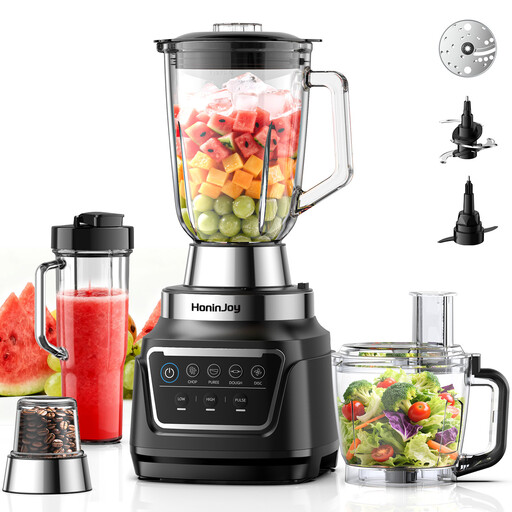
Why it suits this profile: This model is intended for users who want to chop, grate, grind, purée and prepare dough as well as make smoothies. The set is designed for meal preparation and multiple kitchen tasks.
The accessories and functions are described separately: a 1.5-litre blender jug, a 2-litre food processor bowl, a grinder jar and a sports bottle. Check beforehand whether you need all these components.
Up to 1300 W according to the product description, multiple accessories and dishwasher-safe removable parts according to the listing.
We have put together a complete, up-to-date list of products that fully meet these strict selection criteria and the applicable European safety regulations.
A blender will generally last longer when you use it within the stated limits. Do not fill the jug above the maximum mark. Add liquid first, followed by solid ingredients. When blending ice or frozen fruit, use the designated programme and allow the motor to cool down whenever the instructions require it.
Clean the jug immediately after use. A short rinse programme prevents fruit fibres and nut butter from drying around the blades. Before putting anything in the dishwasher, check that the jug, lid and blades are dishwasher-safe. Clean the motor base with a slightly damp cloth. When working with hot liquids, follow the safety instructions for the specific model. Allow ingredients to cool first where necessary, and never open the lid while the appliance is running.
For everyday smoothies, frozen fruit and common cold preparations, 1200 W can be suitable. The result also depends on blade geometry, speed, the amount of liquid and the preparation time. For nuts, ice or dough, it is wise to check the individual model’s maximum capacity and functions.
Not necessarily. Glass is heavy, feels sturdy and, on certain models, is suitable for hot and cold preparations. Plastic can be lighter and easier to handle. Pay particular attention to the stated heat resistance, total versus usable capacity, susceptibility to scratches and cleaning instructions.
Power consumption depends on the wattage and how long the appliance runs. A 1200 W appliance running for one minute theoretically uses around 0.02 kWh. The actual cost depends on your energy tariff. Short blending programmes and cleaning the appliance immediately usually have a greater impact on ease of use than small differences in power.
