
Raita lover who likes a bit of texture
You want to keep the texture of grated, drained cucumber and decide whether an appliance would add anything. The Netherlands Nutrition Centre’s recipe uses grating and draining.


You don’t need a blender for raita with recognisable pieces of cucumber: grate the cucumber, leave it to drain and mix it with yoghurt, as in the Netherlands Nutrition Centre’s recipe. A food chopper may be more useful if you also want to chop herbs; choose a hand blender or mini jug blender mainly if you also make smooth sauces or smoothies. Before buying an electrical appliance, check that it carries the applicable CE marking. The Netherlands Food and Consumer Product Safety Authority (NVWA) says this includes electrical equipment with a rated AC voltage of 50–1,000 V.
You want to keep the texture of grated, drained cucumber and decide whether an appliance would add anything. The Netherlands Nutrition Centre’s recipe uses grating and draining.
You make small portions and are weighing up a compact appliance against chopping by hand, while bearing in mind how much room you have to store it.
You’re looking for an appliance to make smooth drinks or sauces, while recognising that raita with pieces calls for a different method.
First decide what texture you want for your raita. Then consider whether an appliance is useful enough for other preparations to justify the space it takes up and the cleaning involved.
| What to consider | What to look for | Who should consider this most? |
|---|---|---|
| Cucumber texture | Grate and drain the cucumber for pieces; chopping and blending produce a different result. | If you want raita with recognisable pieces of cucumber, it’s best to start with the method in the recipe rather than a blender. Around 36% of consumers prioritise getting the texture they want above all else. |
| Portions and storage space | Compare the dimensions and bowl capacity of the exact model with your portion sizes and available cupboard space. | If you usually make small quantities and have limited cupboard space, you won’t want to store a larger bowl than you need. Around 29% of consumers put small portions and storage space first. |
| Other smooth preparations | Think about whether you mainly want to blend or also want to chop; if you’re considering a hand blender, check which accessories are included. | If you make smoothies or smooth sauces more often than raita with pieces, a blending function may matter more to you. Around 21% of consumers prioritise smooth preparations above all else. |
| Cleaning and parts | Check the cleaning instructions for each part and see what comes with the model. | If you want to clean as few parts as possible after preparing a small quantity and would rather not store unused accessories, the specific model matters. Around 14% of consumers prioritise easy cleaning and fewer unnecessary parts. |
The Netherlands Nutrition Centre’s recipe uses coarsely grated cucumber, which is drained first. A blender is designed for mixing and blending, and won’t replace those preparation steps.
Decide first whether you want pieces or a smooth sauce. If you want raita with pieces, compare using a grater and sieve with the space an appliance would take up.
An appliance may be unnecessary if you only make raita with pieces.
Hand blenders come with different accessories. A blending foot doesn’t automatically mean a food chopper is included.
Check what’s in the box and whether any food chopper is compatible with the exact model.
You may need a separate accessory for chopping.
For the Tefal K1330404, Tefal says the bowl and blades are dishwasher-safe, but the lid should be cleaned with a damp sponge or cloth.
Read the cleaning instructions for each part before choosing a model.
According to the Government of the Netherlands, you’re entitled to a product that is fit for purpose, but there is no fixed statutory guarantee period in the Netherlands. A manufacturer’s guarantee doesn’t replace your statutory rights.
Check the extra terms and conditions of any additional guarantee, and keep the seller’s purchase details.
The models mentioned are designed for different tasks: the HR2510/90 is a mini jug blender, while the HR1501/00 is a food chopper.
The ErgoMixx MSM64110 is a hand blender for blending and mixing small quantities in the measuring beaker supplied with the described model.
The manual 5 Second Chopper K1330404 is a cordless option for chopping vegetables and herbs.
Braun lists 350 ml and 500 ml food chopper accessories in its MultiQuick range.
This selection of Joybuy products includes hand blenders, chopping functions and a mini jug blender for chopping, blending and mixing, as well as making cucumber raita.
 No image available
A set to consider if you want to chop or whisk as well as make raita; chopping doesn’t replace grating and draining.
The product name lists a food chopper and whisk; the description specifies a 500 ml food chopper and a 700 ml measuring beaker.
Before buying, check the applicable CE marking for the exact electrical model.
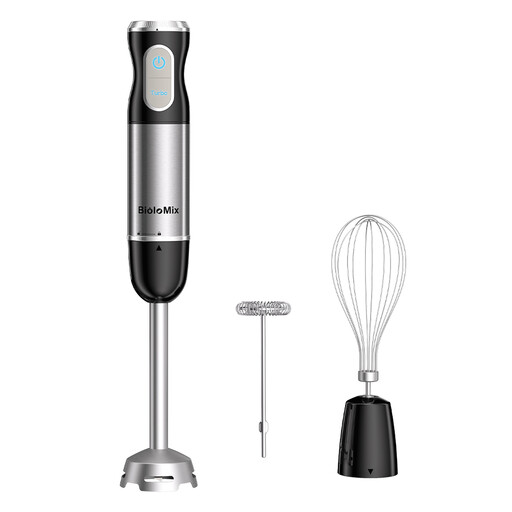 No image available
A hand blender to compare if you want to make smooth preparations as well as raita; grating is still a separate step if you want pieces of cucumber.
The product name specifies a 3-in-1 hand blender with a detachable design.
Before buying, check the applicable CE marking for the exact electrical model.
 No image available
Worth considering if you want to make smooth preparations and chop ingredients as well as make raita; the stated capacity may be relevant to your portion sizes and storage space.
The product name specifies 1.5 l, 600 W and three speed settings, alongside blending, chopping and grinding functions.
Before buying, check the applicable CE marking for the exact electrical model.
 No image available
A good fit if you mainly want to make smoothies or smooth sauces as well as raita; the recipe for raita with pieces still calls for grating and draining.
The product name specifies a 0.6 l capacity and 350 W power.
Before buying, check the applicable CE marking for the exact electrical model.
 No image available
Worth comparing if you’re looking for a hand blender for other preparations as well as raita; check which parts are included if you also want to chop.
Before buying, check the applicable CE marking for the exact electrical model.
No, not for the Netherlands Nutrition Centre’s recipe: coarsely grate the cucumber, leave it to drain in a sieve, then mix it with yoghurt. Blending is an option if you’d prefer a smoother texture.
It depends on the model and the individual parts. For the K1330404, Tefal says the bowl and blades are dishwasher-safe, but recommends cleaning the lid with a damp sponge or cloth. Philips says the bowl and blades of the HR1501/00 are dishwasher-safe.
Cover leftovers well, refrigerate them within two hours and eat them within two days. The Netherlands Nutrition Centre recommends a fridge temperature of 4 °C.
You’re entitled to a product that is fit for purpose, and you should contact the seller if there’s a problem. According to the Government of the Netherlands, there is no fixed statutory guarantee period in the Netherlands; any manufacturer’s guarantee doesn’t replace your statutory rights.
According to the Netherlands Food and Consumer Product Safety Authority (NVWA), CE marking is compulsory for electrical equipment covered by the low-voltage rules described, including appliances with a rated AC voltage of 50–1,000 V. The marking is not an independent quality assessment, so check that it applies to the exact model. The electrical voltage rule mentioned does not apply to a manual food chopper without an electrical connection.