
Making several frappés for guests
You want to make more than one drink per batch when entertaining. Compare the usable capacity, not just the jug’s total capacity.


If you’re making several frappés in one batch, a jug blender is likely to be a better fit. For a single small serving, a personal blender is a more compact option. Compare the usable capacity and check whether the instructions allow you to blend ice: wattage and the jug’s maximum capacity alone won’t tell you how finely it will crush ice.
You want to make more than one drink per batch when entertaining. Compare the usable capacity, not just the jug’s total capacity.
You want a model that specifically states it can process ice. The stated wattage doesn’t measure the final texture of the ice.
You usually make one drink and want a compact blending cup. When entertaining, this may mean blending several batches.
When making frappés for guests, your first choice largely depends on portion size, instructions for blending ice, and how much time you want to spend cleaning and storing your blender.
| What to consider | What to look for | Who this matters to |
|---|---|---|
| Making several drinks per batch | Compare the effective or usable capacity of the exact model. Philips lists an effective capacity of 1 l for the HR2041/00; Tefal lists a usable capacity of 1.5 l for the BL871D31. | If I want to make several drinks for friends at once, I look at the usable capacity, not just the jug size. Around 34% of consumers put making drinks for a group first. |
| Blending ice | Check whether the instructions allow you to crush ice, and note the recommended quantities and settings. The Consumentenbond notes that some blenders only shave ice or let it melt. | For a frappé with finely crushed ice, I want to know what the exact model can do with ice. Around 33% of consumers give ice processing top priority. |
| Cleaning up after serving | Check the cleaning instructions for each part. Tefal says the BL871D31 has removable blades and a dishwasher-safe glass jug; Nutribullet says the cup of the NB904CP can go in the top rack. | If I want to clear up quickly after serving, I check which parts can be removed and how they can be cleaned. Around 20% of consumers put ease of cleaning first. |
| Compact storage | Compare the cup’s capacity and shape with the way you plan to use it. Nutribullet lists a 700 ml cup for the Pro 900 NB904CP. | If storage space is limited or I usually make one small portion, a personal blender cup suits the way I use it better, even if I have to blend in batches when entertaining. Around 13% of consumers make compact size their top priority. |
For the Philips HR2041/00, Philips gives a maximum capacity of 1.9 l and an effective capacity of 1 l. That difference can affect how much you can blend at once.
Compare the effective or usable capacity of the exact model and stick to the stated fill limit.
The stated power on its own doesn’t tell you how a blender handles ice. The Consumentenbond reports that some blenders only shave ice or let it melt; this isn’t a verdict on every individual model.
Check the ice function and the instructions for use. An independent test of the exact model is more relevant to its performance than the wattage alone.
Nutribullet says the Pro 900 NB904CP has a 700 ml cup, while Tefal lists a usable capacity of 1.5 l for the BL871D31. These are manufacturer specifications for different models, not an independent comparison of their frappé results.
Choose a personal blender cup if small portions suit the way you use it; for a larger batch, compare the usable capacity of jug blenders.
The features below apply to the models or product ranges mentioned. They are not a general assessment of every product from each brand.
Philips describes the 3000 Series HR2041/00 as a jug blender with a pulse setting and an ice function.
According to Tefal, the PerfectMix+ BL871D31 is a jug blender with an ice-crushing programme.
According to Nutribullet, the Pro 900 NB904CP is a personal blender designed for smaller batches.
According to Braun, the PowerBlend 9 JB9040 is a jug blender with adjustable texture settings.
These jug blenders are for anyone considering making larger batches. For the exact model, check whether it can process ice and what the fill limits are. According to the Netherlands Food and Consumer Product Safety Authority, CE marking is mandatory for electrical consumer products placed on the market in the Netherlands; check the marking on the model you choose.
 No image available
A jug blender for anyone who wants to process ice and blend several portions.
The product name lists 1300 W, a 1.5 l jug, two speeds, a pulse function and ice crushing.
Check the CE marking for this exact model and follow the instructions for ice and fill levels.
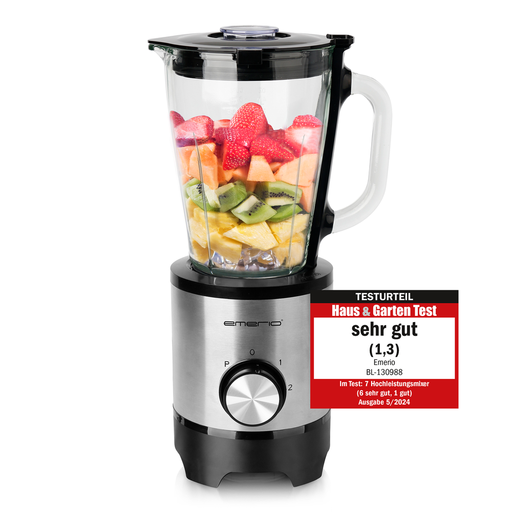 No image available
A jug blender to compare if you want to make larger batches for guests.
The product name lists a 1.5 l glass jug and a stainless steel, black and silver finish.
Check the CE marking for this exact model and consult the instructions for processing ice and cleaning.
 No image available
A jug blender for anyone who wants to blend larger portions and needs an ice-crushing function.
The product name lists 600 W, a 1.5 l jug, three speeds and ice crushing.
Check the CE marking for this exact model and follow the instructions for the permitted quantities of ice and liquid.
 No image available
A jug blender to consider for larger batches; check whether the ice function on this exact model suits the way you plan to use it.
The product name lists 1200 W and a capacity of 1.5 l.
Check the CE marking for this exact model and consult the instructions for processing ice and cleaning.
 No image available
A jug blender to compare if you want to prepare several portions at once.
The product name lists a 1000 W motor and a 1.5 l jug.
Stick to the stated maximum fill level. Check the CE marking for this exact model and consult the instructions before blending ice.
Not without checking the usable capacity: Philips lists a maximum capacity of 1.9 l and an effective capacity of 1 l for the HR2041/00. Work out how much you want to make and stick to the fill limit for your chosen model.
Let the coffee cool first and follow the instructions for your model. Philips recommends using cold or room-temperature liquids for the models covered by its published warning; this warning applies to specific models and doesn’t automatically apply to every blender.
Voedingscentrum advises keeping fresh milk products refrigerated at 4 °C, taking them out shortly before use and putting them back in the fridge afterwards. Use clean utensils, too.
According to the Netherlands Food and Consumer Product Safety Authority, CE marking is mandatory for electrical consumer products placed on the market in the Netherlands. Check the marking and product information for the exact model; a general product description doesn’t automatically confirm that every individual model carries the marking.
In the Netherlands, you should contact the seller about a fault. The Dutch government says there is no fixed statutory guarantee period; what you could reasonably expect from the product and the circumstances of the fault are relevant. For online purchases from a business, you will often also have a 14-day cooling-off period. This is separate from your rights if the product is faulty.