For several glasses of coffee frappé, choose a jug blender whose specific model is suitable for crushing ice and whose usable capacity suits your recipe. A larger jug can take up more space and be heavier. If you usually make just one drink or storage matters more, a smaller model may be a better fit, although you may need to blend in several batches.
Who is this buying guide for?
Family batch maker
You want to make several cold drinks for breakfast, one after another or all in one jug, and are mainly comparing usable jug capacity and suitability for ice. The Consumentenbond (Dutch Consumers’ Association) highlights jug capacity and ice-crushing ability as important factors when choosing a blender.
Icy frappé fan
You want a smoothly blended drink with ice cubes, so you check whether the exact model can crush ice rather than relying on its stated power alone. The Consumentenbond includes ice-crushing ability in its blender assessments.
Quick breakfast maker
You prioritise easy cleaning, a manageable size or individual cups, even if you might need to make more than one batch for the family. Check which parts are removable or dishwasher-safe on the model you’re considering.
What should you look for when buying?
First compare the quantity in your recipe with the ice-crushing instructions for the exact model. Then look at cleaning, size and the parts included.
| What to consider |
What should you check? |
Who should pay particular attention? |
| Capacity for one batch |
Compare the usable filling capacity with your recipe and the number of glasses you want to make. The Consumentenbond suggests 1,5 litres or more as a guide for people who often blend larger quantities; this doesn’t equate to a fixed number of portions. |
If I want to make several glasses for the family at once, I need to know whether the coffee, milk and ice will all fit. Around 29% of consumers put the size of a family batch first. |
| Crushing ice cubes |
Check the full model number to see whether the manufacturer says the blender can crush ice. Power alone doesn’t show how well a blender handles ice. |
If my frappé needs ice cubes, I want to know whether the specific model is designed to handle them. Around 36% of consumers prioritise ice-crushing ability. |
| Use and cleaning |
Check which parts are removable and dishwasher-safe. If low noise is important, look for an independent noise assessment. |
If I use the blender early in the morning, I don’t want to spend ages hand-washing lots of parts afterwards. Around 21% of consumers put ease of use and cleaning first. |
| Size and included parts |
Compare the dimensions of the appliance and jug, and check which cups are actually included with the model. |
If my kitchen has limited storage or I want to make individual drinks, I weigh up the size and included cups against the batch size. Around 14% of consumers prioritise space or the purchase trade-off. |
Common buying mistakes
-
Looking at the wattage alone
A blender’s stated power doesn’t tell you by itself whether it can crush ice cubes or what texture your frappé will have.
Check the manual and specifications for the exact model. If texture is a deciding factor, look for independent test results on ice-crushing performance.
-
Assuming the stated jug capacity is the amount you can blend in one batch
Ice and other ingredients take up space, so your recipe may not fit as easily as the stated capacity suggests.
Compare the usable filling capacity with your own recipe before choosing a large jug or personal blender cup.
-
Confusing a manufacturer’s guarantee with all your statutory rights
An additional commercial guarantee doesn’t replace your statutory rights if a product is faulty. According to the Dutch government, there is no fixed statutory guarantee period in the Netherlands, and the retailer is your point of contact if there’s a problem.
Check exactly what an additional guarantee covers, and contact the retailer if the product is faulty.
Brands to consider
Braun
The PowerBlend 3 JB3150BK we looked at is a jug blender worth comparing if you want to make several portions.
- Braun lists the JB3150BK as having a glass jug with a usable capacity of 1,5 litres, 800 W, ice-crushing capability, and a dishwasher-safe jug, lid and blades.
- Braun claims that this model blends more quietly; no independent noise rating is listed for it.
nutribullet
According to the manufacturer, the Combo NBF500MB combines a pitcher with individual drinking cups for family and personal use.
- The manufacturer lists a 1.800 ml pitcher, 700 and 900 ml cups, 1.200 W and suitability for ice.
- Check the specific model and included parts: the product information also contains a general reference to a different power rating.
Bosch
The VitaPower Serie 4 MMB6141B is a traditional jug blender worth comparing if you’re looking for a generous-capacity jug.
- Bosch lists 1.200 W, a 1,5-litre jug, two speed settings, a pulse function and dishwasher-safe parts.
- These specifications alone don’t show how the model will perform with your coffee and ice recipe; check the instructions.
Philips
The information here is specifically about the refurbished 7000 Series HR3760/01R1, for reference.
- Philips lists a 1.500 W motor for this refurbished model.
- Don’t assume the /01R1 suffix is the same as HR3760/01 or /10 without checking, and don’t infer ice-crushing performance from the power rating alone.
Blenders for larger batches of cold drinks
These Joybuy products are jug blenders worth comparing for making larger batches of cold drinks. Check the ice-crushing instructions for each exact model, and make sure its capacity suits your recipe.
 No image available
Cecotec Power Black Titanium 1300Max, 1.5L
The stated jug capacity and ice-crushing function make this an option to compare for several cold portions; check that the usable capacity suits your recipe.
1.300 W; 1,5 L jug; 2 speeds; pulse function; 4 blades; ice crushing.
View at Joybuy
 No image available
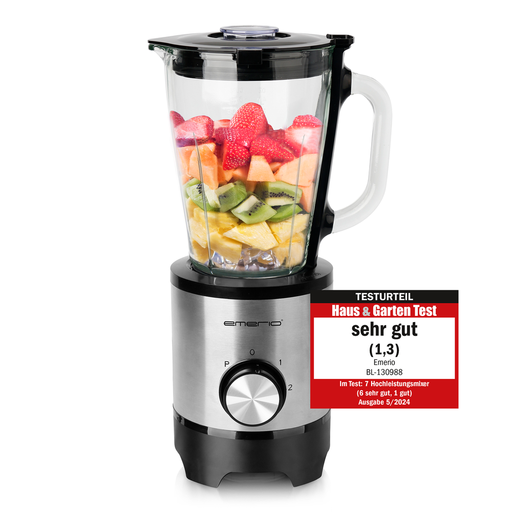
Emerio BL-130988, 1.5L
The 1,5-litre glass jug gives you a capacity to compare with your own recipe. Check the instructions separately to see whether ice cubes are suitable for this model.
1,5 L glass jug; stainless steel; black/silver.
View at Joybuy
 No image available
ochama Multifunction Blender 600W, 1.5L
The stated jug capacity may help you compare larger batches. For your recipe, also check the filling instructions and whether the blender can be used with ice.
600 W; 1,5 L jug; 3 speeds; ice crushing.
View at Joybuy
 No image available
Philips Blender HR3020/20
Compare the stated jug capacity with your recipe and check the instructions to see whether this exact model is suitable for crushing ice.
1.000 W; 1,5 L jug; dishwasher-safe parts according to the product name.
View at Joybuy
 No image available
Ninja Detect Blender Pro TB301EU
Compare this jug blender with your preferred batch size, and check the model-specific instructions to see whether ice cubes and your recipe are suitable.
View at Joybuy
Frequently asked questions
Is a high wattage enough to blend ice cubes?
No. Not every blender can crush ice cubes. Check the instructions and specifications for the exact model; its stated power alone doesn’t prove that it’s suitable for ice.
How do I choose a jug capacity for several glasses?
Add up the ingredients in your recipe, including the space taken up by ice, and compare the total with the usable filling capacity. The Consumentenbond suggests 1,5 litres or more as a guide for people who often blend larger quantities; this doesn’t guarantee a set number of glasses.
What should I look for when cleaning and using a blender safely?
Check the manual for the exact model to see which parts are removable and dishwasher-safe, and follow the instructions for assembly and handling the blades. Braun lists dishwasher-safe parts for the JB3150BK we looked at; this doesn’t automatically apply to other models.
Can everyone have the same coffee frappé at the family breakfast table?
Bear caffeine in mind and make separate drinks if needed. The Voedingscentrum (Netherlands Nutrition Centre) advises that children up to and including 13 years old should have no more than one 125 ml cup of coffee a day; decaffeinated coffee still contains a small amount of caffeine.
What rules and rights apply when buying in the Netherlands?
Electrical appliances placed on the market in the Netherlands must meet the applicable safety requirements and CE obligations; parts that come into contact with food are subject to food-contact materials regulations. If a product is faulty, the retailer is your point of contact for your statutory guarantee; there is no fixed statutory end date for this in the Netherlands. According to ACM ConsuWijzer, online purchases generally come with a 14-day cooling-off period from delivery, subject to statutory exceptions.


