
Frappé maker using ice cubes
You want a cold coffee frappé with crushed ice. So check the ice-crushing function on the exact model: according to the Dutch Consumers’ Association, not every blender can crush ice cubes.


For a coffee frappé with whole ice cubes, choose a model whose manufacturer explicitly says it can crush ice; the Dutch Consumers’ Association warns that not every blender can. A personal blend-and-drink cup can be handy for a single serving, but also measure the space available and check the manual for permitted ingredients, cleaning instructions and temperature limits.
You want a cold coffee frappé with crushed ice. So check the ice-crushing function on the exact model: according to the Dutch Consumers’ Association, not every blender can crush ice cubes.
You usually make one serving, so compare the dimensions and cup capacity before finding a place for the appliance on the worktop or in a cupboard. The Dutch Consumers’ Association also recommends checking the size of the mixing cup if you want a blender for taking out and about.
You want to blend and take your drink with you in the same cup, with as little washing-up as possible. Capacity and cleaning instructions vary by model; Philips says the HR2670/01 has dishwasher-safe parts.
When choosing a personal blender for coffee frappés, the key considerations are ice-crushing performance, kitchen space, ease of cleaning and cordless use.
| What to consider | What to check before buying | Who it matters to |
|---|---|---|
| Crushing ice cubes | Look for an explicitly stated ice-crushing function and check the manual for any limits on quantity and use. | If you want to use whole ice cubes in your frappé, you’ll want to know whether your chosen model can handle them; ice-crushing performance is the top priority for around 36% of consumers. |
| Space and capacity | Measure the available height, width and depth and compare them with the appliance’s dimensions. Also check that the cup is large enough for your serving. | If you have limited worktop or cupboard space, you’ll want the blender and cup to fit where you plan to keep them; space is the deciding factor for around 28% of consumers. |
| Drinking and cleaning | Check whether a drinking lid is included and which parts are dishwasher-safe individually. | If you want to blend and drink straight from the same cup, convenience matters, but don’t overlook the cleaning instructions for the separate parts; this is the top priority for around 18% of consumers. |
| Cordless use | Check how it charges, the cup capacity and any ice-crushing limitations for the specific version. | If you want to blend somewhere without a plug socket, portability may matter more than crushing a large quantity of ice; cordless use is the main consideration for around 18% of consumers. |
Not every blender can crush ice cubes, and manufacturers may specify different limitations depending on the model and quantity.
Look for an explicitly stated ice-crushing function and read the usage restrictions for the exact version you’re considering.
Personal blenders vary in height, width, depth and cup capacity. As a result, an appliance may not fit where you intend to put it, or it may not hold enough for your serving.
Measure the space available and compare all the appliance’s dimensions with the portion size you want to make.
Cleaning instructions may vary for the cup, lid and blade.
Check the manual to see whether each part can go in the dishwasher.
The Pro 900 NB904CP is a mains-powered model, while the Portable NBP003YE is rechargeable and designed for a smaller quantity of ice.
The VitaPower Serie 2 MMB2111S is a slim mini blender with a 0.6 l travel bottle.
The Blend & Go HR2670/01 is designed for a single drink in a compact cup with a drinking lid.
The PowerBlend 1 JB1000WH is a jug blender worth comparing if a personal drinking cup doesn’t offer enough capacity.
This selection includes personal blenders whose product information mentions ice-crushing, with differences in cup capacity, controls and usage limitations. Check that the stated ice-crushing function and other specifications suit your recipe and the exact version.
 No image available
An option if you want to blend and take a cold drink with you; the product information says it can crush ice.
The cup has a capacity of 710 ml. The product information lists three automatic programmes, a pulse function and removable dishwasher-safe parts.
 No image available
An option for a personal serving; the product information says it can crush ice and has a setting for hard ingredients and ice.
The cup has a capacity of 0.6 l. The product information lists 350 W, two speeds and removable dishwasher-safe parts.
 No image available
An option for a personal frappé; the product information mentions ice cubes and a cup you can drink from.
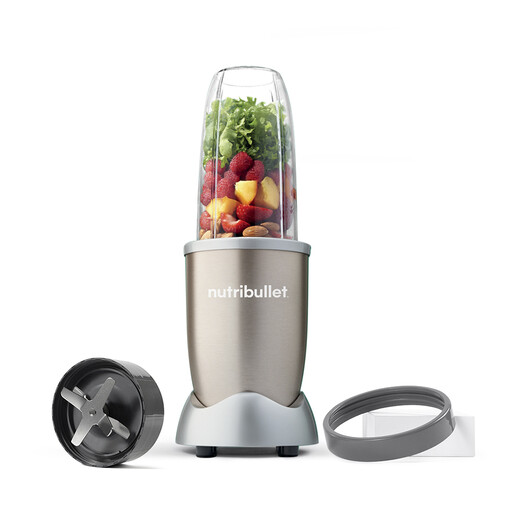
The cup has a capacity of 700 ml. The product information lists 900 W, a pulse function and a Tritan cup. Ingredients and liquids must be no warmer than 21 °C, according to the product information, so use cooled coffee.
 No image available
An option for a smaller drink; the product information says the blades can crush ice.
The product name lists a capacity of 500 ml and a glass jug. The product information lists 250 W and removable dishwasher-safe parts.
 No image available
An option if cordless use matters; the product information lists a rechargeable battery and says it can crush ice.
The cup has a capacity of 475 ml and the appliance charges via USB-C. Hot liquids must not be blended, according to the product information.
No. The Dutch Consumers’ Association warns that not every blender can crush frozen fruit or ice cubes. Check the manual for the exact model and any limits; for example, the manufacturer says the nutribullet Portable NBP003YE can crush only a small quantity of ice.
Don’t assume you can. The Dutch Consumers’ Association recommends letting boiling liquids cool first and not exceeding the maximum fill level. Also check the temperature limit for the specific cup; the product information for the Nutribullet Pro Blender Ice Grinder 900W gives a maximum of 21 °C for ingredients and liquids.
Follow the manual for each part: according to the Dutch Consumers’ Association, removable parts can often, but not always, go in the dishwasher. Wipe the motor housing with a damp cloth and dry the cup thoroughly after washing.
Not necessarily. According to the Dutch government, products sold in the Netherlands are covered by a legal guarantee of conformity, with no fixed statutory guarantee period; a commercial or manufacturer’s guarantee is in addition to this. If there’s a fault, contact the seller first.
An electric blender sold in the Netherlands as an electrical consumer product must carry the CE marking. The NVWA and Your Europe explain that CE is the manufacturer’s declaration of conformity, not an independent quality mark. Parts intended to come into contact with food or drink must comply with the relevant EU rules on food contact materials.