
Vandaag of morgen in huis

Kwaliteit gegarandeerd

Welkomstaanbiedingen ontgrendelen: GRATIS bezorging | Tot 80% korting | Gratis 30 dagen JoyPlus-proefperiode
Download de app
Buying a blender seems straightforward until you have to choose between a countertop blender, hand blender, food chopper or smoothie blender. Manufacturers often focus on wattage, automatic programmes and large capacities. However, these features do not tell you everything about day-to-day use. For example, high power does not automatically mean that an appliance is suitable for small portions, hot soup or prolonged use.
The most important question is therefore: what do you want to prepare, for how many people and how often?
A powerful 1,200-watt blender sounds appealing, but the result also depends on the blades, the shape of the jug and the amount of liquid. An 800-watt hand blender may be useful for soup in a pan, while a compact smoothie blender may be better suited to a single portion.
As well as the power, check:
A 2-litre jug is practical for several people, but you cannot always use its full capacity safely. Pay attention to the maximum-fill marking. For a single smoothie, a 2-litre jug is also less efficient than a 600 or 700 ml cup.
A blender with a glass jug is worth considering if you are looking for a sturdy, stain-resistant material. Glass is heavier than plastic, however, and should be protected from sudden changes in temperature. Always check the manual before processing hot ingredients.
A 4-in-1 hand blender with a whisk, measuring jug and food chopper can be versatile, but it takes up more space and requires additional cleaning. Conversely, a simple smoothie blender is less suitable for meat, herbs or small amounts of vegetables.
Choose features based on the recipes you regularly make, not the longest list of accessories.
For soft vegetables, fruit and sauces, medium power is often sufficient. For ice, nuts and frozen fruit, a suitable blade system, enough liquid and short pulses are important. An appliance with a high maximum power rating may still need rest periods during use.
For example, the ROUNY hand mixer lists a maximum power of 1,200 watts and a speed of 15,000 rpm, but also specifies a maximum operating interval of one minute, followed by one minute of rest. This makes the specification relevant to anyone who wants to prepare several portions consecutively.
Consider the portion size:
A glass jug can be useful for sauces and cold drinks, while a Tritan or plastic cup is lighter for taking on the go. Also check whether the parts are dishwasher-safe and whether the motor base must never be immersed in water.
A pulse function helps you process ingredients briefly without immediately starting a long blending cycle. For a blender designed to crush ice, a specifically stated function or suitable blade construction is important. An automatic setting can be convenient, but manual speed settings give you more control over the texture.
The temperature limit is also important for soup and smoothies. Not every blender is suitable for hot ingredients. Follow the product manual and do not exceed the stated temperature or maximum fill line.
A countertop blender is suitable for larger quantities of smoothies, cold drinks and sometimes soup. A hand blender works directly in a pan or bowl and is useful for sauces, purées and soup. A food processor or food chopper is better suited to meat, onions, herbs and vegetables. A mini blender is compact and practical for one person, but usually has a smaller capacity and fewer options for large or heavy preparations.
The options below are linked to specific product specifications and usage situations.
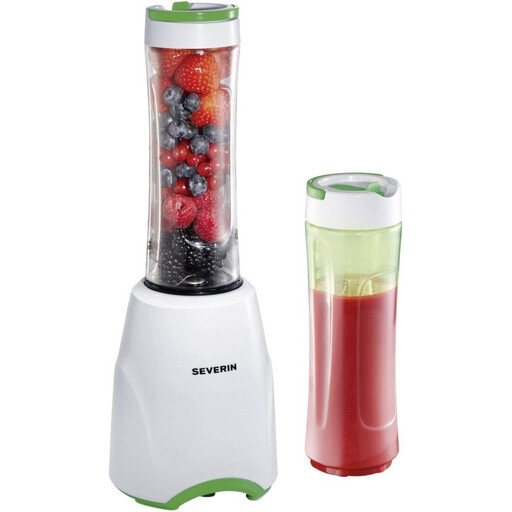
Why it suits this profile: The two 0.6-litre cups are designed for smoothies, milkshakes and sports drinks. After blending, you can put a lid on the cup and take it with you.
You are not paying for a large jug or lots of programmes if you mainly make one portion at a time. The listed specifications state 300 watts and two speeds.
Two removable cups, 0.6-litre capacity and dishwasher-safe parts according to the product information.
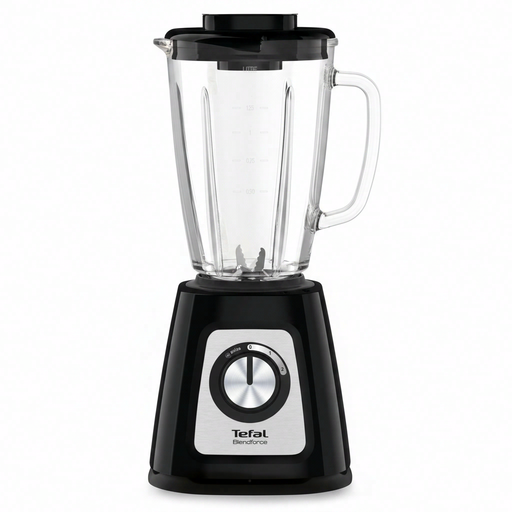
Why it suits this profile: This countertop blender combines a 1.25-litre glass jug with 800 watts, two speeds, a pulse function and a stated ice-crushing function.
The choice is not based solely on power: the jug material, capacity, controls and safety lock are listed separately.
1.25-litre glass jug, stainless-steel blades, pulse function and dishwasher-safe parts according to the product description.

Why it suits this profile: The 2.1-litre jug and 700 ml cup offer different portion sizes. The product information states 1,200 watts, 14 manual speeds and four automatic programmes.
The combination of a large jug and small cup means you do not need a different appliance for every portion size. Always use the stated fill markings.
2.1-litre jug, 700 ml cup, ice crusher according to the product description and manual speed control.
A blender has sharp blades and a motor that generates heat. Keep these basic rules in mind:
Cleaning is also important for everyday use. Removable, dishwasher-safe parts can save time, but check which parts are suitable for this for each model. The statutory warranty for many electrical kitchen appliances is at least two years in the EU; additional terms may vary by product and seller.
We have compiled a complete, up-to-date list of products that fully meet these strict selection criteria and the applicable European safety regulations.
A blender is practical for larger quantities of smoothies, cold drinks and smooth mixtures. A hand blender is more flexible for soup, sauce and purée, as you can work directly in a pan or bowl. If you prepare both types of dishes, you may wish to consider a 3-in-1 hand blender with a food chopper.
The lifespan depends on use, maintenance and workload. Regularly overfilling the appliance, blending for too long at a time or using too little liquid can put additional strain on the motor and blades. Follow the operating times in the manual and allow the appliance to cool down when instructed.
Energy consumption depends on the power rating and how long the appliance is used. In theory, a 1,200-watt appliance running for one minute uses more energy than a 300-watt model running for the same length of time. In practice, how quickly the desired result is achieved also makes a difference. Choosing a suitable size and using short pulses can help limit unnecessarily long operation.
