
Vandaag of morgen in huis

Kwaliteit gegarandeerd

Welkomstaanbiedingen ontgrendelen: GRATIS bezorging | Tot 80% korting | Gratis 30 dagen JoyPlus-proefperiode
Download de app
A blender can make smoothies, shakes, soups, sauces and baby food in no time. But it’s not a good idea to choose one based solely on wattage or an attractive product photo. A compact mini blender can be handy for a single serving, while a kitchen blender with a large jug may be a better fit for a family. Choose the wrong type and you could end up paying for features you rarely use.
Look out for these three common pitfalls:
Start by thinking about what you’ll actually be making. A smoothie blender or smoothie maker is designed for fruit, yoghurt and shakes. A larger kitchen blender has more room for several servings. For soup and sauces, a stick blender, also known as a hand blender, is often more practical: you can blend directly in a pan, bowl or measuring jug.
Choose according to your needs:
Wattage is useful for comparing models, but it doesn’t guarantee smooth results. A basic 150 W stick blender is suitable for light tasks such as blending soft vegetables, sauces and milkshakes. A 650 W model offers more power for making soups and purées regularly. According to its product specifications, a powerful 1200 W kitchen blender is designed for larger quantities and ingredients such as ice.
Also check the maximum continuous operating time. For example, the Philips HR2534/00 should not be used continuously for more than one minute, according to the product instructions. Let it cool down afterwards. This helps prevent the motor from being overloaded if you’re doing several demanding jobs in a row.
A 300 to 500 ml cup is suitable for one smoothie or shake. The Nutribullet Portable has a stated capacity of 0.48 litres, while the Xiaomi Portable Blender has a capacity of 400 ml. That’s handy for the office, gym or travelling, but limiting for a household.
For larger quantities, a 2.1-litre jug is more practical. The Ninja Detect Blender Pro also comes with a 700 ml cup. Bear in mind that the maximum fill line is not the same as the total capacity. Never fill a blender above the indicated line.
A corded blender plugs directly into a 220–240 V socket. A cordless blender gives you more freedom to move around, but needs to be charged. For models with USB-C, check that you’re using the supplied cable and recommended adapter.
Also check:
Don’t use a portable blender for hot or carbonated liquids if the product information says not to. Pressure can build up and force the contents out of the cup. When using a stick blender, keep the blade guard fully submerged in the ingredients to reduce splashing. Always keep fingers, cutlery and kitchen utensils away from the moving blades.
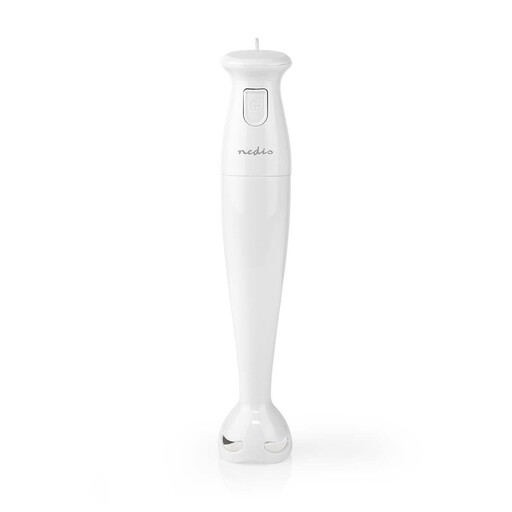
Why it suits this profile: A simple hand blender for anyone who mainly makes soup, sauce, milkshakes or soft baby food and doesn’t need extra accessories.
The specifications are straightforward: 150 W, one speed, no chopper and a one-metre cord. So you won’t be paying for features you don’t use.
Compact design, one-button operation and blending directly in a bowl, pan or cup.
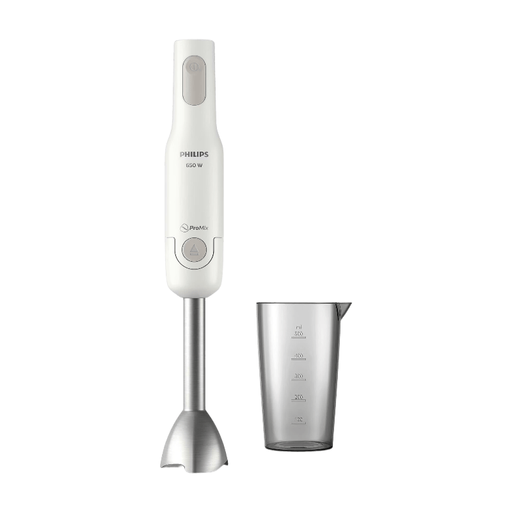
Why it suits this profile: Ideal for households that regularly make soups, sauces and purées, and value a metal blending shaft and measuring jug.
The product information lists a splash guard, metal shaft and detachable blending shaft. Just remember to check the maximum operating time of one minute.
650 W, 15,000 rpm according to the product specifications, a 1.2-metre cord and a measuring jug.

Why it suits this profile: A household that makes larger portions, smoothies and several recipes each week can make good use of the roomy jug and range of programmes.
The capacity and features are clearly stated: a 2.1-litre jug, 700 ml cup, 1200 W and four automatic programmes. It does need enough storage space, though.
Large capacity, 14 manual speed settings and programmes for tasks such as chopping, grinding and pulsing.

Why it suits this profile: A student, gym-goer or commuter who wants to make a single smoothie without needing a socket gets a compact cup with a carry handle.
The product details list a 0.48-litre capacity, USB-C charging, detachable parts and a sealable drinking lid. The capacity is still best suited to one serving.
Around one hour to charge, more than 15 blends per charge according to the product information, and a leakproof lid.
We’ve put together a complete, up-to-date list of products that meet these strict selection criteria and comply with current European safety regulations.
For soft ingredients and simple sauces, 100 to 300 W may be enough. For making soups and purées regularly, or blending tougher ingredients, 600 W or more is a sensible choice. As well as power, check the operating time, blade design and ingredients the blender can handle.
It depends on the model. According to the product information, portable blenders from brands including Xiaomi and Nutribullet are not designed for hot liquids. A stick blender may be more convenient for soup, but always follow the instructions and take care to avoid splashing.
A corded model uses electricity while blending; for short bursts, consumption is generally low. A cordless blender uses a built-in battery that needs charging. The running costs depend on the power, how often you use it and how you charge it. Before buying, also check the warranty and availability of replacement parts.
