
Vandaag of morgen in huis

Kwaliteit gegarandeerd

Welkomstaanbiedingen ontgrendelen: GRATIS bezorging | Tot 80% korting | Gratis 30 dagen JoyPlus-proefperiode
Download de app
A blender may seem easy to choose: look at the wattage, capacity and number of programmes. Yet many households buy an appliance that does not really suit the way they use it. A compact smoothie blender may be convenient for one person, for example, but impractical for a family. A powerful blender can process a wide range of ingredients, but takes up more space and often requires additional cleaning.
If you are planning to buy a blender, it is therefore worth considering how you will use it first. Do you mainly make smoothies, want to purée soup, chop nuts and herbs, or need a blender for baby food? Below, you will find the key points to consider, along with a selection of models for different types of user.
Higher power does not automatically mean that every recipe will turn out better. The blade design, rotation speed, blending jug and recommended usage time also play a role. Check whether the stated power is nominal or maximum. The Cecotec Power Black Titanium, for example, states 1300 W maximum power, while other models show rated power or standard motor power.
For soft vegetables and fruit, a more modest motor is often sufficient. For frozen fruit, ice or harder ingredients, a kitchen blender with more power and a pulse function is more practical.
A 1.5-litre jug does not always mean that you can fill it with 1.5 litres at once. The maximum fill line in the manual is the important guide. A large jug is useful for making several portions, but a 400 to 500 ml mini blender is more efficient if you usually make a single smoothie.
Also consider the size of the appliance. A blender with a large capacity can be difficult to store on a small kitchen worktop.
A stick blender, also known as a hand blender, is flexible because you can purée ingredients directly in a pan or bowl. A blender with a chopper and whisk can also replace several kitchen tools. On the other hand, extra accessories also mean more parts to wash.
Therefore, check:
For smoothies made with soft fruit, a compact blender of around 250 to 350 W is often sufficient. For frozen fruit, nuts or ice, a powerful blender with a higher motor specification is more suitable. Do not just look at the number of speeds. A pulse function delivers short, powerful bursts and is useful for chopping ingredients more coarsely or processing ice.
Brands may, of course, describe performance in their own way. Phrases such as ‘perfect results’ or ‘lump-free’ come from the brand’s product description and are not a universal guarantee. Instead, focus on verifiable information such as wattage, rotation speed, blade material, capacity and programmes.
A blender for soups and smoothies should suit the size of your portions. A 1.2 to 2.1-litre jug is practical for a family. A 350 to 800 ml cup is better suited to individual shakes, sauces or baby food.
When it comes to materials, consider:
A blender should stand securely and only operate when the jug or lid is fitted correctly. Check whether the model has non-slip feet, a locking mechanism and clear maximum fill markings. The product information may mention a CE marking, but always follow the manual for assembly, cleaning and maximum usage time.
Do not use boiling-hot liquids in a portable blender unless the manufacturer expressly permits this. For models with a lithium battery, such as a cordless blender, charging should be carried out in accordance with the safety instructions.
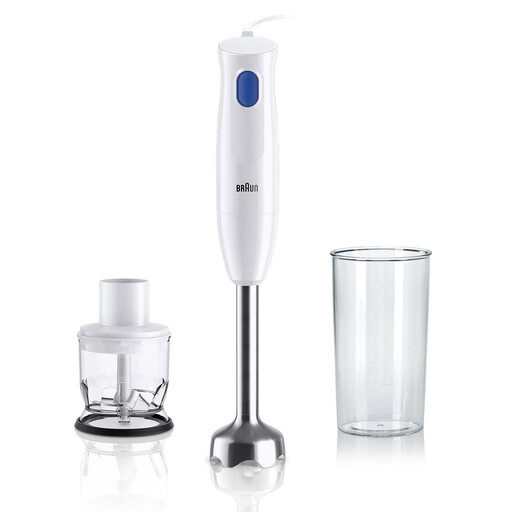
Why it suits this profile: This hand blender is designed for simple preparations such as smoothies, sauces and desserts. The 450W motor, single speed and included 600 ml measuring jug keep operation straightforward.
You are not paying for a large number of programmes that you may never use. The product information mentions an EasyTwist system and dishwasher-safe cleaning for certain parts; check the manual for details.
Lightweight design, one-button operation, 600ml BPA-free measuring jug and a 350ml chopper, according to the product details.

Why it suits this profile: This model is ideal for households that want to combine large portions, manual settings and multiple programmes. The jug has a capacity of 2.1 litres and the motor is rated at 1200W according to the specifications.
The generous jug makes it clear what you are paying for: several portions in one go. The product description also mentions a pulse function, ice crusher and 14 manual speeds.
2.1L jug, 700ml cup, 1200W power and separate programmes for chopping, grinding and pulsing.

Why it suits this profile: If you regularly process larger quantities, hard ingredients or ice, this countertop model offers a 1.5-litre jug, four blades and two speeds.
The product details state the maximum power, rotation speed, number of blades and a separate pulse function. This allows you to compare the core specifications rather than relying on a marketing term alone.
1300W maximum power, 1.5L capacity, four titanium blades, two speeds and an ice-crushing function according to the product description.
For students, sports enthusiasts and travellers, a cordless blender with a small cup is often more convenient than a large countertop model. The Nutribullet Portable has a capacity of 475 ml, USB-C charging and a stated operating time of 20 minutes. Xiaomi offers a 400 ml portable blender with a USB-C connection. Use these appliances in accordance with the safety instructions and do not blend hot liquids when this is not permitted.
A blender with a chopper or a 4-in-1 stick blender is better suited to anyone who wants to prepare soup, sauces, whipped cream, herbs and baby food. The ochama Hand Blender 600W comes with a whisk, 500ml chopper bowl and 800ml cup. Hygiene remains important when preparing baby food: wash the parts immediately after use and follow the manufacturer’s age and safety information.
We have put together a complete, up-to-date list of products that fully meet these strict selection criteria and the applicable European safety regulations.
Only if you often make iced drinks, smoothies with frozen fruit or milkshakes. Check whether the manual permits processing ice and use the pulse function when available. This function is not essential for soft-fruit smoothies.
Its lifespan depends on how often it is used, the workload, cleaning and whether the maximum usage time is observed. Allow the motor to cool down after heavy preparations and avoid overloading it. The statutory guarantee in the EU is generally at least two years, but check the terms for each product and seller.
Consumption depends on the power rating and how long the blender is used. In theory, a 1200 W motor uses less energy when running for one minute than when used continuously for ten minutes. Short preparation times, the right amount of liquid and an appropriate speed can help prevent unnecessarily long blending.
