
Vandaag of morgen in huis

Kwaliteit gegarandeerd

Welkomstaanbiedingen ontgrendelen: GRATIS bezorging | Tot 80% korting | Gratis 30 dagen JoyPlus-proefperiode
Download de app
A blender can quickly prepare smoothies, soups, sauces and iced drinks. However, the differences between models can be substantial. A compact smoothie blender for one person needs different features from a kitchen blender for a family or a machine designed for intensive daily use.
The product name does not tell you the whole story. Pay particular attention to these common pitfalls:
For soft ingredients such as bananas, yoghurt or cooked vegetables, a lower power rating is often sufficient. If you regularly want to process frozen fruit, nuts, hard vegetables or ice, it is better to look for a powerful blender with a suitable blade design and pulse function.
A 1000-watt blender is a practical mid-range choice for many households. According to their product specifications, 1200- or 1300-watt models offer more motor power, but that does not mean every recipe will automatically be blended faster or more smoothly. Also check:
For hot soup, a sealed jug with clear temperature instructions is important. For example, the Philips HR3020/20 states that ingredients must not be hotter than 80 °C. Allow hot ingredients to cool when instructed to do so in the manual.
A compact countertop blender with a capacity of 500 to 700 ml is suitable for one person and is handy for a smoothie to take with you. For two people, around 1 litre of usable capacity is often more practical. A blender for the whole family needs more capacity, but pay attention to the difference between the total jug capacity and the working capacity.
A model with a 1.5-litre jug is suitable for several portions, while according to the product information, the Ninja Detect Blender Pro has a 2.1-litre jug and a 700 ml cup. Check in advance whether the jug will fit in your kitchen cupboard. Also consider its height if you plan to position the blender underneath wall cupboards.
A blender with a glass jug feels sturdy and is less likely to absorb colour or odours. On the other hand, a glass jug can be heavier and may break if dropped. Plastic jugs are lighter. When choosing plastic, check the stated material and whether the parts are BPA-free, if that is an important purchase criterion for you.
Also check whether:
A dishwasher-safe blender generally does not mean that the entire blender can go in the dishwasher. The motor base should be cleaned with a slightly damp cloth. Always unplug the appliance before cleaning, assembling or disassembling it, and never touch the sharp blades with bare hands.
The selection below is based on verifiable product details, such as power, capacity, functions and materials. Where a brand describes a function or technology, this information comes from the brand’s product description.
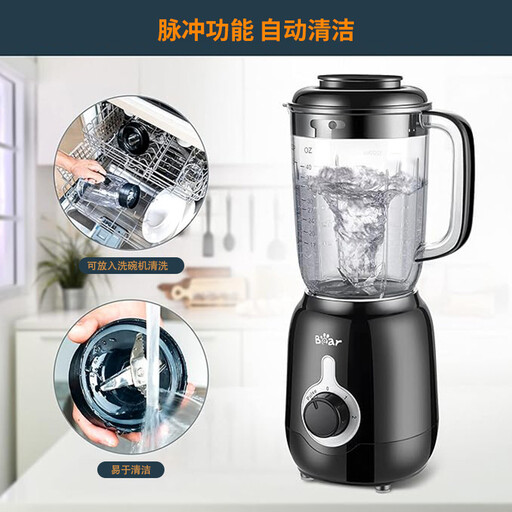
Why it suits this profile: The 1.2-litre capacity is suitable for several glasses, while 500 watts and two speeds offer a straightforward starting point for smoothies and cold preparations.
The specifications clearly state the power, capacity, blades and pulse function. This means you do not have to rely solely on a general marketing term.
1.2-litre capacity, four stainless-steel blades, pulse function, and included grinding and chopping cups.

Why it suits this profile: According to the product information, this model combines 1200 watts, a glass jug, three programmes, a touchscreen and a pulse function for a range of preparations.
The relevant functions are listed separately: manual speed control, pulse, ice crush and Auto-Clean. However, check the user manual for temperature and filling limits.
1200 watts, 2-litre total jug capacity with a 1.5-litre working capacity, glass jug and dishwasher-safe jug according to the product description.

Why it suits this profile: The 2.1-litre jug, 700 ml cup, 14 manual speeds and automatic programmes are suitable for larger portions and a wide range of recipes.
In addition to 1200 watts, the speeds, programmes, portion size and safety warnings are listed. According to the product description, BlendSense adjusts the settings to suit the ingredients and quantity.
2.1-litre jug, 1200 watts, 14 manual speeds, four automatic programmes and ice-crushing function.

Why it suits this profile: This blender has three speeds, pulse, a 2-litre jug with a 1.5-litre working capacity, and removable parts for easy maintenance.
The product specifications distinguish between total capacity and working capacity. The cleaning setting and dishwasher-safe removable parts are also listed separately.
1000 watts, three speeds plus pulse, removable blade unit and dishwasher-safe removable parts according to the product information.
We have put together a complete, up-to-date list of products that fully meet these strict selection criteria and the applicable European safety regulations.
For soft smoothies, a lower power rating is often sufficient. For frozen fruit and ice, a model with around 1000 watts or more is a sensible choice, preferably with a pulse or ice-crushing function. Also check the manufacturer’s instructions and always use enough liquid when recommended.
No. Check the permitted temperature and maximum working capacity. Some blenders must not process liquids above a certain temperature. Allow soup to cool if the manual says to do so, and close the lid securely before starting.
The lifespan depends on use, maintenance and workload. A blender that is regularly overloaded or operated for too long at a time may wear out more quickly. Follow the maximum operating time, clean the removable parts immediately after use, and check the jug, lid, blade unit and cable regularly. In the Netherlands, consumers are also covered by the statutory guarantee under the applicable EU and national consumer protection rules.
