
Vandaag of morgen in huis

Kwaliteit gegarandeerd

Welkomstaanbiedingen ontgrendelen: GRATIS bezorging | Tot 80% korting | Gratis 30 dagen JoyPlus-proefperiode
Download de app
Buying a blender might seem straightforward, until you look at the differences in motor power, jug capacity, blades and programmes. A compact model can be handy for a single smoothie, while a blender with a large jug is better suited to a family. And a powerful blender isn’t automatically right for every recipe.
When comparing, focus on verifiable specifications. Marketing terms like “professional”, “ultra-powerful” or “perfect results” don’t tell you much without information on power, capacity, materials and usage time.
A high wattage can indicate a strong motor, but it doesn’t tell you everything about performance. The shape of the jug, blade design, speed control and the maximum continuous running time all play a part. A blender for frozen fruit or a blender with an ice crusher generally demands more from the motor than a model for soft banana and yoghurt.
So check:
A 1.5 or 2 litre jug isn’t always usable right up to the rim. With hot liquids, stricter filling instructions often apply. What’s more, a large blender jug takes up more space on your worktop and in your kitchen cupboard.
A blender with a large jug is practical for multiple portions, but for a single user, a personal blender to go can mean less washing up and less waste.
A multi-function blender with lots of programmes sounds appealing, but extra buttons and accessories can make the appliance more complicated. If you mainly juice oranges and grapefruits, you might be better off with a separate citrus juicer. For soup, sauces and small quantities, a stick blender can be simpler.
For smoothies with soft fruit, a compact model is often sufficient. If you regularly crush ice, process frozen fruit or make hummus and pesto, you could look at a powerful blender with a higher stated power and a suitable blade construction.
Examples from the range:
Always use small quantities of hard ingredients as per the instruction manual. For the ochama, for example, it states that the motor should not run continuously for longer than one minute and must then rest.
Choose the capacity based on your household:
Also consider the material. Glass is heavy and can hold heat differently to plastic. Tritan beakers are lightweight and are often used for takeaway cups. Also check whether parts are dishwasher-safe and whether separate accessories are available.
A pulse function helps you mix briefly or loosen ingredients. For daily use, a well-sealing lid, non-slip feet and a safety lock that prevents operation without the jug are more important than a large number of settings.
Sharp blades should not be cleaned by hand between the blades. Unplug the appliance before removing parts and never immerse the motor base in water. With hot liquids, follow the manufacturer’s instructions; some models may only be partially filled.

Why this fits the profile: This model combines a 1.5 litre capacity with three speeds and functions for juice, baby food and grinding. That makes it a practical choice for daily use without immediately going for a larger appliance.
The product information states the power, capacity and maximum running time. This allows you to compare capabilities without relying solely on marketing language.
600 W motor, 1.5 litre jug, three speeds and disassembly for easy cleaning.

Why this fits the profile: The combination of 1200 W, a 2.1 litre jug, a 700 ml beaker and multiple programmes suits households that make both large portions and smoothies.
The functions are clearly described: 14 manual speeds, four programmes and a setting for ice crushing. According to the manufacturer, BlendSense recognises different ingredients and portion sizes; treat this as an automatic control feature, not a guarantee for every recipe.
1200 W motor, large 2.1 litre jug, 700 ml beaker and separate programmes for chopping, grinding and pulse.
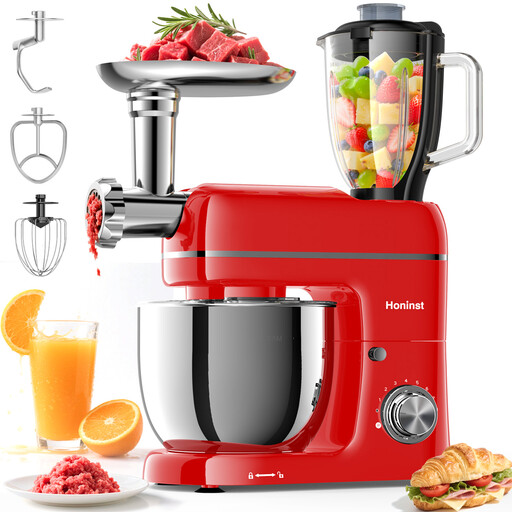
Why this fits the profile: This is more than just a standalone blender: the appliance combines a mixer, blender and meat grinder with a stainless steel bowl of 6 QT.
The extra cost of a multi-function food processor only makes sense if you also make dough, cream, mince or sauces. The instruction manual limits use to normal household quantities.
Maximum 1300 W, 6 QT stainless steel bowl, eight speeds and pulse function with multiple accessories.
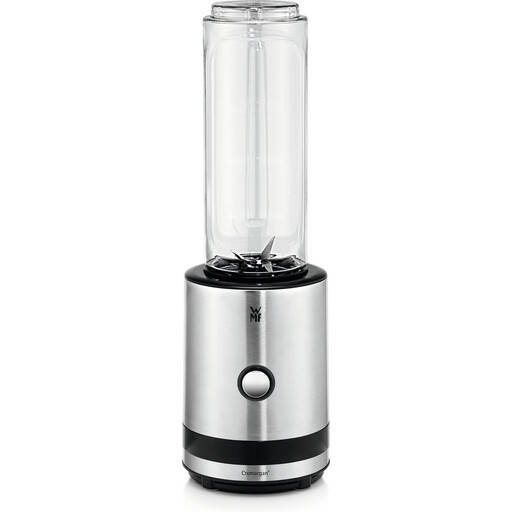
Why this fits the profile: The compact capacity and two Tritan drinks bottles are designed for a single portion you can take to work, school or training.
The small capacity prevents you from buying a large jug for individual smoothies only. According to the product information, the bottles are dishwasher-safe.
0.6 litre capacity, two drinks bottles, four stainless steel blades and a safety lock that prevents blending without the jug in place.
We’ve put together a full, up-to-date list of products that fully meet these strict selection criteria and comply with current European safety regulations.
Not every preparation calls for a countertop blender. A citrus juicer like the Nedis KAJC100CWT uses 25 W, has a jug of around 0.7 litres and automatically rotates left and right. That’s suitable for daily orange juice, but not for smoothies with fibrous ingredients.
A stick blender like the Braun MultiQuick 3 MQ3000WH has 700 W, two speeds and a measuring beaker of 600 ml. This type is handy for soup, sauces and small portions. Do check the stated running time; for this model, one minute of continuous use is specified.
For soft ingredients, a lower power is often sufficient. For frozen fruit, ice and hard ingredients, a model with more power and a suitable ice crusher function makes more sense. Look beyond wattage at the running time and the manufacturer’s instructions.
The lifespan depends on use, maintenance, overloading and cleaning. Let the motor cool down when the instruction manual advises it, do not exceed the maximum fill level and do not use hard objects not intended for the appliance. In the European Union, consumers are at least covered by the statutory conformity guarantee; for several of the models mentioned, a period of at least two years is stated.
The consumption depends on the power and the running time. An appliance of 1200 W running for one minute theoretically uses around 0.02 kWh. In practice, the total cost therefore mainly depends on how often and how long you blend. A 25 W citrus juicer uses less per use, but of course has different applications.
