
Vandaag of morgen in huis

Kwaliteit gegarandeerd

Welkomstaanbiedingen ontgrendelen: GRATIS bezorging | Tot 80% korting | Gratis 30 dagen JoyPlus-proefperiode
Download de app
A blender can be useful for smoothies, sauces, soups and chopped ingredients. However, the differences between a countertop blender, immersion blender and multifunctional appliance are significant. A model that looks powerful on paper may not be the right fit for your kitchen, preferred batch size or cooking routine.
The three most common buying mistakes are easy to avoid:
The right choice starts with the types of preparations you make most often.
An immersion blender, also known as a stick blender, is compact and suitable for soups, purées, sauces and small portions. You blend directly in a saucepan or bowl, saving both storage space and washing-up. Pay close attention to the temperature instructions, though: some manufacturers recommend allowing hot liquids to cool first.
An immersion blender with accessories can also chop ingredients or whip cream and egg whites. Always check which components are actually included. Product names such as “4-in-1” or “multifunctional” may refer to different accessory sets.
A countertop blender has a fixed jug and is practical for smoothies, milkshakes, cold drinks and larger batches of soup. A blender with an ice-crushing function is worth considering if you frequently use frozen fruit or ice. Check whether ice crushing is a dedicated function and what maximum quantity the manual permits.
A food processor with blender is designed for anyone looking to combine several appliances. In addition to blending, such a set may chop, slice, grate, knead or mill. The trade-off is that the main unit and accessories require more storage space. If you mainly make smoothies every day, this type of multifunctional blender may be unnecessarily elaborate.
The stated wattage, such as 450 W, 800 W, 1000 W or 1200 W, is a technical specification of the motor. It does not fully predict the final result. The blade design, speed, amount of liquid and firmness of the ingredients also play a role.
Also check the recommended runtime. The 600 W ochama blender, for example, specifies a maximum of one minute of continuous use, followed by two minutes of rest during demanding blending cycles. The ROUNY immersion blender likewise specifies a one-minute operating interval, followed by one minute of rest. This is important if you plan to prepare large quantities or thick mixtures.
For one or two glasses, a 500 to 800 ml cup may be sufficient. For a family, a 1.2 to 2.1-litre jug is more practical. Take the recommended fill line into account, as well as the space needed for ingredients that rise during blending.
A glass jug, such as the one supplied with the Tefal BlendForce 2, feels sturdy and includes measurement markings. Glass is heavier than plastic, however. A BPA-free plastic cup is lighter and easier to handle. Check the product information to see which components are BPA-free and which are dishwasher-safe.
Multiple speed settings provide greater control, but they are not essential for everyone. A blender with two speeds and a pulse function may be perfectly adequate for simple smoothies and sauces. A model with 20 or 25 speeds is better suited to users who want to fine-tune texture precisely.
Also look for:
According to the product description, the Braun MultiQuick 5 Pro offers 25 speeds, a turbo setting and a chopper with three texture settings. The manufacturer states that the chopper can also process ice cubes; follow the accessory and quantity guidance provided in the manual.
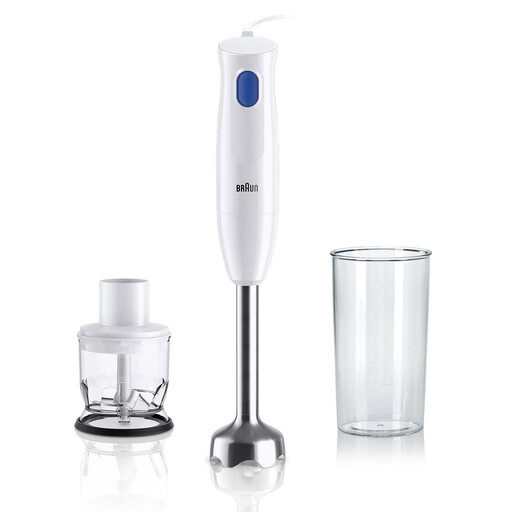
Why it suits this profile: This compact stick blender offers simple one-speed operation and a 450 W motor. It is suitable for smoothies, sauces and small everyday preparations.
The product information does not overstate the feature set. You are paying for an immersion blender, a 600 ml measuring cup and a 350 ml chopper, with some dishwasher-safe components according to the manual.
450 W motor, one-button operation, EasyTwist system and BPA-free 600 ml measuring cup.

Why it suits this profile: This model is aimed at users who regularly prepare smoothies, cold drinks and larger batches, while enjoying the flexibility of combining manual settings with automatic programmes.
The specifications list concrete features: 14 manual speeds, four programmes, a 2.1-litre jug and a 700 ml cup. This makes the capacity clearer than on models without measurement markings.
1200 W, ice-crushing function, 2.1-litre jug, 14 speeds and BlendSense function according to the product description.
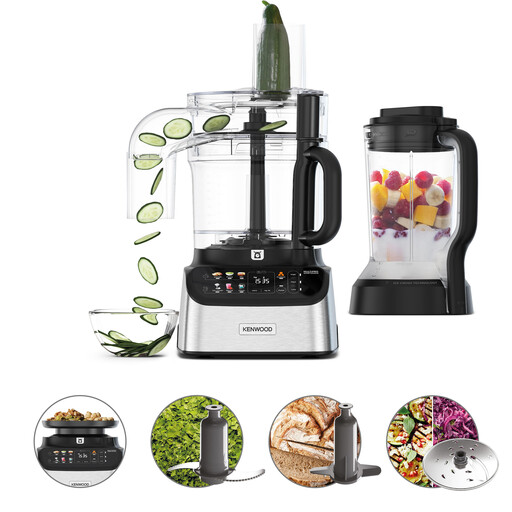
Why it suits this profile: A practical choice for home cooks who want to weigh, chop, slice, grate, knead and crush ice as well as blend—all with one kitchen appliance.
The functions are linked to specific components, including a 1.5-litre blender jug, dough hook, slicing and grating disc and integrated scales. Check that you have enough storage space before buying.
1000 W, six programmes, 1.5-litre blender jug and multiple food processor functions.
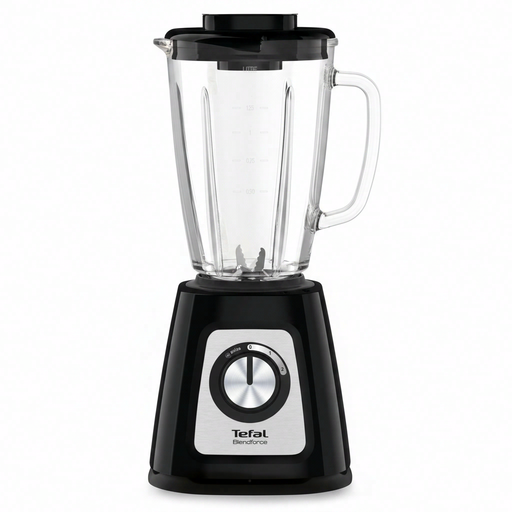
Why it suits this profile: This countertop blender is a good fit for households looking for a fixed jug for smoothies, cold drinks and batches of up to 1.25 litres.
The product information specifies 800 W, two speeds, pulse and a dedicated ice-crushing setting. This makes it clear which functions you get, rather than relying on a general claim about power.
800 W, 1.25-litre glass jug, pulse function, ice-crushing setting and dishwasher-safe components according to the product description.
We have compiled a complete, up-to-date list of products that fully meet these rigorous selection criteria and the applicable European safety regulations.
A longer service life depends primarily on using the appliance appropriately, cleaning it correctly and staying within the recommended capacity. Most products mentioned in this guide are supplied with statutory consumer rights; check the specific product page and terms for full details.
An immersion blender is convenient for blending soup directly in a saucepan and for preparing small portions. If you want to make several smoothies at once, a countertop blender with a jug of around 1.2 litres or more is more practical. Always check the instructions for your chosen model when preparing hot mixtures.
A 450 to 600 W model may be sufficient for simple smoothies and sauces. For ice, frozen ingredients or thick mixtures, models from 800 W upwards are worth considering, provided the manual permits this type of use. In addition to wattage, look at the blade design, speed settings and maximum runtime.
Power consumption depends on the wattage and operating time. An 800 W appliance running for five minutes theoretically uses around 0.067 kWh. In practice, blending cycles are often shorter. The purchase price, cleaning time and available accessories therefore usually have a greater impact on total running costs than a few minutes of electricity consumption.
