
Vandaag of morgen in huis

Kwaliteit gegarandeerd

Welkomstaanbiedingen ontgrendelen: GRATIS bezorging | Tot 80% korting | Gratis 30 dagen JoyPlus-proefperiode
Download de app
A blender can be useful for smoothies, sauces, soups and chopping ingredients. However, a high wattage does not tell you everything. A large appliance can be impractical in a small kitchen, while a portable blender is not always suitable for hard ingredients or larger portions.
As a Joybuy Product Recommendation Officer, I therefore focus mainly on verifiable specifications: power, capacity, functions, accessories, materials and ease of cleaning. This helps you avoid paying for features you will rarely use.
A powerful blender with, for example, 1,200 or 1,300 watts sounds appealing, but the result also depends on the blades, jug design, speed and operating time. A smoothie blender also has different requirements from a hand blender for soup.
Therefore, check:
High power does not guarantee that every ingredient will be processed without problems.
A 2-litre jug may have a lower maximum fill level in practice. For example, Philips lists a 2-litre jug capacity and a working capacity of 1.5 litres for the HR3020/20. This difference is important for families and when preparing several portions.
Never fill a blender above the indicated line. Extra care is needed with hot liquids: follow the instructions and allow the ingredients to cool if the product is not suitable for hot preparations.
A blender with a chopper, whisk or extra cup can be versatile, but first check whether you really need these accessories. More components also mean more parts to store and clean.
Pay attention to:
Sharp blades must always be handled carefully, even when a component is dishwasher-safe.
A compact smoothie blender may be sufficient for simple smoothies and soft ingredients. A kitchen blender with multiple speeds gives you more control over the texture. A pulse function is useful for short bursts of power, for example when processing coarser ingredients or ice.
According to the product description, the Cecotec Power Black Titanium has a maximum power of 1,300 watts, a speed of up to 20,000 revolutions per minute, two speeds and a pulse function. The manufacturer also mentions four blades and an ice-crushing function. This information comes from Cecotec’s product description; see the manual for permitted ingredients and operating times.
A hand blender works differently. You move the appliance through a pan, bowl or cup and usually have more control over small quantities. For everyday cooking, a hand blender with a chopper and whisk may be more practical than a large jug.
Choose the capacity based on how you intend to use it:
A glass jug is relatively heavy, but feels sturdy and is less prone to discolouration. Plastic or Tritan is often lighter, making it suitable for a portable blender. Always check whether the material is BPA-free if this is important to you. A statement such as “BPA-free” should come from the product specifications or the manufacturer’s documentation.
A blender with removable blades or dishwasher-safe parts can save time. According to the product information, the Philips HR3020/20 has removable blades, a manual cleaning setting and removable dishwasher-safe parts. The product information also states that liquids must not be hotter than 80 °C.
Before buying, also check:
Do not run a blender empty and unplug it before assembling, disassembling or cleaning it.
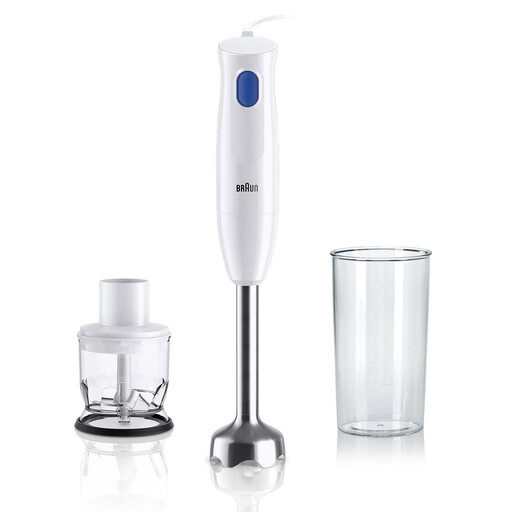
Why it suits this profile: This compact hand blender is suitable for simple smoothies, sauces and small preparations. Its one-speed control keeps things straightforward for anyone who does not need lots of settings.
The focus is not on unnecessarily high power, but on a lightweight housing, straightforward controls and a 600 ml cup for small portions.
450 watts, a BPA-free 600 ml measuring cup and an EasyTwist system for accessories. According to the product information, a 350 ml chopper is included.

Why it suits this profile: This model is well suited to households that prepare large portions and want extra settings for different types of preparation.
The 2.1-litre jug offers more space than a personal blender. The specifications list 14 manual speeds, four programmes and a pulse function.
1,200 watts, a 2.1-litre jug and a separate 700 ml cup. According to Ninja, BlendSense adjusts the time and speed based on the ingredients; this is a brand claim from the product description.

Why it suits this profile: This hand blender is designed for users who want to chop as well as blend and create different textures.
The 25 speeds and turbo button offer more adjustment than a simple one-button blender. The chopper has three texture settings and, according to the product information, is suitable for ice cubes.
1,000 watts, SplashControl to help prevent splashes and an EasyClick system for accessories. The manufacturer states that the parts are dishwasher-safe; check the manual for details.
We have put together a complete, up-to-date list of products that fully meet these strict selection criteria and the applicable European safety regulations.
A portable blender or cordless blender is particularly handy for making a single drink while you are out and about. According to the product specifications, the Ninja Blast BC251EUGY has a rechargeable battery, USB charging and two 530 ml cups. The Nutribullet Portable has a capacity of approximately 475 ml and is also designed for smoothies and shakes.
For crushing ice, making large portions or preparing hot ingredients, a countertop model is generally more suitable. A mini blender saves space, but usually has a smaller capacity. So decide how you will use it first, and choose the size afterwards.
Lower power may be sufficient for soft ingredients and simple smoothies. For hard ingredients, ice or larger portions, a model with more power and a pulse function is more practical. Always look at the complete product specifications and permitted operating time, not just the wattage.
Its lifespan depends on usage, maintenance, overloading and following the instructions. Allow the motor to cool when instructed, do not run the blender empty and clean the blades carefully. The statutory consumer guarantee in the EU is at least two years, but this is separate from the product’s total lifespan.
Electricity consumption depends on the power rating and operating time. In theory, a 1,000-watt appliance running for one minute uses approximately 0.017 kWh. In practice, consumption is affected by the actual load and the programme selected. Higher power therefore does not automatically mean high costs when you use the appliance for a short time.
