
Vandaag of morgen in huis

Kwaliteit gegarandeerd

Welkomstaanbiedingen ontgrendelen: GRATIS bezorging | Tot 80% korting | Gratis 30 dagen JoyPlus-proefperiode
Download de app
A blender can quickly prepare smoothies, soups, sauces and shakes. But not every model is right for every kitchen. A compact personal blender is handy for making a single serving, while a large jug is better suited to family use. And if you mainly make hot soup, your needs will differ from those of someone who regularly blends ice and frozen fruit.
When comparing models, don’t focus only on wattage or a long list of accessories. Below, you’ll find the main buying pitfalls, key technical points and some popular options for different needs.
A higher wattage doesn’t automatically mean a blender will handle every recipe better. The shape of the jug, blade design, amount of liquid and maximum filling capacity all affect the result too. A powerful blender with 1200 watts may be suitable for ice and hard ingredients, but it often takes up more space and can be noisier.
For soft ingredients such as banana, yoghurt and cooked vegetables, a lower wattage is often enough. So consider how you’ll use the blender overall, rather than focusing only on the number on the packaging.
A stick blender or hand blender is used directly in a saucepan, bowl or measuring jug. It’s handy for soup, sauces, baby food and small quantities. A jug blender blends ingredients in a lidded jug and is often more practical for smoothies, ice and larger portions.
A stick blender is usually compact to store. A blender with a cup or jug takes up more space, but can save time when you’re making several portions.
A blender with accessories may come with a whisk, chopper, measuring jug or extra drinking cup. That sounds versatile, but check whether you really need these attachments. Also see which parts are dishwasher-safe and which need to be washed by hand.
Check whether ice can only be crushed in the chopper, too. Some models have specific instructions for this.
Use these guidelines as a starting point:
A manufacturer may claim performance benefits such as “extra-fine results” or a certain percentage improvement. Don’t take these as a guarantee for every recipe. A brand’s own research may show that a technology offers an advantage under specific test conditions, but your ingredients and preparation method will still make a difference.
A personal blender with a capacity of around 500 to 700 ml is suitable for making one smoothie or shake. A 1.5 to 2.1-litre jug is better for families or several portions of soup. Always check the usable capacity. The maximum capacity isn’t always the same as the amount you can safely blend at once.
A blender with an ice-crushing function should also be suitable for the amount of ice you want to blend. Don’t fill the jug above the marked line.
Multiple speeds give you more control over thin and thick mixtures. A model with one button, on the other hand, is easy to use for everyday puréeing. Look out for these practical details:
Only blend hot liquids if the product instructions allow it. Let ingredients cool first where necessary. Switch off the blender and unplug it before removing blades, cups or accessories. The blades are sharp, and the motor unit must not be submerged in water.
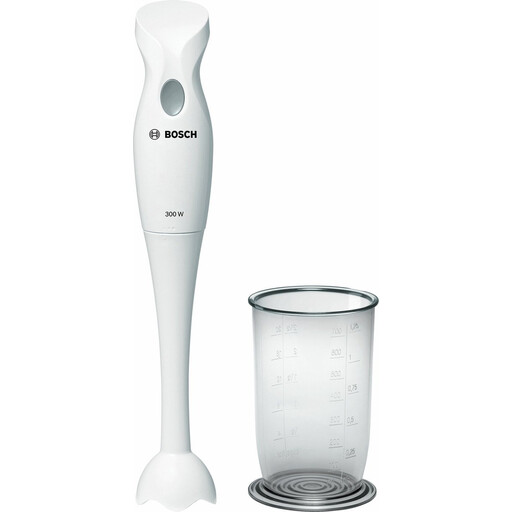
Why it suits this profile: This compact hand blender is designed for simple preparations such as sauces and puréed ingredients. The included measuring jug makes it easy to get started.
You don’t pay for an extensive set of accessories if all you want to do is purée. According to the product information, this model has 300 watts, one speed and removable dishwasher-safe parts.
300 watts, turbo function, measuring jug and a 1.5-metre cord.

Why it suits this profile: If you want more control and versatility, this model gives you a well-equipped stick blender for everyday and more demanding preparations.
The 25 speeds and turbo function mean you’re not limited to a single fixed setting that’s difficult to adjust. According to the product information, ice should only be crushed in the SizeControl chopper.
1000 watts, 25 speeds, turbo function, chopper with three textures and dishwasher-safe parts.

Why it suits this profile: This full-size jug blender is designed for larger portions, smoothies and recipes involving ice or frozen ingredients.
The choice isn’t based on power alone: the jug has a 2.1-litre capacity, there are 14 manual speeds and automatic programmes for chopping, grinding and pulsing, among other tasks.
1200 watts, 2.1-litre jug, ice crusher, 14 speeds and four automatic programmes.

Why it suits this profile: The large jug and straightforward speed selection are practical if you regularly make several glasses of smoothie, soup or sauce.
The jug has a total capacity of 2 litres and a stated working capacity of 1.5 litres. This makes it clearer how much you can prepare at a time.
1000 watts, 2-litre jug, three speeds plus pulse setting and removable blade unit.
We’ve put together a comprehensive, up-to-date list of products that meet these strict selection criteria and the applicable European safety regulations.
For one person, a personal blender with a cup of around 500 to 700 ml is practical. For several people, a jug blender with a working capacity of around 1.5 litres is more convenient. Frozen fruit also calls for sufficient power and a blade or jug design intended for the job.
How long it lasts depends on how you use and maintain it, the strain you put on it and whether you follow the instructions. Let the motor cool down when advised, don’t exceed the maximum fill line and clean the blades carefully. When buying, also check the warranty terms and whether replacement parts are available.
A blender is usually only used for a short time, so the electricity used per preparation is limited. Consumption depends on the wattage and how long you use it. A 1000-watt model running for one minute theoretically uses about 0.017 kWh. To work out the actual cost, multiply this consumption by your electricity tariff. Also consider how easy it is to clean: dishwasher-safe parts can save time, but always check which parts are suitable.
