
Vandaag of morgen in huis

Kwaliteit gegarandeerd

Welkomstaanbiedingen ontgrendelen: GRATIS bezorging | Tot 80% korting | Gratis 30 dagen JoyPlus-proefperiode
Download de app
A blender can be useful for smoothies, soups, sauces, shakes and baby food. Yet many people buy a model that becomes less suitable for their routine after just a few weeks. A large jug can take up unnecessary space, while a compact smoothie blender may struggle with several portions. A high wattage rating does not necessarily make a blender easier to use either.
In this buying guide, you’ll find out what to look for before buying a blender. The selection is based on verifiable specifications such as power, capacity, controls, materials, accessories and cleaning.
A powerful blender is often marketed primarily on the basis of its motor power. That is only one factor. The number of speeds, blade design, jug capacity and maximum operating time also determine whether an appliance is suitable for your recipes.
A 1300 watt blender can be useful for larger quantities and hard ingredients, but it is not automatically practical for making a single smoothie. Conversely, a mini blender with lower power may be the more sensible choice for everyday use on the go.
A blender with a 1.5-litre jug is suitable for several portions, but you cannot fill the jug completely. Check the maximum fill line in the instruction manual. For a household of one or two people, a personal blender of around 0.5 to 0.7 litres is often sufficient. Families may be better off looking at a 1.5-litre blender or larger.
Blades that are difficult to remove, hard-to-reach edges and parts that cannot go in the dishwasher can make everyday use less appealing. So check whether the jug, blade assembly and accessories can be removed. With a hand blender, the supplied beaker, whisk or chopper can also be more important than the motor power alone.
For soft vegetables, fruit, sauces and simple smoothies, a compact model is often sufficient. For frozen fruit, nuts or ice, a blender with an ice-crushing function or pulse function is more practical. Also check the recommended maximum operating time. Some models, for example, may run for a maximum of one minute at a time and then need to cool down.
When choosing a powerful blender, pay attention to the difference between rated and maximum power. A product description may state a maximum wattage that is not the same as the appliance’s continuous power consumption.
A blender with a glass jug is less prone to retaining odours and becoming discoloured than some plastic alternatives, but glass is heavier and can break. Tritan and other plastic beakers are lighter and often suitable for use on the go. When the container comes into contact with food, check whether the material is stated to be BPA-free.
For hot preparations, such as soup, always follow the instruction manual. Not every smoothie blender or personal blender is suitable for hot liquids. Some models specify a maximum temperature; do not exceed it.
Two speeds with a pulse function may be enough for many everyday tasks. Automatic programmes are particularly useful if you often make the same preparations. Non-slip feet, a locking system and a tightly fitting lid help reduce the risk of the blender moving or spilling.
The blades are sharp. Unplug the appliance before removing or cleaning any parts. Never immerse the motor base in water.
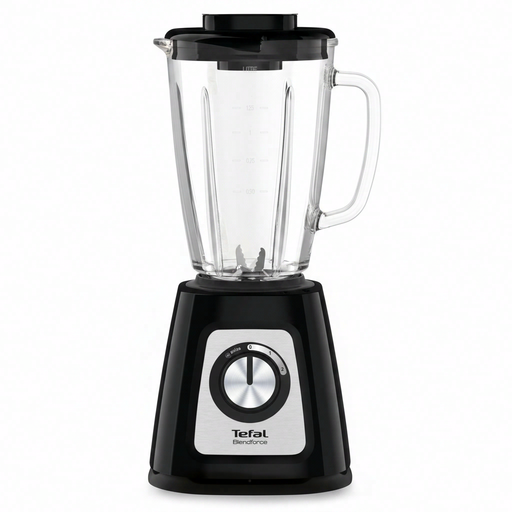
Why it suits this profile: The 1.25-litre glass jug provides enough space for several glasses, while the controls remain straightforward for everyday use.
The specifications list not only 800 W, but also 2 speeds, pulse and ice-crushing modes. This means you look beyond the wattage alone.
1.25-litre glass jug, 800 W, safety lock, non-slip feet and dishwasher-safe parts according to the product description.

Why it suits this profile: This model combines a large jug with automatic programmes and a touchscreen, making it ideal for users who prepare a variety of recipes.
The stated usable capacity is 1.5 litres with a 2-litre jug. This makes the difference between total and practical capacity clearer.
1200 W, heat-resistant glass jug, 3 automatic programmes, pulse function and Auto-Clean programme according to the product information.

Why it suits this profile: The combination of a 1.5-litre capacity, pulse function and separate ice-crushing function is well suited to larger portions, hard ingredients and frozen preparations.
The choice is not based solely on 1300 W: the model has 2 speeds, a rotary dial, 4 blades and a stated speed of 20,000 revolutions per minute.
1.5-litre jug, 1300 W maximum power, pulse function and 4 black titanium blades according to the product description.
We’ve put together a complete, up-to-date list of products that fully meet these strict selection criteria and the applicable European safety requirements.
For baby food, an even consistency is important, but always follow the preparation and cooling instructions. No blender is a substitute for safe food preparation or supervision.
For soft ingredients and simple smoothies, lower power is often sufficient. If you regularly process ice, frozen fruit or nuts, look for a model with more power, a pulse function and a blade design intended for these ingredients. Always consider the wattage together with the other specifications.
Its lifespan depends on how often it is used, cleaning, the level of load and whether the maximum operating time is observed. Allow the motor to cool down when instructed to do so in the manual, and do not use a damaged jug or blades. In the European Union, consumers are covered by the statutory guarantee of conformity in any event; the precise rights depend on the circumstances and proof of purchase.
Consumption per preparation is usually limited because a blender typically runs for only a short time. You can estimate energy use with: power in kilowatts × operating time in hours. An 800 W appliance running for one minute uses approximately 0.013 kWh. The actual cost depends on your energy tariff and how often you use it.
