
Households that share smoothies
You want to divide one banana smoothie between several glasses. Look at the jug’s usable capacity and make sure it suits the quantity in your recipe.


If you want to split one batch between several glasses, focus on the jug’s effective or usable capacity, not just its maximum capacity. For soft banana, a standard jug blender is often a sensible choice; a travel cup is handy for a serving on the go, while a more powerful model is mainly worth considering if you regularly want to blend ice or frozen fruit. Check which parts can be cleaned, too, and follow the instructions for your chosen model.
You want to divide one banana smoothie between several glasses. Look at the jug’s usable capacity and make sure it suits the quantity in your recipe.
If you usually use soft ingredients, a standard blender may be all you need. You may not need extra features for heavier-duty blending.
If you regularly use frozen fruit or ice, check that the specific model and its instructions allow for this.
Choose this when: you mainly blend soft banana with liquid and then pour the smoothie into several glasses.
The trade-off: the effective capacity may be lower than the maximum capacity, and a travel cup may not be included.
Choose this when: you sometimes share a smoothie at home and at other times want to take a serving with you.
The trade-off: check the exact model code and which cups are actually included with that version.
Choose this when: frozen fruit or ice is a regular part of your recipe.
The trade-off: extra power alone doesn’t tell you whether a model is suitable for your ingredients; check each model’s capabilities and instructions.
| What to consider | What to look for when buying | Who is this most relevant to? |
|---|---|---|
| Enough smoothie in one batch | Compare the effective or usable capacity with the quantity in your recipe and the fill line. | If I want to make one jug for several glasses, the capacity I can actually use matters more to me than the jug’s total capacity. Around 36% of consumers prioritise making enough servings in one batch. |
| Suitable for soft banana | Check which ingredients the manufacturer allows and what controls the model has; don’t judge the blending result by motor power alone. | If you usually make a simple smoothie with soft banana, you may not want to pay for features you rarely use. Around 29% of consumers prioritise simple blending. |
| Cleaning up after eating | Check the manufacturer’s cleaning advice for each part, including removable blades and dishwasher use. | If you want to tidy away the blender straight after sharing a meal, clear cleaning instructions matter. Around 21% of consumers prioritise easy cleaning. |
| Frozen fruit or ice | Check the capabilities and instructions for the exact model; wattage alone doesn’t guarantee a particular result. | If you regularly want to blend frozen fruit or ice, the appliance needs to suit those ingredients and your recipe. Around 14% of consumers make this a key buying priority. |
Philips lists the HR2041/41 with a maximum capacity of 1.9 litres and an effective capacity of 1 litre. For a shared meal, that difference could determine whether you can blend everything in one go.
Compare the effective or usable capacity and the fill line with the quantity in your own recipe.
If everything doesn’t fit in one batch, you may need to blend it in several rounds.
What’s included can vary between versions in the same product range. The Braun JB 3150 BK is described as a jug blender without travel cups, while the JB 3272 SI is described as coming with two bottles.
Before buying, check the full model code and what’s included in the box.
If you want to use a cup later on, check whether a compatible version or accessory is available.
Power alone doesn’t tell you whether a blender is suitable for your recipe with frozen ingredients. Consumentenbond assesses smoothie results and ice blending as separate parts of its blender reviews.
Check which ingredients are allowed in the manual, and look for a test of the exact model if texture is important to you.
The model code is important for distinguishing between versions. For example, the Philips HR2041/00 and HR2041/41 have different model codes.
Compare the full model code and product specifications before choosing a version.
The 3000 Series HR2041/41 is a jug blender for simple blending tasks.
The PerfectMix+ BL871D31 is worth considering if you want to blend ice as well as make smoothies.
The PowerBlend 3 Series includes versions with different accessories.
According to the manufacturer, the SmartSense 1500 Combo NBF550DG combines a jug with separate blending cups.
Model 16180133 is a jug blender to consider if you’re comparing glass jugs and straightforward controls.
This selection includes jug blenders for making smoothies at home, including a version with a travel cup and models whose product names also mention ice blending.
 Image unavailable
A jug blender for making smoothies for several glasses and blending ice, too.
1300 W; 1.5-litre jug; two speeds and an ice function.
 Image unavailable
Worth considering if you want to make a smoothie at home and take a serving with you, too.
800 W; 1,500 ml blending jug; 600 ml travel bottle; 300 ml chopping cup.
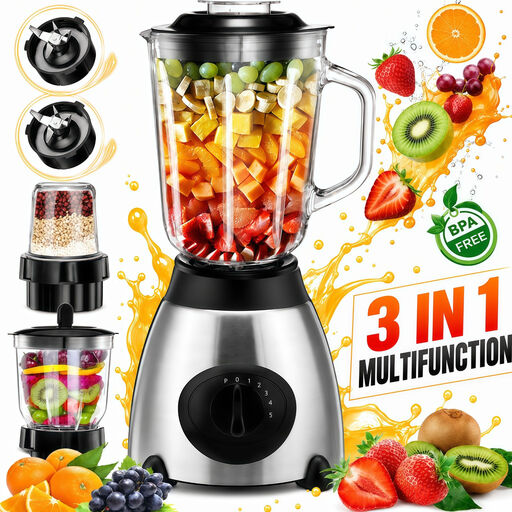 Image unavailable
A jug model for making smoothies for several people and blending ice, too.
1.5-litre jug; six blades; the product name mentions an ice function.
 Image unavailable
A jug blender to consider if you make smoothies at home and want to choose the blending setting.
600 W; 1.5-litre jug; three speeds.
 Image unavailable
A jug blender to compare if you want to make smoothies for several glasses.
1000 W; 1.5-litre jug.
Choose based on the effective or usable capacity and the quantity in your recipe. For example, Philips lists the HR2041/41 with a maximum capacity of 1.9 litres and an effective capacity of 1 litre.
Don’t assume the same rule applies to the whole appliance. Melissa specifically says that the glass jug of model 16180133 is dishwasher-safe; check the cleaning instructions for the blades, lid and other models.
Unplug the blender before attaching, removing or cleaning the jug or blades. Braun includes this warning on the product page for the JB 3150; always follow your model’s manual as well.
No. According to the Dutch government, there is no fixed period for the statutory guarantee in the Netherlands; what you can expect depends, among other things, on the product, its price and the information provided by the seller. If a product is faulty, contact the seller. A manufacturer’s guarantee is in addition to these rights.
The Netherlands Food and Consumer Product Safety Authority states that CE marking is mandatory for electrical products. Parts intended to come into contact with food must also meet the applicable Dutch and European requirements for food contact materials. A CE marking or a particular jug material alone doesn’t prove that an individual model has been independently tested.