
Small-batch cook
Do you usually make dressing or dip for yourself, and want to keep the appliance and washing-up to a minimum? Compare a hand blender with a suitable beaker. Braun says the MQ50236M comes with a measuring beaker.


For small batches of avocado dressing, a hand blender with a suitable blending beaker is a sensible first option to compare: you can blend the dressing in a separate container, then put the blender away. A personal blender may be a better fit if you also make smoothies regularly. A jug blender is worth considering mainly for larger quantities, but it takes up more storage space and needs more cleaning. Check the beaker supplied with the exact model, its cleaning instructions and the product safety information.
Do you usually make dressing or dip for yourself, and want to keep the appliance and washing-up to a minimum? Compare a hand blender with a suitable beaker. Braun says the MQ50236M comes with a measuring beaker.
If you also want to use the same appliance for drinks, compare a personal blender with the portions you usually make. The Consumentenbond describes smoothie blenders with a small blending beaker; Nutribullet lists a 700 ml beaker for the NB603DG.
Do you often make several portions of sauce or drinks, and have space to store a jug? Compare its usable capacity with the amount you prepare. Tefal lists a usable capacity of 1.25 litres for the BL5958F0.
Best for: small portions of dressing or dip, and an appliance you want to put away after use.
Keep in mind: you hold the blender while blending and use a separate beaker.
Best for: anyone who regularly makes smoothies as well as dressing, and wants to use a beaker for both.
Keep in mind: the beaker's capacity alone doesn't tell you whether it will blend your small portion well; the blade and beaker also need cleaning.
Best for: anyone who regularly makes larger quantities of sauce or smoothies and has room for a jug.
Keep in mind: a larger jug can be impractical for a single small portion, and takes up storage space and needs washing up.
Start with the amount you usually make, then consider whether you also want to use the appliance for smoothies or larger batches.
| What to consider | What should you check? | Who is this important for? |
|---|---|---|
| Small portions | Compare the beaker supplied and the shape of the blending area with your usual portion. Don't infer a minimum fill level from the wattage. | If I'm mainly making a little dressing, I want the blending set-up to suit that amount. Around 33% of consumers prioritise small portions. |
| Storage and cleaning | Check the dimensions, detachable parts and model-specific cleaning instructions. | In a shared or small kitchen, I want to avoid having lots of separate items to store and wash. Around 27% of consumers prioritise space and ease of cleaning. |
| Dressing and drinks | Check what's included with the exact model and compare the beaker with your usual portions. | If I make smoothies as well as dressing, a beaker that works for both is worth considering. Around 20% of consumers prioritise this combined use. |
| Larger portions | Compare the usable capacity, rather than just the total jug capacity, with the amount you make. | When cooking for housemates, I want enough usable capacity without choosing a jug that doesn't suit my portions. Around 20% of consumers place most importance on larger portions and long-term use. |
Total capacity is not the same as usable capacity, and doesn't tell you whether a single small portion will blend well. Tefal lists a usable capacity of 1.25 litres for the Blendforce 3 BL5958F0.
Start with your usual portion and compare it with the usable capacity and shape of the blending container.
Braun compares a claim about a finer result using a different model and an almond milk recipe. This doesn't demonstrate how the blender performs with avocado dressing.
Compare the beaker, intended use and cleaning instructions separately; don't treat a claim as proof of how it will work with your recipe.
If a product is faulty, you can also contact the retailer. The Rijksoverheid states that the Netherlands has no fixed statutory guarantee period.
Check what an additional guarantee covers and keep your proof of purchase.
MultiQuick hand blenders are an option if you want to blend dressing in a separate beaker.
The Original 600 NB603DG personal blender is an option if you want to blend drinks in a beaker as well as make dressing.
The Blendforce 3 BL5958F0 is a jug blender option for larger quantities of sauce or drinks.
This selection includes hand blenders for small batches and blenders for anyone who also wants to make sauces, smoothies or larger quantities.
 No image available
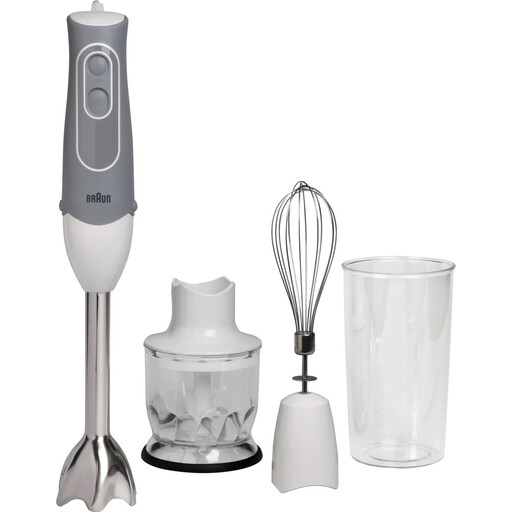
The hand blender and measuring beaker are useful if you want to blend dressing in a separate container; compare the beaker with your portion size.
The product description lists a 700 ml measuring beaker, a 500 ml chopper and a whisk. According to the description, the detachable parts are dishwasher-safe.
 No image available
This set may suit you if you make smoothies as well as sauces and want to use different containers; bear in mind that the extra parts need storage space and cleaning.
The product name lists a 1500 ml blending jug, a 600 ml travel bottle and a 300 ml chopper bowl. The description mentions dishwasher-safe accessories.
 No image available
A hand blender is an option for blending small batches in a suitable bowl or beaker.
The product name lists 600 W, two speeds and 220V. The product description mentions a 350 ml chopper and detachable, dishwasher-safe parts.
 No image available
This mini blender may suit you if you want to make sauces or smoothies; compare the jug with the amount you usually prepare.
The product name lists a 0.6-litre jug and 350 W. The description mentions two speeds, a pulse button and detachable, dishwasher-safe parts.
 No image available
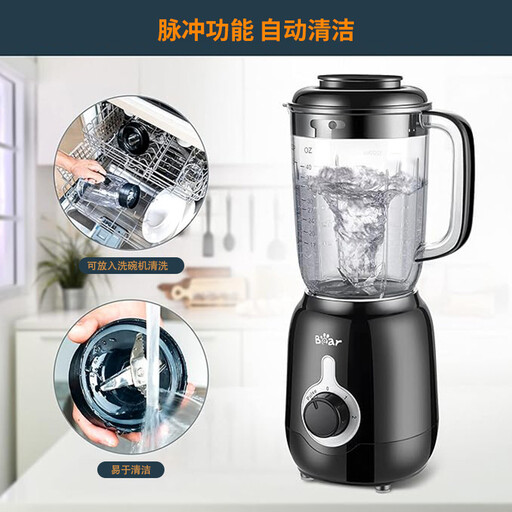
This jug blender is better suited to larger batches than a very small portion of dressing: the instructions specify a minimum of 300 ml of liquid.
The product name lists a 1.2-litre jug, 500 W, two speeds and a pulse function.
Check whether the model comes with a suitable blending beaker and follow the instructions for filling and use. The stated beaker capacity or motor power alone doesn't tell you what the minimum suitable portion is.
For the Nutribullet NB603DG, the manufacturer advises unscrewing the blade assembly and washing it with soap and water; according to the instructions, the beaker can go on the top rack of the dishwasher. Don't automatically apply these instructions to other models.
The Voedingscentrum advises covering leftovers well and putting them in the fridge within two hours of preparation. Its guidance recommends a fridge temperature of 4 °C; the ingredients in your dressing may affect how long it keeps.
Report a faulty product to the retailer. According to the Rijksoverheid, the Netherlands has no fixed statutory guarantee period: what you can expect from a product depends, among other things, on the product and the sales information. A manufacturer's guarantee is in addition to your statutory rights.
According to Ondernemersplein, the manufacturer must ensure that an appliance meets the applicable European requirements, affix a CE mark and draw up an EU declaration of conformity. Check the product information for the exact model; a statement alone doesn't prove that an individual appliance has been assessed.