
Vandaag of morgen in huis

Kwaliteit gegarandeerd

Welkomstaanbiedingen ontgrendelen: GRATIS bezorging | Tot 80% korting | Gratis 30 dagen JoyPlus-proefperiode
Download de app
Long summer days, bright city streetlights, or simply the desire to sleep in on weekends. There are plenty of reasons why you might want to make a room completely dark. Good blackout window treatments are more than just a luxury in these cases. Not only do they promote better sleep, but their insulating properties can also contribute to lower energy bills.
As a Joybuy Product Recommendation Officer, I'm here to guide you through the options. In this article, you'll find practical tips and a selection of popular products to help you make an informed choice that suits your home and your needs.
Before making a decision, it's helpful to consider a few key factors. The right window treatment depends on your window type, your desired level of light-blocking, and your interior design style.
The two most common choices are curtains and roller blinds.
The effectiveness of blackout window treatments is determined by the material. Many blackout curtains use triple-weave technology: three layers of fabric woven together to effectively block light. A thermal roller blind often has a special coating on the back, such as a silver thermal layer. This layer reflects sunlight in the summer and retains heat in the winter, which can help lower heating and cooling costs.
Measure your windows carefully before ordering. Check the product information for the dimensions of the fabric and the complete system (including the mounting hardware). Many products are sold as ready-made curtains or roller blinds, including all necessary installation accessories. This makes installation much simpler.
Based on product specifications and functionality, we have curated a selection of top options for you.

Why it stands out This roller blind from VidaXL is designed for maximum light blockage. According to the manufacturer, the thermoplastic silver layer on the back provides 100% light reduction. This makes it a popular choice for bedroom curtains where complete darkness is desired. The 140 cm width is a common size for many windows.
Pros
Who is it for? For anyone looking for a sleek, functional solution that lets in virtually no light. Ideal for bedrooms, home cinemas, or other spaces where darkness is essential.

Why it stands out These grey curtains from PONY DANCE combine style with functionality. They utilise triple-weave technology, a weaving technique with a black yarn layer in the middle that, according to the manufacturer, blocks 85-95% of sunlight and UV rays. The metal eyelets make hanging them on a curtain rod incredibly simple.
Pros
Who is it for? For those who prefer the ambiance and insulating properties of curtains. A great choice for living rooms and bedrooms where a combination of darkness, privacy, and style is desired.
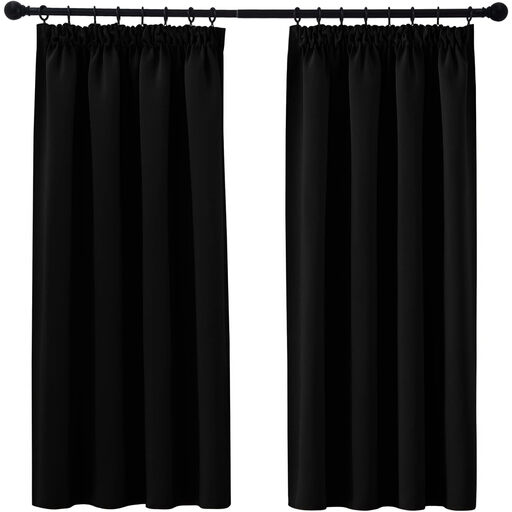
Why it stands out This version from PONY DANCE offers the same triple-weave blackout technology but features a classic pencil pleat header. This makes the curtain highly versatile, as it can be hung on a curtain rod (with hooks and rings) or a traditional curtain track.
Pros
Who is it for? For households with an existing curtain track or for those who prefer the classic look of curtains with a pencil pleat header.
Choosing window treatments is a very personal decision and depends on your specific windows. If a roller blind is more your style, or if you're looking for a different size or colour, many more options are available.
Explore more options in our Blackout Roller Blinds category.
1. What is the difference between room-darkening and blackout? Although the terms are often used interchangeably, there is a slight difference. 'Room-darkening' (or dim-out) means that a large portion of light is blocked, typically around 85-95%. 'Blackout' implies that 100% of the light is blocked, usually thanks to a special coating. For most bedrooms, a high degree of room-darkening is sufficient.
2. Do insulating curtains really help save energy? Yes, they can make a noticeable difference. The thick fabric or special coating of insulating curtains creates an extra barrier in front of the window. In the winter, this helps to keep heat in, and in the summer, it keeps the sun's heat out. This can lead to reduced heating and less reliance on air conditioning.
