
Vandaag of morgen in huis

Kwaliteit gegarandeerd

Welkomstaanbiedingen ontgrendelen: GRATIS bezorging | Tot 80% korting | Gratis 30 dagen JoyPlus-proefperiode
Download de app
A black cooker hood can look right at home in a modern kitchen, but appearance tells you little about how well it works. A glossy front can show fingerprints, a compact hood may not cover enough of the hob, and a high-capacity model can still be noisy in an open-plan kitchen. If you choose based only on colour or an appealing airflow figure, you could end up with a hood that’s impractical for your needs.
In this buying guide, we compare key specifications and match a selection of models to different uses. The features described are based on information from the manufacturer or seller. Always check the latest technical details and installation instructions before buying.
A high airflow figure sounds appealing, but real-world performance also depends on the outlet, duct length, bends and filters. With recirculation, air isn’t vented outside. Instead, the cooker hood uses a charcoal filter to reduce cooking smells. This filter is a consumable and should be replaced regularly, as specified in the product information.
For a ducted cooker hood, the diameter of the air outlet must match the instructions. A duct that’s too narrow or has too many bends can reduce performance and create extra noise.
A 60 cm cooker hood suits many standard hobs, but don’t measure the hob alone. Check the available space between wall units, the wall and any tiled edges too. A 90 cm cooker hood can provide more coverage over a wider hob.
A 52 cm model, such as a compact integrated cooker hood, can be practical in a small kitchen, but it won’t cover as much of a wide cooking area. For a kitchen island, a wall-mounted model is usually unsuitable; you’ll need an island cooker hood instead.
A quiet cooker hood won’t necessarily be quiet on its highest setting. Compare the stated maximum noise level in decibels. A difference of a few decibels can be noticeable in an open-plan kitchen. Also check the energy rating and annual energy consumption in kWh. The energy rating alone doesn’t always show the full picture.
First, choose the type of hood:
For a wall-mounted cooker hood, check the adjustable height. For example, Ciarra’s 60 cm wall-mounted models have different stated heights depending on the version. When installing a hood above a gas or electric hob, follow the minimum distance specified in the instructions.
A model suitable for both ducted extraction and recirculation gives you more flexibility when installing it. Be sure to check what’s included. Some models come with charcoal filters, while others require you to buy them separately.
A washable metal grease filter helps keep ongoing costs down. Clean it regularly according to the instructions. Product information for several models recommends cleaning every two to four weeks, depending on use. A saturated filter can restrict airflow.
Compare the airflow in m³/h at a similar setting. For example, the product information for the Ciarra CBCB6102-B lists a maximum airflow of 650 m³/h and a maximum noise level of 59 dB. The Ciarra CBCB6201 has three settings, ranging from 221 to 367 m³/h, and a maximum noise level of 63 dB.
A cooker hood with LED lighting illuminates the hob directly. Some versions have dimmable lights. A Wi-Fi cooker hood can be controlled via an app, but check whether you’ll actually use this feature. Extra technology can be useful, but it can’t make up for incorrect sizing or unsuitable ducting.
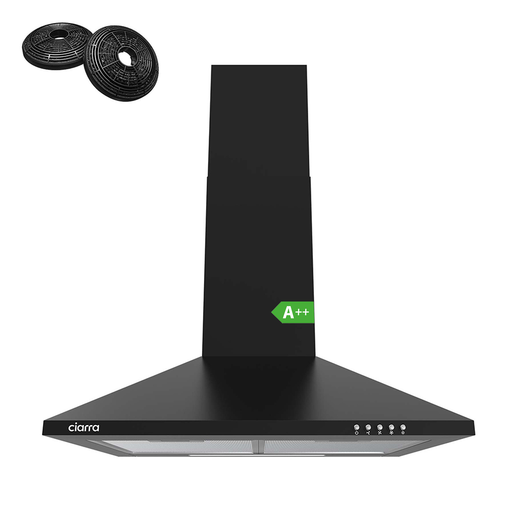
Why it suits this type of buyer: This black wall-mounted cooker hood is 60 cm wide, has push-button controls and supports both ducted extraction and recirculation. That makes it a straightforward choice for a standard kitchen or rental property where installation options are limited.
The product information lists two washable aluminium grease filters and two ventilation modes. This means you’re not immediately reliant on an external duct or a disposable grease filter.
60 cm wide, maximum airflow of 367 m³/h according to the product information, LED lighting and A++ energy rating.
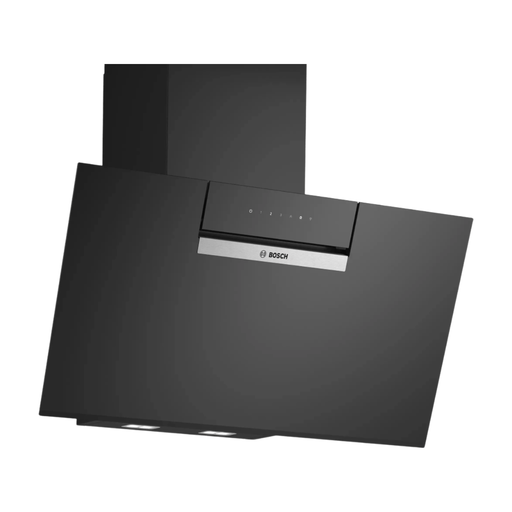
Why it suits this type of buyer: This 80 cm black wall-mounted model is aimed at people looking for an angled cooker hood with app control, LED lighting and several ventilation settings.
The product information gives separate capacity figures for ducted extraction and recirculation, and lists a dishwasher-safe aluminium grease filter. Check whether the recirculation kit is included with the version you choose.
80 cm wide, Home Connect, three settings plus intensive mode, A+ energy rating and a maximum noise level of 56 dB on the normal ducted setting according to the product information.
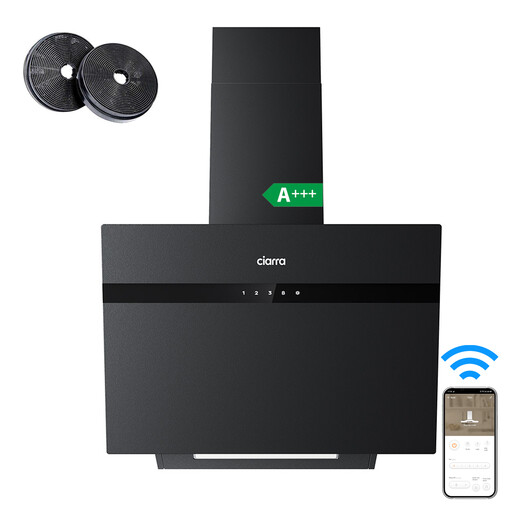
Why it suits this type of buyer: For frequent cooking, this model offers maximum airflow of 650 m³/h, a boost function and three settings, according to the product information. Wi-Fi and app controls are handy if you want to adjust the lighting or extraction remotely.
The stated maximum noise level of 58 dB and separate boost function make it clearer what to expect from the balance between capacity and noise. The washable aluminium filter reduces the need for repeated replacement of the grease filter.
650 m³/h, maximum noise level of 58 dB, A+++ energy rating, Wi-Fi/app control and two brightness levels for the LED lighting according to the product information.
We’ve put together a complete, up-to-date list of products that meet these strict selection criteria and the applicable European safety regulations.
A 60 cm cooker hood fits many standard hobs, but check the actual cooking area and the clearance above the cooker. For a wider hob or frequent cooking, an 80 or 90 cm model may provide better coverage.
It depends on the installation and how you use the hood. Recirculation avoids the need for an air outlet duct, but the charcoal filters need replacing periodically. With external ducting, ongoing costs for odour filters are often lower, but installation can be more involved. So compare not just the energy rating, but also the annual consumption and maintenance costs.
According to product information, a metal grease filter usually needs regular cleaning. For normal use, cleaning every two to four weeks is often recommended. A charcoal filter for recirculation is generally not washable and should be replaced as instructed. Don’t use the cooker hood without the filters fitted correctly, and switch off the power before carrying out maintenance.
