
Households counting carbohydrates per portion
If someone at home wants to count the carbohydrates in each snack, the weight and carbohydrate content of each biscuit, slice or agreed portion matter more than the figure per 100 g alone.


When choosing biscuits to share, don’t rely on claims such as ‘sugar-free’, ‘zero’ or ‘no added sugar’ alone: compare the carbohydrates in the amount actually eaten. Regular biscuits are a different choice from products intended to help you buy less sugar; in both cases, portion size and nutritional information matter. For products containing polyols, check the ingredients and any warning on the packaging too.
If someone at home wants to count the carbohydrates in each snack, the weight and carbohydrate content of each biscuit, slice or agreed portion matter more than the figure per 100 g alone.
If you want to replace regular biscuits with a lower-sugar product, the rest of the nutritional information matters too. A sugar claim doesn’t tell you how many carbohydrates a portion contains.
When buying a larger pack to share, a clearly stated number of biscuits or pre-cut slices can make it easier to take an agreed amount from the biscuit tin.
First, choose the type of product that suits your household. Then use the label to compare the amount served at each eating occasion.
When: You prefer familiar biscuits and your household wants to agree on a set amount.
Consider: This isn’t an option for buying less sugar: Jumbo lists 38.1 g of sugars per 100 g for Lotus Biscoff speculoos biscuits.
When: You’re looking for a biscuit with less sugar and are also comparing the carbohydrates per portion.
Consider: Albert Heijn lists 63 g of carbohydrates per 100 g for AH Digestive 0% sugar and warns that excessive consumption may have a laxative effect.
When: A pre-sliced product is better suited to sharing portions among the family.
Consider: Breakfast cake isn’t a biscuit, and ‘no added sugar’ doesn’t mean it contains no carbohydrates or sugars. Jumbo lists 14 g of carbohydrates per 28 g slice of Peijnenburg Volkoren.
| What to consider | What to check when buying | Who it matters to |
|---|---|---|
| Carbohydrates per eating occasion | Compare the carbohydrates per portion with the weight of what you actually take; convert a figure per 100 g if needed. | If I count carbohydrates per snack, I want to know what one biscuit or slice contributes, not just what the label lists per 100 g. For around 42% of consumers, being able to count this is the main priority. |
| Sugar claim and ingredients | Read the exact claim, the carbohydrate and sugar figures, and any information about polyols and warnings. | I want to buy less sugar, but also understand what else is in the portion I’ve chosen and whether I need to take sweeteners into account. This is the main buying concern for around 33% of consumers. |
| Portions in a shared pack | Check the number of biscuits or slices, the portion weight and the latest information on the packaging. | A large pack is handy for our household as long as we can take a clearly defined amount from it. Around 25% of consumers prioritise being able to portion it out in a manageable way. |
A sugar claim doesn’t tell you how many carbohydrates a biscuit contains. Albert Heijn lists 63 g of carbohydrates per 100 g for AH Digestive 0% sugar; Jumbo lists 7.9 g of carbohydrates in one 11 g Céréal Zonder Suikers coconut biscuit.
Compare the carbohydrates in your actual portion, then check the rest of the nutritional information.
The contents of a family pack don’t determine how many biscuits are eaten at one sitting. Countable biscuits or pre-cut slices make it easier to stick to an agreed amount.
Check the number of items and the portion size, then put the rest of the pack away.
Diabetes.nl points out that sweeteners whose names end in ‘-ol’ can cause diarrhoea. Some products also carry a warning that excessive consumption may have a laxative effect.
Read the ingredients list and any warnings on the label, even if the sugar content is low.
Ingredients and nutritional values can change. The information on the packaging is therefore important when you want to calculate a portion or check ingredients and allergens.
Check the label on your chosen product just before buying, especially if the packaging or recipe looks different.
Regular speculoos biscuits for the biscuit tin. Jumbo lists a 250 g pack containing around 32 biscuits.
AH Digestive 0% sugar is a biscuit sold in a 400 g pack, with a stated portion size of 15 g.
Jumbo lists products including Céréal Zonder Suikers coconut biscuits and pre-sliced Peijnenburg Volkoren breakfast cake with no added sugar.
Lidl lists Ontbijtkoek zero in a 485 g pack. Breakfast cake is a different product category from biscuits.
ALDI describes Koek & Bakker Gesneden Ontbijtkoek Zero, 485 g, as pre-sliced breakfast cake with no added sugar.
These two products are worth considering if you’re looking for a shared pack of countable biscuits or cookie bars. A cookie bar isn’t the same product as a regular biscuit; assess each using the portion size and nutritional information on its own packaging.
 Image unavailable
An option for households looking to share regular chocolate biscuits. The pack contains 150 g; check the label to see how many carbohydrates are in the amount you actually eat.
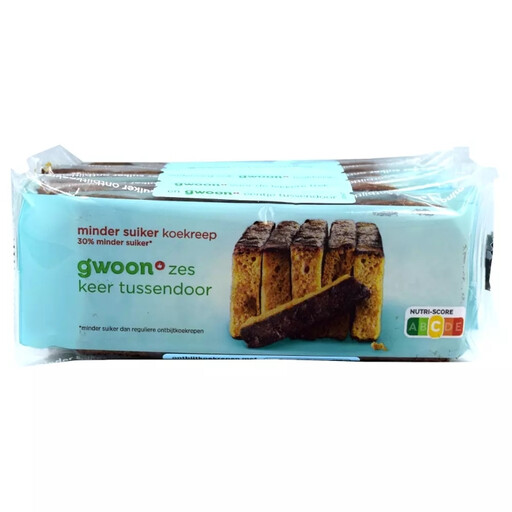 Image unavailable
The six cookie bars can be counted individually when sharing the pack. The name ‘Less Sugar’ doesn’t tell you how many carbohydrates are in one bar; check the weight per bar and the nutritional information on the label.
No, that label doesn’t tell you how many carbohydrates the portion contains. Diabetes.nl stresses the importance of understanding carbohydrate intake, so compare the nutritional information with the number of biscuits or slices you actually eat.
No, a product with no added sugar may still contain sugars and other carbohydrates. Jumbo lists 4.9 g of sugars and 51 g of carbohydrates per 100 g for Peijnenburg Volkoren breakfast cake with no added sugar.
The warning may be related to the polyols used. Diabetes.nl says that sweeteners with names ending in ‘-ol’ can cause diarrhoea; check the ingredients and product warning before choosing a variety.
First compare the weight of the amount you want to eat, then check the carbohydrates in that amount. A small biscuit, a digestive biscuit and a slice of breakfast cake don’t necessarily have the same portion size, even if each is counted as one item.