
The host catering for a larger group
You want to serve plenty of individual biscuits alongside the savoury nibbles without being left with an unnecessarily large opened pack. The stated number of biscuits is more helpful here than the weight alone.


Choose the pack size based on the number of guests and the role of the biscuits alongside the savoury nibbles. A large pack of loose biscuits works well on a sharing platter, while a smaller or resealable pack may be more practical if you expect leftovers. Compare the number of biscuits and the nutritional information per 100 g, and always check the current packaging for guests with allergies or dietary requirements.
You want to serve plenty of individual biscuits alongside the savoury nibbles without being left with an unnecessarily large opened pack. The stated number of biscuits is more helpful here than the weight alone.
Check the ingredients and allergen information on the current packaging before serving. A vegan claim, for example, doesn’t mean a biscuit is free from allergens.
You want to serve biscuits as a small sweet extra, so you compare things such as sugars, saturates, salt and fibre per 100 g. The Netherlands Nutrition Centre recommends using this basis when comparing labels.
First decide how many biscuits you want to serve alongside the savoury nibbles. Then check the allergens and nutritional information, and consider what you can do with an opened pack.
| What to consider | What to check when buying | Who it matters to |
|---|---|---|
| How many to share | Compare the pack weight with the stated number of biscuits, and think about what you’ll do with any leftovers. | When I’m filling a platter for a group, I want enough biscuits without a large pack left over. For around 37% of consumers, quantity is the most important factor. |
| Allergens and dietary requirements | Read the current ingredients list and allergen information; assess any vegan claim separately. | When guests have different dietary requirements or allergies, I want to know which product is suitable before serving. Around 27% of consumers prioritise this check. |
| Nutritional information | Compare similar biscuits for sugars, saturates, salt and fibre per 100 g. | When serving a small sweet extra, I want to compare labels without mixing up different portion sizes. This nutritional information comes first for around 18% of consumers. |
| Storage and portioning | Check whether the pack is resealable and follow the storage advice once it’s opened. | If the get-together goes on for a while or there are biscuits left over, I want to be able to seal the pack easily and avoid putting everything out at once. This is the main consideration for around 18% of consumers. |
A 500 g pack may not be right for your group. Biscuits are an extra alongside the savoury nibbles, and the number of biscuits also affects how many you can offer around.
Compare both the weight and the stated number of biscuits, and consider whether you want to keep an opened pack.
A vegan biscuit can still contain allergens. According to Jumbo, the 250 g Lotus Biscoff variety is suitable for vegans, but contains wheat and soya.
If anyone has an allergy, check the allergen information on the current packaging before buying and serving.
Portion sizes can vary between manufacturers, so nutritional values per portion don’t always give you a consistent basis for comparison.
Compare per 100 g first, as recommended by the Netherlands Nutrition Centre, then decide how many biscuits you want to serve.
Speculoos for anyone looking for a familiar sweet extra to enjoy with coffee or at a get-together.
A supermarket where you can compare own-brand biscuits and branded products while you shop.
A supermarket with own-brand biscuits and branded products in a range of pack sizes.
Lidl’s brand, with a range of biscuits and cookies.
ALDI’s brand, with a large pack of speculoos to consider for a sharing platter for several guests.
These packs of baker’s speculaas are a good fit for a platter of individual biscuits as a sweet extra alongside savoury nibbles. Choose between 450 g and 600 g based on the size of your group, and check the pack for the number of biscuits.
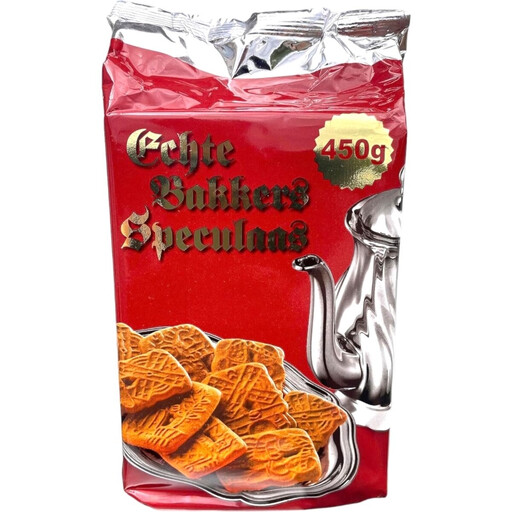 No image available
A pack of baker’s speculaas to add a sweet touch to your sharing platter.
Pack size: 450 g. Before serving, check the current packaging for the number of biscuits and allergen information.
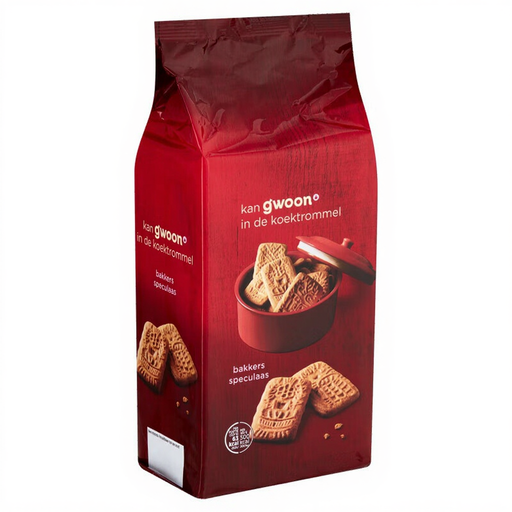 No image available
A larger pack of baker’s speculaas to consider when you want more biscuits to share.
Pack size: 600 g. Check the current packaging for the number of biscuits and any listed allergens.
Use the stated number of biscuits as a starting point, then consider how many guests are likely to want something sweet too. For comparison, ALDI lists around 71 biscuits in 500 g of Koekkie Speculoos biscuits; according to Jumbo, 250 g of Lotus Biscoff contains around 32 biscuits. These are examples of pack sizes, not a set amount per guest.
Compare similar biscuits per 100 g first, so different portion sizes don’t skew the comparison. The Netherlands Nutrition Centre recommends this basis for comparing labels; then consider how much you’ll actually serve.
Read the ingredients list and allergen information on the current packaging for the product you choose. The Netherlands Food and Consumer Product Safety Authority explains that 14 designated allergens must be clearly listed on the label. Which of these are present varies from one biscuit to another.
Follow the storage advice on the packaging and seal any opened pack tightly. For a biscuit variety described by Jumbo, the advice is to reseal the pack tightly after opening and store it in a dark place. Don’t assume the same advice applies to every other product.
Not necessarily: a vegan claim doesn’t mean a product is free from allergens. According to Jumbo, the 250 g Lotus Biscoff variety is suitable for vegans, but contains wheat and soya. Always check the label on the specific pack you’re serving.