What should you look for when choosing?
First decide whether you’re looking for a biscuit for a planned treat or a regular snack for a child. When comparing biscuits, check the sugar level and claim, then look at the ingredients and portion size.
| What to consider |
What to check before buying |
Who it matters to |
| Sugars and claims |
Compare ‘of which sugars’ per 100 g and per portion. Check whether the claim refers to sugars, added sugars or a reduction. |
When comparing biscuits by sugar content, I want to understand the figure on the label rather than just read the wording on the front. An estimated 36% of consumers put this first. |
| Snack time for children |
Decide whether it’s a regular snack or a planned biscuit break, and choose the portion in advance. |
For a child, I want to distinguish a holiday treat from what I’d give them as a snack on an ordinary day. This is the main consideration for around 29% of consumers. |
| Ingredients and allergens |
Read the current ingredients and allergen information; for biscuits containing polyols, check the warnings too. |
If someone I’m with needs to avoid certain ingredients, I need to be able to check the exact option I’ve chosen. This check matters most to around 21% of consumers. |
| Portion and energy |
Compare the nutrition information per 100 g with the amount of biscuits you’ll actually serve or take with you. |
For a day out, I want to decide in advance how many biscuits to take, without mistaking a small portion for a low value per 100 g. Around 14% of consumers prioritise this consideration. |
Biscuits for a planned snack
These g'woon Cookie Bars are an option for a planned biscuit break. ‘Less Sugar’ appears in the product name; read the nutrition information and the comparison behind that claim before deciding whether they’re right for you.
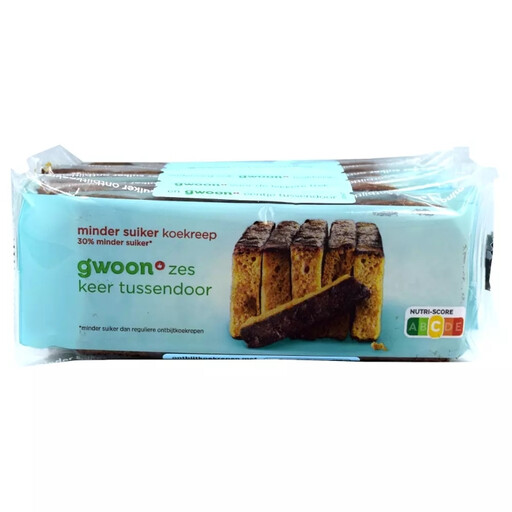 Image unavailable
g'woon Cookie Bars Less Sugar, 6 pieces
For a planned biscuit break, you can compare these Cookie Bars with other snacks, without treating ‘Less Sugar’ as proof that their sugar content has been reduced.
Pack: 6 pieces. Check the current packaging for the sugars per 100 g, the amount per bar, the ingredients and allergens.
View at Joybuy
Frequently asked questions
Does ‘reduced sugar’ mean a biscuit is sugar-free?
No. Under EU Regulation 1924/2006, a claim about a reduced content requires a reduction of at least 30% compared with a similar product; it doesn’t mean the product contains no sugars. So check both the exact claim and the ‘of which sugars’ figure in the nutrition table.
Can a biscuit with no added sugar still contain sugars?
Yes. According to Albert Heijn, Verkade San Francisco zero states ‘0% added sugar’ and also contains 1.7 g of sugars per 100 g. Compare the sugar level when choosing between biscuits like these.
Why is there sometimes a warning about a laxative effect?
Some biscuits containing sweeteners carry this warning if consumed in excess. Albert Heijn includes it for AH Digestive 0% sugar and Verkade San Francisco zero; check the warning on the current packaging when choosing a portion.
Are biscuits with a sugar claim a regular snack for children?
A sugar claim doesn’t automatically make a biscuit suitable as a daily snack. For children aged 4 to 12, the Netherlands Nutrition Centre recommends fruit and vegetables as good snacks. Decide separately whether you’re looking for a regular snack or a planned biscuit break.
What should I check if I have a food allergy?
Read the ingredients and allergen information on the packaging of the exact option you want to buy. The biscuits mentioned differ in this respect: for example, Jumbo lists wheat and the possible presence of nuts, milk, egg, soya and sesame, among other allergens, for Céréal Zonder Suikers Kokos Smaak.


