
Running small workstations
You have participants make crumbs in small batches and want to check the texture after each short pulse.


For small batches where you want to check the texture as you go, a mini chopper with a chopping blade and pulse control is an obvious choice. For repeated batches or extra slicing and mixing tasks, you could also consider a larger food processor. KitchenAid lists breadcrumbs as one use for the 5KFC3516ECU, but this is not a measured result for biscuits. So compare the usable capacity and cleaning instructions, and take ingredients and allergens into account if the appliance will be shared.
You have participants make crumbs in small batches and want to check the texture after each short pulse.
You’re planning repeated batches and comparing how much dry food will fit in the bowl in practice, rather than relying on its stated capacity alone.
You’re sharing equipment between participants or recipes and want the ingredients, bowls and cleaning routine to meet your workshop’s requirements.
First decide whether you mainly need to control the texture of the crumbs, the number of batches or the cleaning routine. Then consider whether you need extra functions for other workshop recipes.
| What to consider | What should you look for? | Who is this important for? |
|---|---|---|
| Control over crumb texture | Check for a chopping blade and pulse control, and assess the crumbs as you go. | If I want to control the texture batch by batch for a topping or pie crust, I look for pulse control; around 40% of consumers prioritise control over texture. |
| Batch size and pace | Compare the stated capacity for dry ingredients where available; don’t rely on the bowl’s total capacity alone. | When running several workshop sessions, I want to know how much dry food will actually fit in the bowl; around 30% of consumers prioritise planning batch sizes. |
| Cleaning and keeping ingredients separate | Check the cleaning instructions for each part, and agree how to keep ingredients and equipment separate between recipes. | If equipment is shared between recipes, I want to agree on a practical cleaning and separation routine beforehand; around 20% of consumers prioritise cleaning and keeping ingredients separate. |
| Other workshop recipes | Work out which blades, discs and bowls you actually need for other tasks. | If I also want to slice or grate with the same appliance, I check which accessories are included; around 10% of consumers prioritise versatility. |
Manufacturers may state a smaller capacity for dry ingredients alongside the bowl’s total capacity. Even that figure is not necessarily a tested capacity for biscuits.
Check the dry ingredient limit for the exact model and don’t plan batches based on bowl size alone.
Allergens can accidentally end up in the next dish. A cleaning specification does not guarantee an allergen-free result.
Check the ingredients and cleaning instructions, and agree before the workshop how participants will handle allergens and shared equipment.
Consumentenbond distinguishes between stand mixers, which are used for tasks such as mixing and kneading, and food processors, which are used for tasks such as chopping.
Check that the model has a suitable chopping blade rather than looking only for a whisk or dough hook.
The 5KFC3516 mini chopper is an option for small batches where pulse control matters.
The MultiPro Go FDP23.140GY combines a compact food processor with a chopping blade and slicing discs.
The MultiTalent 3 MCM3501M could suit workshops that cover chopping, slicing or mixing as well as making crumbs.
According to Magimix, the CS 3200 XL has several bowls for handling different quantities.
This selection includes compact electric mini choppers and a compact multifunction food processor. Compare the listed bowl capacity and pulse control with the batch sizes and tasks you have planned for your workshop.
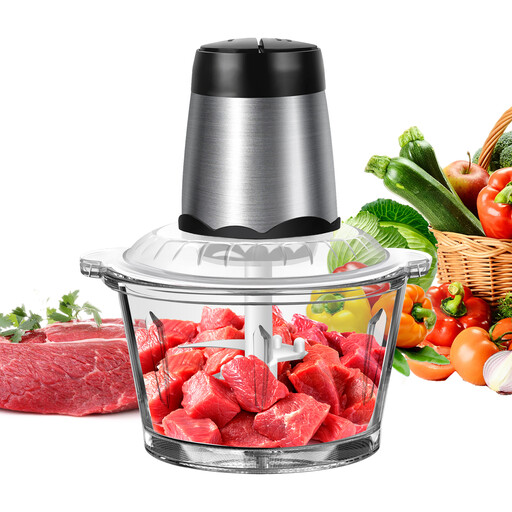 No image available
The product information lists a pulse function to help you adjust the texture as you chop.
2 l glass bowl, four blades and two speeds. The blades are sharp; unplug the appliance before cleaning and do not immerse the motor base.
 No image available
This multifunction food processor is an option if you want to tackle other kitchen tasks as well as chopping.
The product information lists a power rating of 750 W, a 1.8 l bowl, chopping, slicing and grating functions, and short pulses. Do not process boiling liquids, and handle the blades with care.
 No image available
The two bowl sizes give you the choice of a smaller or larger batch.
The product information lists 2 l and 0.6 l glass bowls, two speeds and short pulses. The bowls and lids are not heat-resistant; the blades are sharp.
 No image available
The short pulse function can be useful when you want to check the texture as you chop.
The product information lists a 2 l glass bowl, two speeds and stainless steel blades. Do not run the motor for more than 30 seconds at a time, and handle the blades with care.
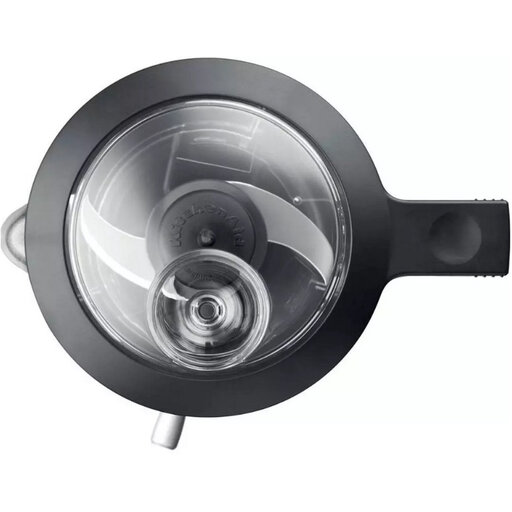 No image available
This mini chopper could suit small batches where you want to check the texture of the crumbs as you go.
KitchenAid lists an 830 ml bowl, a chopping blade, two speeds and a pulse option. The brand mentions breadcrumbs as one use; this does not confirm a measured result for biscuits.
Choose a model with a chopping blade and pulse control if you want to stop processing and check the crumbs as you go. KitchenAid describes these features on the 5KFC3516; there is no set processing time or guaranteed biscuit texture.
Don’t assume you can. For the FDP23.140GY, Kenwood lists a 1.3 l bowl and a 0.75 l capacity for dry ingredients. So the bowl’s total capacity alone doesn’t tell you how many biscuits it will turn into crumbs properly in one go. Check the instructions for your chosen model.
Follow the instructions for your chosen model when assembling and cleaning the blade, lid and bowl. Kenwood says the removable parts of the FDP23.140GY are dishwasher-safe. Keep equipment and utensils clean, and take care to prevent ingredients from accidentally ending up in the next recipe.
Not automatically. According to the Dutch government, there is no fixed statutory guarantee period in the Netherlands; a paid extra guarantee is mainly worth considering if it gives you additional rights. If a product is faulty, contact the seller.
If your situation falls under the Netherlands Food and Consumer Product Safety Authority (NVWA) rules on offering unpackaged food to consumers, you must provide information about any allergens present. The NVWA says this information can be given in writing or verbally. The NVWA also says that food businesses preparing, processing or selling food must work with an HACCP food safety plan or an applicable hygiene code. Whether these rules apply to your particular workshop depends on how it is organised and how the food is offered.