
Podcast editor working with two transcripts
Wants to compare the audio timeline with two language versions while editing. A larger screen doesn’t automatically make text easier to read.


For visual editing, an adjustable 27-inch QHD monitor is a more compact choice if you mainly view the timeline and one text window. A 34-inch ultrawide is a better fit if you want to keep transcripts in two languages alongside the timeline for long periods and have enough desk space. Check the text scaling and your laptop’s video and charging support for each model. A monitor can’t assess your podcast mix: you’ll need a suitable listening setup for that.
Wants to compare the audio timeline with two language versions while editing. A larger screen doesn’t automatically make text easier to read.
Wants a clear view of the timeline, but needs to balance screen width and an adjustable working position against the space available.
Switches between editing and presentation materials, and wants to check in advance that the chosen connection supports video, peripherals and, if needed, charging.
A good fit: if you mainly edit the audio timeline and switch between a transcript and presentation notes, for example on a narrower desk.
Consider: whether two text versions remain readable alongside your editing software depends on window size and text scaling; USB-C features vary by model.
A good fit: if you regularly want to view the timeline alongside Dutch and other-language text, and have room for the wide screen on your desk.
Consider: extra horizontal space doesn’t guarantee readable text at your preferred scaling.
A good fit: if your current screen is still useful and you’d rather keep transcripts or presentation notes separate from the editing window. Adobe Audition supports placing floating windows on a second monitor.
Consider: check that your computer and software support the setup you want, and that both screens can be positioned comfortably.
| What to consider | What to look for | Who should pay particular attention? |
|---|---|---|
| Keeping track of the audio timeline | Test your usual editing windows at the text scaling you normally use; compare the resolution and adjustability of the exact model. | If I mainly want to follow the audio timeline while editing, I check that my windows fit well. Around 36% of consumers prioritise a clear view of the timeline. |
| Comparing two language versions | Place transcripts, the timeline and notes side by side at a text size you find comfortable to read. | If you check Dutch and other-language text at the same time, you won’t want to keep switching between windows. For around 29% of consumers, comparing language versions side by side is the top priority. |
| Readability and working posture | Check the height adjustment, reflections in your workspace and text size during normal use. | For longer editing sessions, I want to adjust the screen position and readability to suit my own workspace. Around 21% of consumers prioritise working posture and readability. |
| Connecting a laptop | Compare your laptop’s video output and charging needs with the monitor’s inputs and USB-C Power Delivery; check the cable too. | If I use the same laptop for editing and presentations, I want to know in advance whether the connection provides video and enough charging power. Around 14% of consumers put connectivity first. |
An ultrawide offers more horizontal pixels than the 27-inch QHD models reviewed, but not more vertical pixels. The extra space only helps if your windows remain readable at the scaling you use.
Test your editing windows and both language versions at your preferred text size, and measure your desk width in advance.
A monitor that doesn’t fit your desk properly, or makes text too small, can make your intended layout impractical.
Video support and Power Delivery depend on the connections and capabilities of both the monitor and the laptop.
Compare the specifications of both devices and check that the cable supports the connection you need.
Depending on the devices you choose, you may need a separate power adapter or a different video connection.
A computer monitor is designed for visual editing; the presence of speakers doesn’t prove they’re suitable as a listening reference for a podcast mix.
Assess the audio using a listening setup suited to your editing. Adobe describes listening through audio outputs and speakers or headphones; Focusrite discusses separate monitor speakers for podcast post-production.
The P2725DE is a 27-inch QHD monitor with a USB-C hub for a laptop workspace.
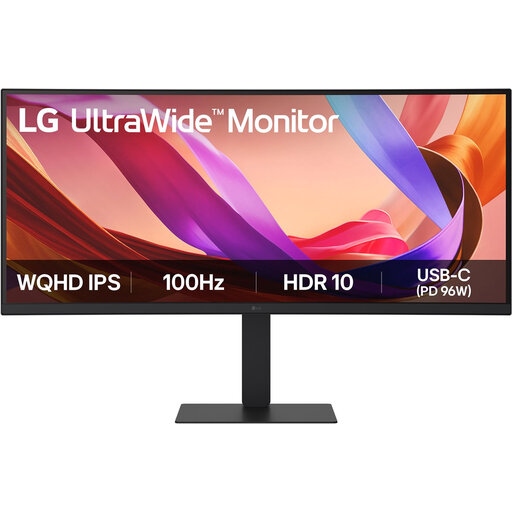
The 34U650A-B is a 34-inch ultrawide option for anyone who wants to arrange several windows side by side.
The 27E1N5600AE/00 is a 27-inch QHD model with USB-C.
The GW2790QT is a 27-inch QHD model with documented connections and adjustment options.
These computer monitors are ultrawide options for anyone who wants to view an audio timeline and text windows side by side. Check your available desk width and readability at your preferred text scaling before you buy.
 No image available
The 21:9 layout and 3440 × 1440-pixel resolution may suit a workspace where you keep the timeline and text windows side by side; check the text scaling and the space available on your desk.
The product description lists USB-C with DisplayPort Alt Mode, up to 90 W Power Delivery and an adjustable stand. Check that your laptop supports this connection and charging capacity.
 No image available
The ultrawide layout is an option if you want to view editing and text windows at the same time; measure the available space in advance and test your usual text size.
The product description lists 21:9, 3440 × 1440 pixels and USB-C with up to 96 W Power Delivery. Check that your laptop supports the video connection and charging you need.
 No image available
The 34-inch screen with a resolution of 3440 × 1440 pixels is an option for placing a timeline and text windows side by side; check that the size and text scaling suit your workspace.
The product description lists Thunderbolt 4, USB Power Delivery up to 100 W and height adjustment. Check your laptop’s compatibility and charging needs.
 No image available
The 5120 × 1440-pixel resolution offers a wide layout for several windows; check that the screen fits your desk and that text remains readable at your preferred scaling.
The product description lists KVM and USB-C with 90 W Power Delivery. Check that these features suit your computer setup and laptop requirements.
 No image available
The 34-inch UWQHD layout may suit a workspace where you want to view the timeline and text windows side by side; check the desk space and text scaling in advance.
The product description lists a USB-C dock, KVM and 15 cm of height adjustment. Check that the connections suit your computer setup.
4K isn’t a general requirement for this kind of editing. First decide which timeline and text windows you want to see at the same time at a readable size; QHD and ultrawide models offer different screen layouts.
Only if the laptop supports video through the USB-C port in question and the monitor provides enough charging power. The Dell P2725DE reviewed here lists 90 W; the BenQ GW2790QT lists DisplayPort Alt Mode and 65 W Power Delivery. Check the cable too.
Don’t assume so. A computer monitor is designed for visual editing; you need a suitable listening setup for audio. Adobe describes listening through audio outputs and speakers or headphones. This doesn’t establish the sound quality of any particular monitor.
Adjust the viewing position and text size to suit your workspace, and watch out for reflections. For employees who work at a screen for more than two hours a day, Arboportaal explains that the screen and keyboard must not be fixed together; this rule applies to that working situation.
According to the Dutch government, many applicable online consumer purchases come with a 14-day cooling-off period. Conditions and exceptions apply, so check which ones are relevant to your purchase.