For short podcast takes, a USB microphone with an easy-to-reach mute control is handy if you often start again. If you want to check each Dutch and other-language take straight away, choose a model with direct headphone monitoring. In a less quiet room, a dynamic microphone positioned close to you may suit your setup, while a condenser microphone involves different considerations around background noise. Test the placement where you record: these differences are not the result of a comparative listening test.
Who is this for?
Quick solo-take creator
If you often want to re-record an intro without changing your setup each time, look for a simple USB connection and an easy-to-reach mute control. HyperX describes the SoloCast 2 as having tap-to-mute control; RØDE lists direct monitoring for the NT-USB Mini.
Recording in a typical room
If you can speak close to the microphone but need to take room and desk noise into account, consider the microphone type and positioning options. FIFINE describes the AM8T as a dynamic microphone and lists a boom arm as included in the kit.
Speaker who listens back to takes straight away
If you want to check what you’ve recorded after each Dutch and other-language sentence, look for a headphone output and direct monitoring. RØDE lists this feature for the NT-USB Mini; Audio-Technica lists a headphone output for the AT2020USB-X.
What to consider when choosing
First, decide whether you mainly want to switch quickly between takes or listen back to your recording straight away. Then consider the acoustics of your recording space and any plans to use another speaker or connection.
| What to consider |
What should I check? |
Who should pay extra attention? |
| Switching quickly between takes |
Check the USB connection, included cable and stand, and whether the mute control is easy to reach. |
If I want to start again as soon as I finish a short take, I want the microphone to be easy to connect and mute. Around 36% of consumers consider getting started again quickly their top priority. |
| Recording in a less quiet room |
Compare the microphone type, polar pattern and mounting options; test the placement where you record. |
When I record in a typical room, I want my voice to remain clear without assuming that the microphone will eliminate background noise. Around 29% of consumers give the greatest weight to room noise. |
| Checking every take straight away |
Check whether the microphone has a headphone output and direct monitoring, and whether microphone and computer audio can be mixed. |
If I want to assess my pronunciation, speaking volume and distance straight away, listening back directly matters to me. Around 21% of consumers give checking takes top priority. |
| A different speaker or setup |
Decide whether you need multiple separate tracks and check the complete recording chain; XLR requires additional recording equipment. |
If I want to use a second speaker or a different connection later, I consider which options I actually need. Around 14% of consumers put setup flexibility first. |
Common mistakes when choosing
-
Assuming a higher bit depth or sample rate proves the sound is better
Listed recording formats don’t tell you how your voice, microphone placement and room will sound together.
Compare the controls and make a short recording in both languages where you plan to use the microphone. Don’t treat specifications as a comparative listening test.
-
Assuming different versions are the same model
SoloCast and SoloCast 2, or NT-USB+ and NT-USB Mini, are different model names. The controls and included accessories may vary between versions.
Check the full model name and key specifications before comparing a product with a model in a ranking.
Choosing the wrong version may mean different controls or included accessories.
-
Assuming USB and XLR offer the same features
FIFINE states that the AM8T’s function buttons and lighting don’t work over XLR.
If you plan to switch from USB to XLR later, check which features are available with each connection type.
Using XLR requires additional recording equipment.
Brands to consider
HyperX
The SoloCast 2 is a compact USB condenser microphone for a straightforward solo setup.
- According to HyperX, the SoloCast 2 has tap-to-mute control, a stand, a built-in pop filter and internal shock absorption.
- Direct headphone monitoring hasn’t been confirmed for this model. Don’t confuse the SoloCast 2 with the older SoloCast.
RØDE
The NT-USB Mini is a compact USB condenser microphone with direct monitoring; the PodMic USB is a separate dynamic USB/XLR model.
- RØDE lists a built-in pop filter and detachable stand for the NT-USB Mini.
- The PodMic USB isn’t an identical version of, or a replacement for, the NT-USB Mini.
FIFINE
The AM8T kit is designed for a close-positioned dynamic microphone with a boom arm and USB/XLR connection.
- FIFINE lists a headphone socket, gain control and mute control for the AM8T.
- According to FIFINE, the function buttons and lighting don’t work over XLR. Check which accessories come with the kit version you choose.
Audio-Technica
The AT2020USB-X is a USB condenser microphone with direct monitoring and a control for balancing microphone and computer audio.
- Audio-Technica lists a headphone output, mix control and touch-to-mute control for this model.
- An optional shock mount isn’t included.
Shure
The MV7+ is a dynamic USB/XLR microphone with additional settings for close-up voice recording.
- Shure lists a headphone output, mute panel and software features for the MV7+.
- Claims about voice isolation and noise processing are the manufacturer’s statements, not independently measured performance.
Logitech G
The Yeti is a USB microphone with multiple pickup patterns and on-microphone controls.
- Logitech lists multiple patterns, gain control, mute and a headphone output.
- Multiple pickup patterns don’t automatically mean that voices are recorded to separate tracks.
Joybuy products
This selection includes USB-C wireless microphones for compatible mobile devices and USB microphones for desktop setups. Check that each model’s connection and included accessories are suitable for your phone or computer.
 No image available
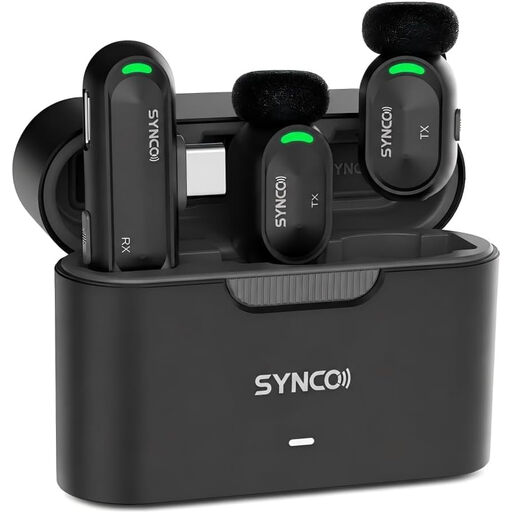
SYNCO P2XT USB-C wireless microphone
The product description lists podcasting and real-time audio monitoring via the receiver as potential uses and features.
The description lists one-way noise reduction and controls for it. OTG is required for compatible Android phones with USB-C.
View at Joybuy
 No image available
SYNCO P1XT USB-C wireless microphone
This USB-C wireless microphone is designed for use with compatible phones or cameras; the product description lists vlogging, streaming and YouTube as uses.
The description lists real-time monitoring via the receiver. OTG is required for Android phones with USB-C.
View at Joybuy
 No image available
SYNCO SMIC AI USB-C lavalier microphone
This clip-on microphone is designed for compatible Android devices with USB-C.
The product description lists automatic level control and features via the SYNCO AI app. Android devices require USB-C with OTG.
View at Joybuy
 No image available
USB condenser microphone with cardioid pattern
The product description lists podcasting as a use and mentions a headphone socket for direct monitoring.
The described kit includes a boom arm, shock mount and pop filter. According to the product description, the microphone has a cardioid pickup pattern and gain control.
View at Joybuy
 No image available
HyperX SoloCast 2 USB microphone
For short takes where easy muting and a compact USB setup matter.
HyperX describes this model as a USB condenser microphone. The product description lists a cardioid pattern, built-in shock mount and pop filter, a mute button with LED indicator, and an included USB-C to USB-A cable.
View at Joybuy
Frequently asked questions
Do I need different microphone settings for each language in a bilingual intro?
Not just because you’re switching languages. Record both versions where you plan to use the microphone and listen back to check clarity and levels. Adjust the distance or gain if needed. RØDE emphasises that suitable microphone placement can vary depending on the environment.
How can I reduce plosives and desk noise during short takes?
Test the microphone’s position and angle, and use a suitable pop filter. A shock mount may help with vibrations. RØDE recommends trying out the placement, as it varies depending on the room and microphone.
Is a two-year manufacturer’s warranty the same as the legal guarantee?
No. According to the Dutch government, the Netherlands has no fixed legal guarantee period; a manufacturer’s warranty is in addition to your right to a product that works as it should. If there’s a fault, contact the seller.
Can I publicly publish a practice take featuring someone else’s recognisable voice?
A recording in which someone is recognisable may contain personal data. According to the Dutch Data Protection Authority, consent is usually required to publish someone else’s personal data publicly. There is a limited exception for exclusively personal or household use; don’t assume that taking part in the recording automatically means consent to publication.


